

Yes. There is no danger mixing synthetic and conventional motor oil. However, conventional oil will detract from the superior performance of synthetic oil and reduce its benefits. In this post, we’ll also look at if it’s safe to use regular oil after synthetic oil.
Let’s take a closer look.
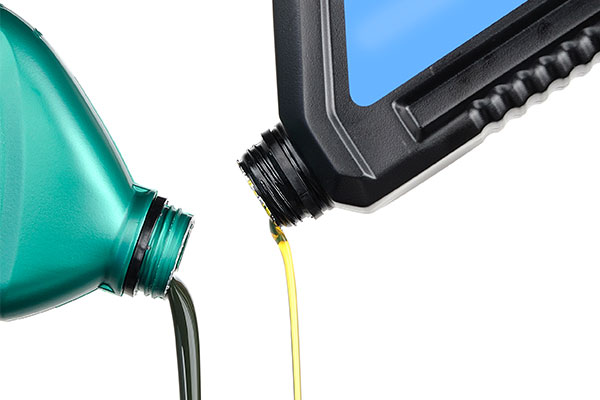
Can I Mix Oil Types?
With synthetic lubricants continuing to grow in popularity, the question of whether synthetic and conventional oil can be safely mixed often arises.
I’m guilty of having mixed different types of motor oil with reckless abandon back in the day. A dash of synthetic-blend to top off my Buick Century one month and a shot of cheap conventional oil the next.
While oil performance probably suffered, my engine always remained in one piece.
That’s because you can safely mix synthetic and conventional oil. In fact, synthetic-blend motor oil is simply conventional and synthetic oil already mixed for you.
But, barring an emergency, it’s not a great idea to mix oil types.

Why It’s Not a Great Idea to Mix Synthetic and Conventional Oil
All motor oil, whether synthetic or conventional, is a combination of base oils and additives.
Synthetic base oils are manufactured using a process that removes the impurities inherent to conventional base oils. Synthetics typically contain higher-quality additives, too.
So, in the end, conventional and synthetic oils are comprised of the same, compatible components – it’s just that the components in synthetics are much higher quality.
While you can safely mix synthetic and conventional oils, you’re doing nothing more than diluting the performance of the synthetic oil.
What is Synthetic-Blend Motor Oil?
We alluded to the answer above: it’s nothing more than motor oil that’s formulated using both conventional and synthetic base oils. Synthetic-blend motor oil is also referred to as semi-synthetic.
Synthetic-blend motor oils fall in between conventional oil and synthetic oil on the motor oil spectrum. The idea behind them is to offer motorists a taste of the improved performance of a full synthetic at a price closer to a conventional oil. Oil marketers see them as a stepping-stone product to help encourage motorists to eventually step up to a full synthetic.
Full Synthetic Oil vs Synthetic Blend
Unfortunately for motorists, there are no industry specifications or regulations that define the minimum percentage of synthetic components for a synthetic-blend to be classified as such. It varies depending on each manufacturer, and they’re not going to divulge that information since it would give their competition an advantage.
That being the case, astute motorists can look for a few clues to help interpret the amount and quality of the synthetic base oils in your synthetic-blend motor oil.
Visit the oil manufacturer’s website and find the oil’s technical data sheet (also called a “product data sheet”). Find the section labeled “Typical Technical Properties,” or some derivative of such. Look for these two values:
- Viscosity Index: Oils with a higher number include a better synthetic base oil that provides more protection to critical components over a wide temperature range by maintaining fluid thickness and the necessary fluid barrier between parts.
- Pour Point: measures the oil’s fluidity at cold temperatures and refers to the lowest temperature at which oil maintains its ability to flow. Lower numbers are likely to indicate a better synthetic base oil.
You should know, however, that an oil’s base oil composition is only part of what determines its performance. The additives also play a large role in fighting wear and deposits.
What If You Have to Mix Oil Types?
You may not have a choice to mix the two in some cases.
If you’re traveling, for example, and suddenly find your engine low on oil, cheap conventional oil may be the only option at the gas station alongside the highway.
While it’s safe to top off an engine that normally uses AMSOIL synthetic motor oil with conventional oil, we recommend changing the oil at your earliest convenience. In fact, AMSOIL does not support extended drain intervals where oils have been mixed.
Can You Use Regular Oil After Synthetic?
Yes, it’s perfectly safe to switch to regular conventional oil after using synthetic oil. As mentioned, both oil types are made of compatible components; it’s just that the base oils and additives in the synthetic oil are higher quality.
But, since synthetic motor oil provides improved wear protection, engine cleanliness, fuel efficiency and other benefits, why would you want to use regular oil again?
This article is part of our Motor Oil Basics guide. See every article in the guide.
Recommended AMSOIL products
Start with AMSOIL synthetic motor oil and find the exact AMSOIL products for all your vehicles with the AMSOIL Product Guide.