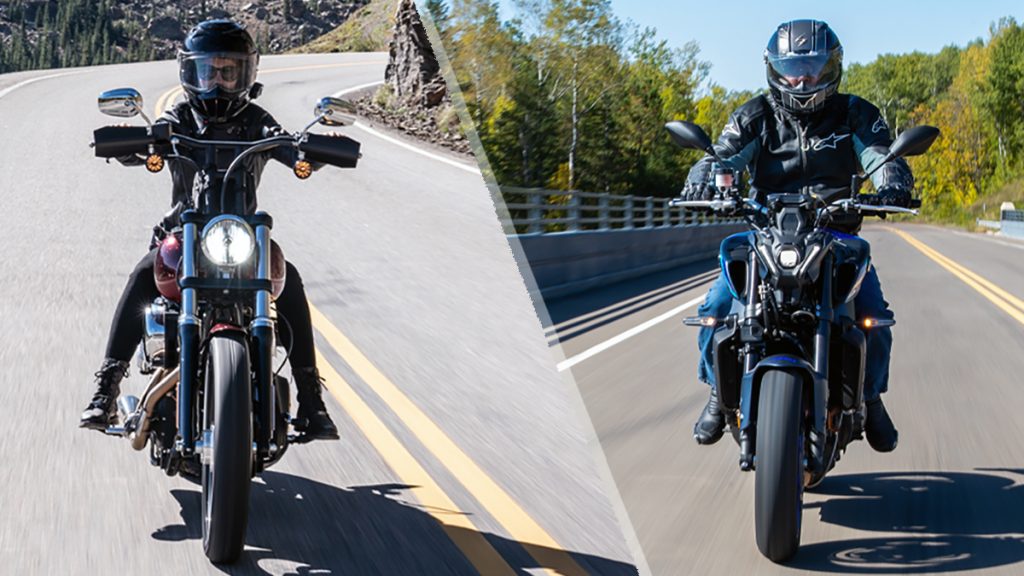
Our stable of expert motorcyclists, with many decades of combined riding experience, offer their tips to help beginning riders go from greenhorn to seasoned veteran.
Start with a bike you can handle
Sure, you want to jump on a big Harley and head for Sturgis. But that’s not the best idea if you’ve never ridden a motorcycle. A big, powerful bike equals a heavy bike, and heavy bikes are harder to handle and keep upright. If you’ve never ridden, start with a lightweight bike with a small or mid-sized engine.
You may even consider starting on a dual-sport bike like a Honda CRF250L or KTM 350EXC, which can be ridden on- or off-road. Smaller, used bikes are affordable and readily available. They are easier to maintain and easier on the wallet.
“I’ve seen too many people, especially women, get bikes that are too big for them to handle comfortably.”
– AMSOIL Trade Show Manager, Patricia Stoll
Take a motorcycle safety course
New riders need to meet a variety of state-specific requirements to obtain a motorcycle license. You may also have to pass a motorcycle training course. Examples include:
- Minnesota: Requires motorcyclists under age 18 to pass an approved Rider Skills Training course.
- California: Basic motorcycle training is mandatory for new riders under 21 years old.
- New Hampshire: Riders under 18 years old are required to complete a Basic Rider course.
Riders typically complete a combination of classroom work designed to get familiar with basic motorcycle operation, and field work that teaches defensive riding tactics, cornering techniques and other skills. A safety course is a great start to a long, safe riding career.
Find a Motorcycle Safety Course near you.
Test rides
Before you drop any money on a new or used bike, test ride as many makes and models as you can. If possible, rent a motorcycle for a few days and put it through its paces. Some dealerships will let you take a bike overnight.
Don’t marry yourself to one particular bike, try to test as many brands and models as you can. You won’t know if a specific bike scares you or stirs your passion until you give it a try. Be realistic about how you plan to ride. Smaller bikes are great for urban riding and weekend jaunts through the countryside, but if you’ll spend most of your time on the highway, consider a bigger bike that can keep up with traffic.
“I can’t tell you how often I hear people say they regret the first bike they bought.”
– AMSOIL Powersports Product Director, Len Groom
Don’t compromise
Once you’ve zeroed in on the bike you want, get it – don’t compromise and choose a different bike. Many riders have settled for a different bike than the one they desire due to an extended warranty or manufacturer rebate. Thy often regret the decision and sell the bike so they can get the bike they wanted all along. Compromise can ruin your love of riding and waste time and money.
Budget for accessories & maintenance
Most motorcycles aren’t cheap, and neither are accessories and maintenance. Don’t blow your whole bankroll on the bike without budgeting for proper hear, including a helmet, gloves and abrasion-resistant pants and jacket. You might also want saddle bags, comfort seats, engine modifications or other upgrades for the bike. Eventually, you’ll need new tires, oil changes, brake pads and other maintenance services. Not planning for these expenses can cost you even more in the long run.
“The object is to vaporize water and coat all internal surfaces with the corrosion inhibitors present in fresh oil.”
– AMSOIL Mechanical Test Manager, John Skuzinski
Don’t skimp on maintenance
Seasoned riders know their bikes intimately. Any unfamiliar sound or sensation sends them to the garage to investigate. They take impeccable care of their bikes, and so should you.
Changing the fluids prior to storage at the end of the riding season is a best practice that improves reliability and extends the life of your motorcycle. Ride the machine until the engine is warm before changing the fluids. After changeout, take another warm-up ride to ensure all internals are fully wetted with fresh lubricant.
The pumping of fresh lubricant between rubbing and sliding surfaces before storage helps protect parts during the next startup. Don’t forget to stabilize the fuel and remove the battery for storage inside for the winter.
AMSOIL motorcycle products are specifically engineered to provide maximum protection and performance by fighting the intense heat of big V-twin engines and the high-rpm stress of adventure and sportbikes.