The AMSOIL mechanical lab, affectionately called the “dyno” or “AML,” draws gearheads to itself like eccentric vehicle builder Gordon Tronson draws a crowd. If you can’t find someone in their office at AMSOIL, chances are you’ll find them down in the dyno.
An Exclusive Look at the AMSOIL Mechanical Lab

Video transcript: Tour the AMSOIL Mechanical Lab
I’m Mark Nahum, Staff Engineer and Mechanical R&D Manager for AMSOIL, and this is our mech lab. Let’s give you a little sneak peek of what this mechanical lab does for AMSOIL. It is a piece of our validation process for all of the products that we come to market. If I was just a blending facility, I wouldn’t need a mechanical lab to validate my products.
I take fully formulated versions from chemistry partners, I mix them together, and I sell them to consumers. But that’s not what we do here. We take it from the chemical level, we break it down, we make really good formulas, and then we need a place to validate them. Then, we take it down here in the mechanical lab and put those formulas to work in actual applications, whether it’s engines, transmissions, hydrostats, compressors.
That’s what we do here. There’s a difference between those that just blend and those that fully engineer their products. Every project that we work on here in the mechanic lab typically starts with an application out in the market. There’s a problem that we identify, or some customer has a need that is not currently being met by another lubricant.
We start with product requirements. We need a way to gauge success, so we bookend what this product should look like in the end. Then we go to work in our chemical lab. We start mixing formulations together and we use industry standard tests to get us successful on the bench level, but we don’t stop there.
We need to validate that product before we commercialize it. That’s why a mechanical lab is a huge asset to AMSOIL. We put those formulations into real engines. We beat them up, we put them through really long tests, insane temperatures, really heavy loads, all so that we can take all that data and see whether we’ve achieved success.
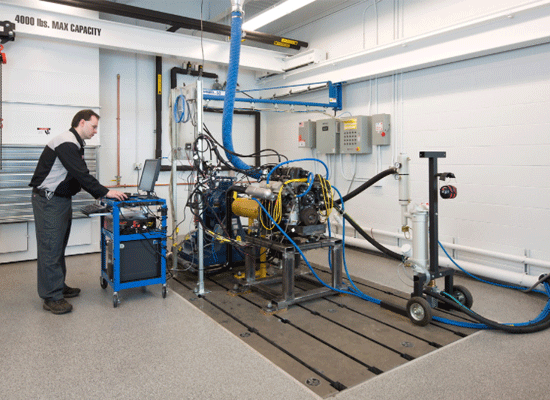
Now that you have a firm grasp of our validation process here in the mechanical lab, let’s go take a look at the capabilities of each of our cells. Our mechanical lab has three dyno cells. In cell 1, we have a SuperFlow water brake, where we’ll put anything from a small snowmobile engine, all the way up to 1,000 horsepower Hellephant engine. Dyno cell 2, a little more flexibility here, where we’ll run small engines on fixed test stands for hundreds of hours.
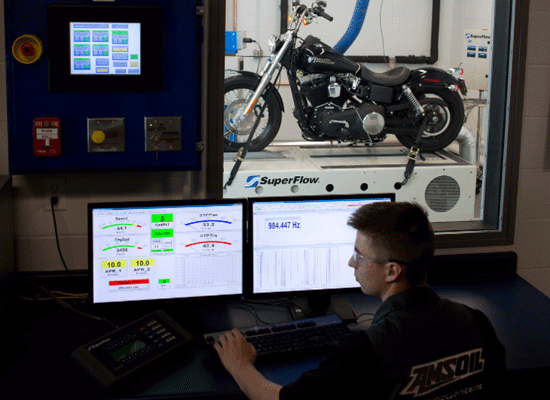
We’ll run weed whips and blowers, making noise for hundreds of hours. We have a Midwest eddy current, which is super accurate for long periods of time, where we’ll run small V6 or V8 engines, or we’ll adapt a different tester and run hydrostats from zero-turn lawn mowers. In our last cell, dyno cell 3, we have our SuperFlow roller dyno, where we’ll put motorcycles, dirt bikes, street bikes, side by sides, and we’ll take field data that we collect from the road in the woods doing hill climbs, and we’ll duplicate it on the dyno. Then, we’ll turn up the knob a little bit to reach what we consider sphere testing.
Very rarely do we make decisions around here based on subjectivity. We are in the business of measuring things. That’s how we learn, that’s how we formulate, that’s how we engineer, and that’s how we make products for you to sell to your customers. How do we measure stuff?
We use the tools built into our dynos, which is measuring horsepower, and RPM, and temperatures. We use data acquisition systems to measure a lot of some of those same things if they’re not really integrated to my dyno. Then, what we do is we graphically look at them, and we make sure that if we’re measuring power, or torque, or RPM, when we set up a dyno profile, we want to make sure that that engine is operating that profile every single time and its not deviating. If it’s a deviation from that, then something’s happening in the engine that we need to know about.
We take these measurements to make sure that our test is valid. At the end of this analysis, we shut down the engine or whatever might be on test of time, and then we tear it apart. That’s where the true physical measurements come in. We use measuring tools, and what we’re doing is we’re comparing before to after.
Let’s dive a little deeper into some of the documentation techniques we use in the mechanical lab. We use a high precision camera to document the before and after condition of the parts under test. What we’re looking for is deposits and wear. In this area of the mechanical lab is where we tear everything down.
This is where we physically measure the before and the after condition of everything that we’ve just taken off of test. For example, we have a Twister blower here, and we’re going to measure the difference between the wear that you might find in the cylinder. We’re going to measure the wrist pin. You look at a hydrostat transmission from a zero-turn lawn mower, we’re going to look at the pistons, and the swashplate that builds pressure and propels that thing forward.
We’re going to look at the deposits that form inside that case. You look at this set of cylinders from a snow machine. We’re going to pay particular attention to the bores, the cylinders, and we’re going to measure that profile difference from before and after. You look at a set of bearings on the other side of the table from the crank and the rods.
We want a before and after measurement of the wear to those bearings. The measurements that we take here are of the utmost importance to AMSOIL. We use these measurements to make decisions on new products coming to the market or new technologies that we’re investigating to put into the current products that we have on the market today. We put a lot of importance on this to help you be successful.
Hopefully, you can make it up here someday and see it yourself. But until then, we got to get back to work to work on the top secret projects that I can’t share with you. Thanks for coming. [ MUSIC ]
The mechanical lab is where we conduct much of our product testing and validation. The legend of the diesel world himself, Gale Banks, visited AMSOIL headquarters and toured the dyno recently. The level of care we put into product testing struck him so much that we thought folks out in the digital realm would like to take a peek inside our mechanical lab, too.
Check out the video for your tour.
You’ll find out that the AMSOIL dyno consists of three cells, each with water systems, air systems and fuel systems to support whatever type of testing we’re doing. On any given day, you might hear a two-stroke snowmobile engine in full-on “braaap” mode, a V-twin motorcycle rumbling away or a V-6 howling like a banshee.
We test everything from passenger car engines to powersports equipment to lawn and garden equipment in the dyno. Not long ago, we tested a racing engine you could hear nearly on the other side of the building.
The main purpose of the AMSOIL mechanical lab is to validate lubricant technologies for product development and for comparative analysis to ensure AMSOIL makes the best products possible.

The Dyno Lineup
In Cell 1 we have a SuperFlow 902S water brake, while the Land & Sea 7-inch dyno is set up to a custom chainsaw installation.
In Cell 2 we have a Midwest 1014 eddy current dyno. It controls from 2 to 6,000 rpm and up to 175 hp. We use it for passenger-car motor oil development. We also frequently run small-engine testing in Cell 2.
Cell 3 contains a SuperFlow CycleDyn eddy current dyno we’ve used for motorcycle, dirt bike and UTV testing.
Airing it Out
Engines are sensitive to combustion air, so we have a Munters combustion air unit that provides 3,000 cfm of humidity-and temperature-controlled air directly to the engines.
Cooling it Off
We perform a lot of steady-state dyno testing compared to performance facilities that might run short-term tests, so we need a lot of cooling and water capacity. The 4,000-gallon water system supplies cooling water and brake water to the test cells along with a 60-ton evaporative chiller. Regardless of the amount of horsepower or length of the test, we can maintain the temperature of our supply water at all times.
All of our fuel, air and water systems are controlled via a computer interface. It can monitor certain conditions, like temperature or pressure, and respond automatically in the absence of human intervention.