


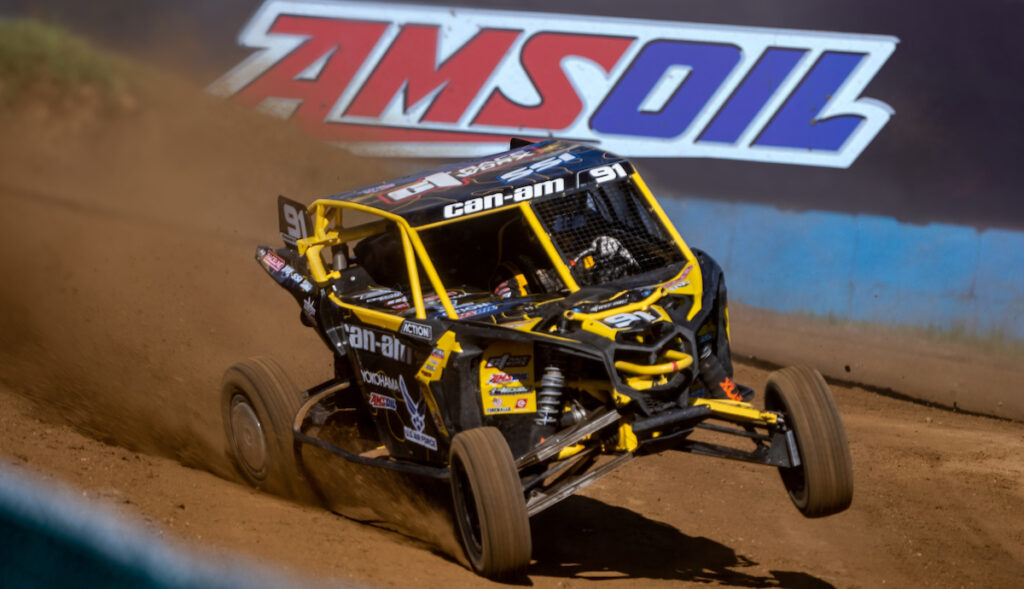
The AMSOIL Championship Off-Road Series is one of the preeminent off-road racing series in the United States. It pits the top Pro 4×4, Pro 2wd and UTV drivers in the country against each other on some of the most exciting off-road tracks in the sport, including Bark River in Michigan, and the granddaddy of them all, Crandon International Raceway in Crandon, Wis.
The series features 900-hp trucks battling fender-to-fender through the mud and dirt, delivering some of the most intense off-road racing around. The Series also delivers UTV racing for fans as the premier drivers in the sport tear up the track in pursuit of the checkered flag.
AMSOIL Championship Off-Road features eight stops from May to September, when the Series closes at a a new stop, Glen Helen Raceway.

Video transcript: What Makes a Pro 4 Truck Race Day Ready?
My name is Kyle Chaney. I race for sharing speed sports. I’m going to show you guys around my Pro 4. This truck runs a Toyota* motor.
It’s a 410 cubic inch small block. It makes it about close to 900 horse. So the way the rules are, it’s 100 pounds for every cubic inch. So if you have a 410 motor, you have to weigh 4100 pounds.
So we usually go in 100 pounds over. So the sink burns a lot of fuel. Usually in a race, we’ll burn anyway. It depends on what track we’re at.
We’re at Crandon. Sometimes we’ll burn up to 15 gallons. So a bunch of fuel weight comes off the truck. So we want to make sure we go out there a little heavy.
So when we come off the track, we definitely make weight. We run Yokohama Tires. This is a DOT series. We have to run a DOT tire.
So the same tires everybody runs on the street. As you can see, this is what a tire looks like after a race. You know, we do groove and sight them. Just to get a little more traction per track, whether it’s going to, we think it’s going to rain or the track’s going to be hard or it’s going to be dry.
We groove. The tire’s different for whatever weather situation we think we’re going to face that day. We use race line wheels on this truck. This is a forged 17 inch wheel from Raceline, which is like a spec for the series.
35, 17 is pretty much a spec for Pro 4. Fortin Hubs, Fortin Differential. Doug Fortin is out of California. He builds lots of trophy trucks.
It’s pretty much one off stuff. Like this isn’t just a diff you can buy and put in anything. They’re pretty much specially made for short course trucks. A howl rack.
Howl pretty much makes the best steering components. So we run all his stuff. Fox shocks. So in this series you’re allowed 20 inches of travel.
We don’t quite have that right now. We’re actually working on lots of stuff to get it. That’s something we’ve just been working on. It’s easier said than done.
So we’re about 17 inches right now. The way these shocks work, this is a coil carrier and this is a bypass shock. So the coil carrier pretty much is, you know, where the coils ride and that gives you your ride height. And there is some valving in the coil carrier, but not a whole lot.
A lot of your valving and stuff comes from the bypass. You know, with these bypasses we have rebound and compression. The rear has a little more tubes, you know, so that way you can adjust your rebound and compression through the stroke. Whether you want more rebound at the bottom or at the top, more compression at the bottom or the top.
You can change it without going in and changing the actual valving sack itself. So the way these tubes work is when the piston goes up through the travel it hits the ports, so that’s why these are at different spots on the reservoir shock. So let’s say I need more bottom out resistance, then I’ll put more compression in the tube that’s closer to the top because that’s where the piston is going to be at full bottom out. So we also run bump stops when you’re getting down, you’re landing off huge jumps.
You need a little bit to help the shock, so the bump stops help catch the shock at the bottom of the travel. So I think there’s like three and a half to four inches of bump. So when we’re full bump, almost hitting the ground, the bumps start catching us and slowing us down a little faster than just the shock. That way we can run a little less valving in the shock to have like a good truck that works really good like mid stroke, but still have really good bottom out resistance.
We run shock covers on all our shocks because once you get that shaft, you know, if you get a rock or something that hits that shaft and put the nick in that shaft, you know, once it goes up into the body, it will ruin the seal and you’ll lose all your nitrogen, all your fluid, and then your shock will stop working. So there’s just a lot of guards on this thing that you have to have to finish a race. In the cockpit, we run a full Motec dash fuel injected. We run a tilt front and rear brake bias.
That way, like if it’s wet, like during the first half of the race, we can put a little more rear brake in it. And then once the track starts getting, starts coming around and getting some more grip, we can get some front back in it and get the truck up on the nose. We also run a Fortin five speed gearbox. It’s a sequential shift.
So we also run a Fortin Spragg. So this thing, when you’re, this is a four wheel drive, it’s a pro four. So when you’re in four wheel drive, you know, all four wheels are locked in. But once you let off the gas, it goes into two wheel drive, which what that does is that helps you get rotated when you get into the turn.
So between the transmission and the front diff, there’s this unit that locks under forward momentum. Like when you’re on the gas, it locks and locks front end in. But once you let off the gas, it opens and free spools. We run wheelwood brakes.
I didn’t really realize how critical brakes were until this year. You know, these things, there’s a lot of force, a lot of momentum going into a corner at a lot of high rate of speed. So good brakes are really hard to have. Plus, you know, I figured out like good brakes help you turn to help the truck get up on the nose.
That was a big upgrade for this year. Back here, we got, I run a rear board sway bar. We’ve actually been working with some sway bar stuff this year, lengthening the arm. I ordered some different lengths, sway bars and stuff, different thicknesses.
You know, the sway bar definitely helps when you’re going into a corner making grip. If you don’t want to make grip or you want the car to slide a little more and be free, sometimes we’ll run a little stiffer sway bar. So on the back of the truck, we run the coolers. We have the oil cooler up top and the radiator down here.
You know, like I said, this thing makes 900 horserests, 9,000 RPMs. It’s under a lot of load being in dirt, being four-wheel drive. You know, essentially these are NASCAR engines, but NASCAR’s not under nearly as much load as we are in off-road. So we put a lot more wear on the engine and on the cooling system.
So, you know, we need a cooling system that really works. So we run C&R stuff in this truck, which works very well. We haven’t had any issues with it. It probably dropped our temps 30 degrees.
We run that in the back, you know, mainly for weight. And, you know, we have like some air ducted to it. And then we run a big bumper behind it that way no one can get into it. You know, with the higher horsepower of these trucks and the load that they’re on, we do run higher oil temps, which is okay running the same oil that we run.
We do get up to 250 degrees oil temps in this truck. The way this chassis is constructed, we do have panels over everything. So, you know, you can’t see any of the internal components right now because of the panels that we do run, and then we’d run a body over this. So, you know, this will have a truck body on top of it.
We have all these panels to keep mud and stuff off. Mud, dirt, rocks off of, you know, the motor and any interior component, which helps a lot for prep and, you know, keeps everything clean. So we can have a whole mud race after the race, come back, rip all the panels off. Everything inside is still clean.
That way the mechanic can get to it, work on it, and get ready for the next race without having to take it over, wash everything off. This way we can just take the panels off, wash the panels, and everything under them are still clean. We’re throwing guards everywhere you possibly can run a guard. You know, we’ve got guards up front, protect the axle shaft and the boots.
The amount of power that these trucks make, you know, rocks come out of the back of the tires pretty fast. So it would be pretty easy to rip an axle boot if you don’t have everything protected. We run a rock screen over the driver, which is part of the rules, but still you get rocks thrown at you, and you definitely don’t want one of them hitting you. So that’s why we run a rock screen over the driver.
I mean, I’ve seen people’s cages before where rocks have hit the cage and actually bent the cage. So you definitely want as much protection as you can get. You know, we have the body hangers, and we make the body hangers out of thinner steel. That way, you know, when we do have side contact, it bends the body hanger instead of bending something on the body.
You know, we can always change out a body hanger. You know, we make them to where they just slide in. We have replacement hangers. When we come back, we can just change the hangers out.
And of course, we bring a lot of extra bodies because there is sometimes quite a bit of contact in pro floor racing. You know, we’ve got the sliders on the side. These are four side impacts, hitting the wall, other drivers, and it helps also not get tired of tire contact. So, you know, let’s say that breaks and you get a tire in, it’s a lot easier for someone to get up on your tire and go rolling.
So you have to have these bars mainly to avoid tire contact and a big wreck. So unlike a side by side where you get new models coming out year after year, the pro four, you know, what you start out with is what you have. You know, every year you want to progress it and make it better. There’s a lot of stuff that I’ve learned over the last couple of years that I want to make better in my truck.
We have a lot of development in R&D to do this off season. Thanks for checking it out.
2025 AMSOIL Championship Off-Road Racing Schedule
- May 2-4 – Show-Me Off-Road Shootout, Wheatland, Miss.
- June 6-8 – Antigo Lions Roaring Raceway, Antigo, Wis.
- June 20-22 – Forest County Potawatomi Brush Run, Crandon, Wis.
- July 11-13 – ERX Off-Road National, Elk River, Minn.
- July 25-27 – Dirt City MotorPlex Off-Road National, Lena, Wis.
- Aug. 8-10 – Island Resort & Casino Off-Road Rumble in the U.P., Bark River, Mich.
- Aug. 28-30 – World Championship Off-Road Races, Crandon, Wis.
- Sept. 26-27 – Glen Helen Off-Road National – San Bernardino, Calif.
This page is part of AMSOIL Racing and Events. See every series, event and show AMSOIL sponsors.
Recommended AMSOIL products
Start with AMSOIL synthetic motor oil and find the exact AMSOIL products for all your vehicles with the AMSOIL Product Guide.