
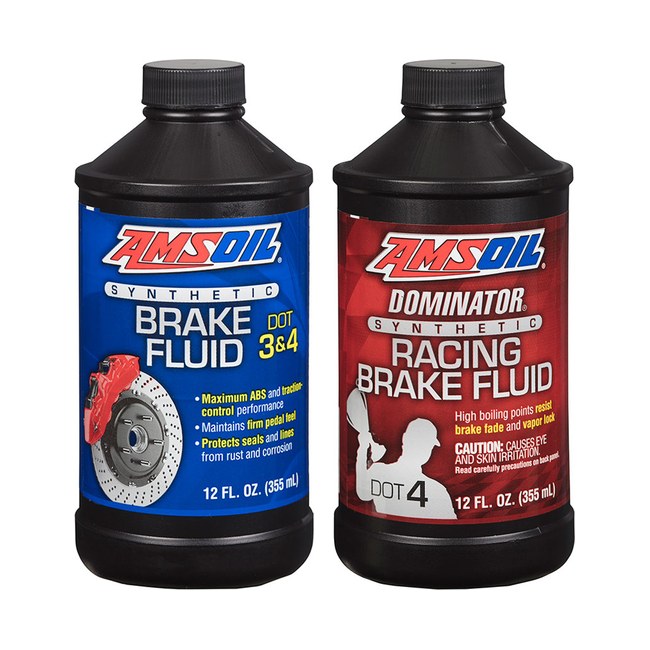

The primary difference between DOT 3 and DOT 4 brake fluid is their respective boiling points.
I suspect I know your next question.
But first, some background. The U.S. Department of Transportation (DOT) classifies brake fluid into four main categories:
- DOT 3
- DOT 4
- DOT 5
- DOT 5.1
Video transcript: Has Your Brake Fluid Gone Bad?
Featuring John Gardner, host of Motorhead Garage, and Leonard “Len” Groom, AMSOIL Director of Product Marketing (author profile).
John Gardner: Well, I have three containers of brake fluid here. If you had to put one in your car, which one would you choose? Welcome to this AMSOIL tech tip. Well, it’s pretty obvious right here.
I wouldn’t want this one. Yeah. This is old brake fluid. It’s been in a vehicle for a while, and it’s kind of contaminated, but looks could be deceiving.
These two here, well, they look pretty similar, so we have to understand all about brake fluid. Brake fluid is hygroscopic. Hygroscopic means it actually absorbs water. So if you leave the cap off or you have a big container, it’s going to absorb water.
Well, that’s a problem because it’s going to lower the boiling point. We’ll look at that in a minute. But we need to check the brake fluid. I’m going to show you.
Which one would you pick? Why is that? Well, I actually have a little meter here that measures water content. So what I’m going to do is I’m going to stick that in this one here, and it’s a little bit of yellow.
It’s been out all night sitting here. Now watch this. This one here, well, I got this out about a week.
Bam. You see it go right to the red there? There’s a ton of water content in that one. So that one’s going to boil.
And when it boils, see, it makes air in the systems. Air is compressible and liquid’s not. That’s not a good thing. When we talk about brake fluid, have to understand the different types.
There’s Dot 3, Dot 4, Dot 5, and Dot 5.1. I’ll make it pretty simple for you. The higher the number, the higher the boiling point. Now there’s one exception.
Dot 3, Dot 4, Dot 5.1 are all glycol based. Dot 5, well that’s silicone based. So Dot 5 is for some special applications, military vehicles, motorcycles, stuff like that. We don’t use that too often, but we do use Dot 3, Dot 4, and Dot 5.1.
The higher the number, the higher the boiling point. Use what your manufacturer service manual calls for, but you can always supersede the number. You can go a little bit higher. For example, if my car called for Dot 4, I could put 5.1 in it, or if it called for Dot 3, I could put 4in it, but I can’t go backwards.
We talked about checking brake fluid. Now we can check it with that tool I just used a little bit earlier. We can also use a refractometer, and you just look through it. And when you look through it, exactly what we see right there is the content of what’s going on of the boiling of the brake fluid.
We can also use these little test strips. We can put them down in there and this actually measures copper content, which is weird, know, but some of the nickel metal lines have some copper in there and the brake fluid starts to deteriorate it. We know it’s going bad. Now we actually boiled some brake fluid, which is pretty cool.
You can see it right here. It’s not a control test, but these are both Dot 4 brake fluids, and you can see the one on the left, it’s not boiling at all. The one on the right, we left out overnight. You can see the color change.
It boiled pretty quick. Len, AMSOIL has us covered with brake fluid as well.
Len Groom: We do. We’ve got brake fluid for all of your different applications. Just, you know, check out your owner’s manual, make sure you’re using what they recommend. But one of the things that I wanted to mention, especially in the climate that we work in, is once that brake fluid picks up some water, it freezes. So your pedal will get extremely stiff in the cold. Something maybe people in the southern states don’t think of, but those of us that work in the north have those issues. So the main thing is use what’s recommended for the vehicle and change it.
John Gardner: Yeah. And I love AMSOIL because theirs is specified for dot three and four, and it actually reaches the specifications of five point one, which is awesome. Now brake fluid is serviceable just like all the other fluids on your vehicle. For all your fluid service needs, go to AMSOIL.com.
Their primary differences are their wet & dry boiling points and their composition.
| Dry Boiling Point | Wet Boiling Point | Composition | |
|---|---|---|---|
| DOT 3 | 205°C/401°F | 140°C/284°F | Glycol Ether |
| DOT 4 | 230°C/446°F | 155°C/311°F | Glycol Ether/Borate Ester |
| DOT 5 | 260°C/500°F | 180°C/356°F | Silicone |
| DOT 5.1 | 260°C/500°F | 180°C/356°F | Glycol Ether/Borate Ester |
DOT 3 is the most common type used in cars and trucks today. DOT 4, however, is gaining popularity due to widespread use of anti-lock braking systems and traction control, which benefit from DOT 4 fluid’s lower viscosity.
Are DOT 3 and DOT 4 Brake Fluid Compatible?
Yes. DOT 3 brake fluid is compatible with DOT 4 brake fluid. However, DOT 4 offers a higher boiling point.
DOT 5.1 is used in high-performance and heavy-duty applications due to its high boiling point. It’s compatible with DOT 3 and DOT 4 fluid.
DOT 5 brake fluid is silicone, meaning it doesn’t absorb water. It’s not compatible with the other brake fluids and is used mostly in classic cars that remain in storage for long periods and need a brake fluid that doesn’t absorb water.
Bring it to a Boiling Point
So, now we’re back to boiling point. What does it mean? After all, we’re not cooking this stuff.
Well, in the right operating and ambient conditions, you are cooking it.
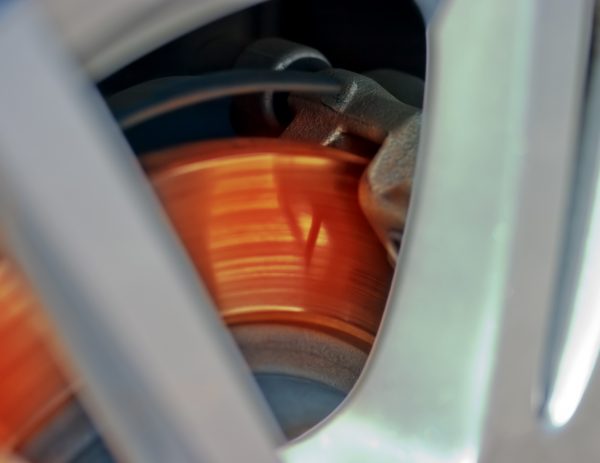
Braking generates intense heat between the brake pads and rotors. Maybe you’ve seen a race on TV where the producers stick a GoPro under the car to show the brakes literally glowing red when the driver depresses the pedal.
Intense heat can vaporize brake fluid, causing it to become compressible, which leads to a spongy feeling when you apply the brakes.
That leaves gas in the lines, which is compressible, leading to a soft pedal. In racing and performance-driving circles, this is known as brake fade, and it’s something drivers actively want to avoid. To drive as effectively and safely as possible, the driver must be confident the brakes will perform on lap 10 as they did on lap one.
Brake fade can also come from the brake pad/rotor interface. The pads release gasses, which reduces contact between the pads and rotors. That’s why high-end rotors are slotted and drilled – to release gasses quicker, limiting fade.
Brake Fade Isn’t Just for Racers
Descending a steep hill, especially when hauling a heavy load or towing a trailer, can generate tremendous heat if you ride or pump the brakes.
By the time you reach the bottom, your pedal may go nearly to the floor, making your heart rate go nearly through the roof.
PRO TIP: Next time, downshift into a lower gear before descending a steep incline.
If you like to toss your vehicle around a curvy country road for a little therapy, standing on the brakes going into corners can create sufficient heat to cause brake fade, too. If you get a little too zealous, you may end up going right through a corner and into the woods.
The fluid’s boiling point indicates the temperature at which the brake fluid vaporizes. The higher the DOT classification, the higher the boiling point, thus the better the fluid is at resisting heat. That’s why racers use DOT 4, not DOT 3, brake fluid.
Boiling Point is Separated Into Dry & Wet Boiling Points
The dry boiling point is determined using fresh fluid straight from a new container. The fluid’s wet boiling point is determined using fluid that’s been contaminated with 3.7% water, thus it’s always lower than the dry boiling point. Why would test administrators contaminate good fluid? Because it’s a reflection of what happens in the real world.
Brake fluid is hygroscopic, meaning it absorbs water (except silicone-based DOT 5 brake fluid). DOT 3 fluid, for example, can absorb up to 2% water every year. Moisture can enter the system when you remove the reservoir cap to add fluid, through worn seals and even through the rubber brake lines themselves. Thus the fluid’s wet boiling point is the number that more accurately represents what’s really going on in your vehicle.
Since brake fluid can wear out, it’s vital you change it periodically. Otherwise, not only will your brakes become spongy and unsafe, the moisture will slowly corrode metal components.
A good rule of thumb is to change the brake fluid every other year in passenger vehicles, and at least every year in racing vehicles. The AAA says 88% of motorists overlook brake maintenance, so you’re not alone if you haven’t changed brake fluid in awhile, like since you bought your vehicle.
It’s not too late to start, though. And when you do, check out our line of brake fluids for your vehicle.