

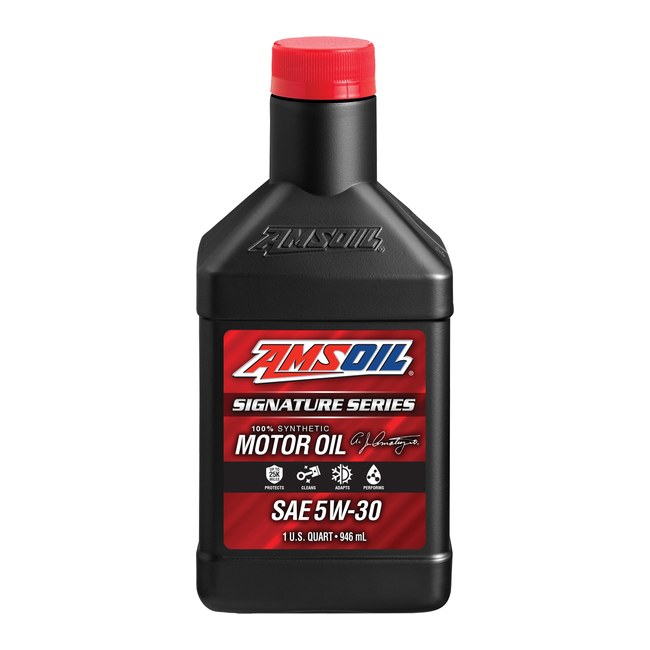

The short answer: dexos R is the General Motors* motor oil specification for its high-performance gasoline engines. It covers two viscosity grades, 0W-40 and 5W-50, and for 2026 GM lists it for the Chevrolet* Corvette* and the supercharged V8 in the Cadillac* CT5-V Blackwing* and Escalade-V.* AMSOIL Signature Series® 0W-40 and 5W-50 are recommended for applications that require GM dexos R.

Dexos R is one of the proprietary GM dexos* motor oil specifications. GM developed it for engines that see high speeds and heavy loads during high-performance driving.
Dexos R oils meet or exceed the performance requirements of dexos2* and dexos1,* making them backward compatible with applications that specify those standards. As a result, dexos R can be used in many vehicles that call for dexos2 or dexos1, while also providing the added performance capability required for high-performance engines.
What is dexos R? Which GM engines require dexos R?
The GM 2026 engine oil capacity chart for the U.S. and Canada lists dexos R for these engines:
| Vehicle | Engine | dexos R grade |
|---|---|---|
| Chevrolet Corvette Stingray, E-Ray | 6.2L V8 (LT2) | 0W-40 |
| Chevrolet Corvette Z06, ZR1 | 5.5L V8 (LT6, LT7) | 5W-50 |
| Cadillac CT5-V Blackwing | 6.2L supercharged V8 (LT4) | 0W-40 |
| Cadillac Escalade-V | 6.2L supercharged V8 (LT4) | 0W-40 |
Every other 2026 GM gasoline engine on the chart calls for dexos1 Gen 3 in 0W-20 or 5W-30. The 3.0L Duramax* diesel in light-duty trucks and SUVs calls for dexosD 0W-20, and the heavy-duty diesels call for API CK-4 or CJ-4. Requirements can differ by model year, so your owner’s manual is the final word.
How is dexos R different from dexos1 Gen 3, dexos2 and dexosD?
Each dexos specification covers a different kind of engine. GM has retired dexos2 and split it in two: dexosD for light-duty diesels and dexos R for gasoline engines.
| Spec | Engines | Grades | Replaces |
|---|---|---|---|
| dexos1 Gen 3 | Most GM gasoline engines | 0W-20, 5W-30 | dexos1, dexos1 Gen 2 |
| dexos R | High-performance gasoline engines | 0W-40, 5W-50 | dexos2 (gasoline) |
| dexosD | Light-duty diesel engines | 0W-20, 5W-30 | dexos2 (diesel) |
| dexos2 | Retired | – | Replaced by dexosD and dexos R |
dexos1 Gen 3 arrived in 2021 to address smaller, more powerful engines. It tightened deposit and sludge control and revised the stochastic pre-ignition (SPI) test. It replaced the Sequence IIIH test with a GM oxidation and deposit test, kept a turbocharger deposit test at stricter limits and added a fuel-economy test run in a Chevrolet Silverado.* It also tightened the Noack volatility limit from 13% to an average of 12.5% over three test runs.
How does an oil earn the dexos name?
Dexos is a GM trademark, and GM licenses it one product and one viscosity grade at a time. An oil maker submits each product for testing, and GM licenses the oils that pass and charges a royalty fee to the oil maker. A licensed oil carries the dexos icon on the front label and license number on the back label, and GM lists every licensed product on its dexos website.
Licensing programs like dexos are voluntary. Some lubricant manufacturers, including AMSOIL, choose to formulate motor oils without the formulation constraints licensing programs can impose. Abstaining from licensing programs can provide great freedom to innovate lubricant formulations.
In those cases, the lubricant manufacturer relies on its own testing and formulation expertise to verify the performance of its products in relevant applications.
AMSOIL Signature Series 0W-40 and 5W-50 meet or exceed the performance requirements of dexos R and are recommended by AMSOIL for applications that require GM dexos R.
Using AMSOIL synthetic lubricants does not void your new-vehicle warranty. AMSOIL products are Warranty Secure, high-performance replacements for vehicle manufacturer-branded products, keeping your factory warranty intact. In addition, the AMSOIL Limited Warranty backs the performance of our products and is built with an extra measure of protection. We don’t place restrictions on our warranty coverage based on total vehicle miles. We stand behind our products for as long as you use them.
Comments
Brad Nelson is an AMSOIL Technical Writer II who develops content about lubricant technology, product performance and vehicle maintenance. He works with engineers and product specialists to translate testing, application requirements and approved performance claims into clear customer guidance. Nelson’s work includes AMSOIL Blog articles, AMSOIL Magazine features and technical explanations concerning motor oils, gear lubricants, vehicle systems and maintenance practices.
Share: