


Increasing fuel economy remains a top priority for most automakers, and use of synthetic oil is just one of the many tools in their arsenals to build vehicles that deliver the power we crave without sucking too much gas.
So, how does synthetic oil increase fuel economy compared to conventional lubricants? Let’s find out.
For a deeper dive, read Synthetic vs. Conventional Oil: The Definitive Guide
Reducing viscosity increases fuel economy
At one time, most passenger cars/light trucks used 10W-40 motor oil. Then it was 5W-30. Today, many vehicles call for 5W-20, 0W-20 and even 0W-16 oil.
The lower the oil’s viscosity – defined as its resistance to flow – the more readily it flows.
Imagine a jar of honey and a glass of water. Stirring water with a spoon requires less energy than stirring honey. The same principle applies to your engine and motor oil.
Lower-viscosity oils are easier to pump through the engine and offer reduced resistance to moving engine parts, increasing fuel economy.
Why do synthetics offer an advantage in reducing motor oil viscosity?
Formulating a 0W-XX motor oil using only conventional base oils is extremely difficult, if not impossible.
Formulators can achieve the 0W rating, but the oil will vaporize more readily at higher temperatures. It’ll also fail other required industry tests.
Simply put, formulating lubricants is a give/take, and conventional base oils don’t provide near the performance as synthetics. This requires formulators to give up too much required performance in one area to gain it in another.
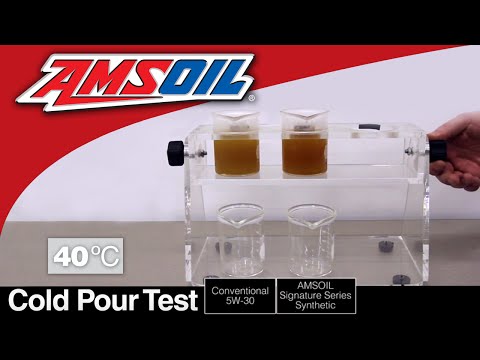
Video transcript: Cold Pour Test: AMSOIL Synthetic Oil versus Conventional Oil
One of the key indicators of lubricant quality is its ability to flow at low temperatures. Liquid lubricants thicken as the temperature decreases until they reach a point at which they are no longer liquid. As they thicken, their ability to circulate is significantly impaired. To demonstrate this, let’s compare two different 5W30 motor oils and see how they perform at very low temperatures.
The oil on the left is a leading conventional motor oil, and the one on the right is AMSOIL Signature Series synthetic motor oil. Both oils were chilled to a harsh 40 degrees below zero Celsius before being placed in the transfer device you see here. Look at the glasses as they are tilted forward to allow each oil to drain. Extreme cold is no problem for AMSOIL Signature Series synthetic motor oil.
Almost instantly, AMSOIL begins to flow from its glass in a continuous and steady stream. Note that the regular product barely moves. Even after a full minute, the grease couldn’t flow out of the glass. Up to 60% of total engine wear occurs during cold starts, before the oil has time to circulate through the engine.
Minimizing this delay significantly reduces the likelihood of wear and helps extend the life of the oil. This also helps the engine start quickly and reliably at low temperatures. Low-temperature performance is another area where AMSOIL synthetic motor oils help protect your engine.
Synthetics offer better cold-flow ability
Synthetics’ improved flow during cold starts also improves fuel economy.
Since they don’t contain waxes, which are inherent to conventional oils, they don’t thicken as much when your vehicle sits overnight. In the morning, when you start your vehicle and drive away, the motor oil, transmission fluid and gear lube don’t require as much effort to circulate.
This results in less wasted energy and improved fuel economy.
It’s important to note that “cold” doesn’t only apply to us northern folks. “Normal” operating temperature for a vehicle can be up to 235ºF (113ºC). Anything below that is considered “cold” to your engine.
So, even down south at the height of summer, synthetics’ improved cold-flow can still help improve fuel economy.
Why pay more for gas? Switch to synthetics to maximize your mpg.
This article is part of our Car and Truck Motor Oil guide. See every article in the guide.