When “jeeps” rolled off assembly lines and into battle during World War II, they were immediately loved by GIs and, soon after, the American people. In the 80 years since, that “thing” enthusiasts have for jeeps has remained strong.
The Jeep* brand elicits that same sense of freedom and adventure with its rugged style and off-road capability. Most Jeep enthusiasts take their vehicles further, modifying them to be even more capable. But Jeeps didn’t find a following overnight. Let’s jump in and explore the history of the Jeep.
WWII | 1940s

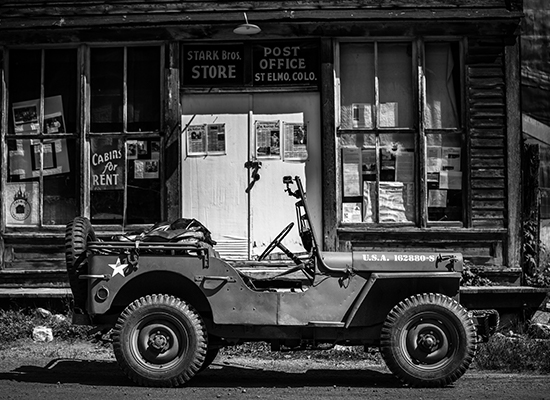
Like AMSOIL, Jeep has its roots in the military. The U.S. Army put out a request for proposal in 1940 for a general-purpose vehicle that was small, lightweight, had four-wheel drive and could carry a light machine gun. American Bantam* and Willys-Overland* both stepped up with design proposals. While the Army began testing those prototypes, they also reopened the door to other automakers, notably Ford* with its massive production capacity.
The final jeep design was a mashup of the best from each proposal: The Bantam Spicer*-sourced four-wheel transmission and differential was mated with the Willys Go-Devil* engine and fitted with the bodywork configuration of the Ford Model GP.*
From fewer than 100 jeeps in 1940, almost 8,500 were built in 1941 in three different versions by Bantam (BRC-40), Willys (MA) and Ford (GP). Willys struggled to reduce the weight of the MA prototype to the U.S. Army specification of 2,160 pounds, coming in about 400 pounds over. But after rigorous testing, Willys was awarded the contract in July 1941 with an initial order of 16,000 MBs at a unit price of $738.74. Today, the MA is the rarest of all pre-production Willys, with only about 30 known in existence.
The simple and tough jeep was an essential tool that helped win the war. The MB rendered other military vehicles obsolete, including horses and motorcycles with sidecars. Not only did they have more capability and versatility than other light vehicles, they could also be modified for other duties, such as battlefield ambulance work, snow plowing, desert patrols, firefighting and more. They were burly enough to go almost anywhere and light enough to be picked up and moved by GIs when they were really stuck.

Video transcript: AMSOIL Signature Series: Expedition Colorado
AMSOIL Expedition Colorado. Here’s the plan. Five days, 550 miles, Colorado Springs to Moab in a 1943 Willys MB. We’re looking for adventure close to home.
We’re rewinding time and being in this Jeep*, definitely more challenging than some of these more modern vehicles. We’re out here. Regardless of how you’re doing it, you’re seeing things that people haven’t seen and experiencing the way that things were 100 years ago. This is how people got across Colorado on these mountain passes that we’re doing.
That was the only way. It’s going to be an adventure, and we’re going to give it a shot. Join us for an exclusive inside look. Connect with racers, gearheads and others pursuing their passions.
Welcome to the AMSOIL Signature Series. [ Music ] We’re here at Lovell Racing headquarters. We’ve had this trip planned for months. We’ve kind of got to shoot from the hip on this trip.
We’ve got a beautiful Colorado morning ahead of us here. We’re taking off from downtown Colorado Springs. We’re running through the front range up to Cripple Creek. Taken some roads I’ve never seen from there down into some pretty remote parts of Colorado.
[ Music ] Behind me is the Antlers Hotel. It burned down twice in the history of Colorado Springs. The one thing that’s never changed is the fact this is the 00 block. Colorado Springs, the original center of town, the official start of the AMSOIL Expedition Colorado.
This really is going back to our roots, and I feel that, you know, this is how we get into racing. This is how we get into rock crawling, Baja, and it’s what we’ll be doing after we’re done with all that stuff. So we’re going to head out. We’ve got 550 miles between us and Moab, Utah, which is our destination.
We’ve got some high mountain passes, passes I grew up on. I’m really excited to get back out there and seeing them because a number of them I haven’t been on in years. I see some parts of Colorado that I’ve never seen before. Get up in the high mountains and head for the desert, and get down to Moab and see some slick rock.
[ Music ] Got to cool down at this point, you know? I think we should just try to go slow. Yeah. Let it cool down as we go.
Let’s just — let’s just cut the pace. But I just want to go fast! You always want to go fast. See what going fast teaches you?
It is getting a little bit warm. The temperature gauge maxes out at 212, which is about the boiling point of water at sea level. So I’ve had some recent bad luck with overheating vehicles. I don’t want to do it to this one, but it seems to be holding in there.
We’re putting all 60 hp to the ground. Had a great first day, a bunch of nice weather. Really hot, a lot of heat. Caused the Jeep to overheat a couple times, vapor lock.
So we’ve been fighting that. That thing’s a runner. I’ve been running it just like I run the race cars, as fast as it can go. Finally we eased up a little bit and slowed off of that but a bunch of great scenery.
Big hills, ups and downs. We’re here at the end of day one. As you can tell, we’ve got a little bit of rain going. We stopped short of getting into the big mountains because the weather’s looking really nasty up there.
Let’s go again. We’re going to get through this little rainstorm here and move on tomorrow. We’re at the start of day two of the AMSOIL Expedition Colorado, and today gets a lot more serious. We’re going to be up above timberline with these rolling thunderstorms.
It’s important we get up there, get over the mountains before the storms move in. And it’s going to be a challenge for the Jeep, too. We’re hitting altitudes up and over 12,000 feet, and I don’t really know how this thing’s going to run up there. But it’s a proven vehicle, and we’re going to give it some more proof.
[ Music ] We’re here in the historic mining town of St. Elmo, which is right below the Continental Divide. This town served all the mines where they were pulling gold ore out. Up above timberline here is a really harsh environment back in the late 1800s.
So we’re going to go up and see some of those mines and take Hancock Pass right up and over the Continental Divide. [ Music ] We just came up to the top of Hancock Pass. We’re on the Continental Divide, and I tell you this is one of the points that had me a little bit worried. You know, it’s definitely a milestone for this.
We’re 12,140 feet. It’s not the highest point we’re going to get to but, again, at least, you know, we’re getting up in that realm. I’ve been friends with the Lovells for probably 10 years now. We race with them in the Ultra4 Series.
And when Brad said he was going to do this adventure with his kids in this Willys Jeep going to Moab, it was awesome. I mean, he’s teaching his kids a lifetime experience. So I get to kind of help guide them along today through the section of the country that I know. Adventures like this are so important, especially with the kids.
We’re seeing part of the world that most people don’t ever see. They see this thing at 30-, 40,000 in a jet going over, and they see it from the highway and they think they’ve been to Colorado and they’ve seen the beauty of it. Being here and just experiencing it is just something the average person doesn’t get to see. [ Music ] [ Raining ] That doesn’t look good, does it?
No. It’s packed full of mud and dirt. Oh, wow. Let’s try it.
Try it? Sure. [ Music ] We got into camp late last night, and everything was waterlogged. So it was kind of a short and rough night.
And up at about 7 o’clock this morning we’re working on the Jeep here, trying to get over this next pass, Pearl Pass. We hear there’s a big ledge up there. And then we’ll work our way down in Crested Butte. So we’ve just got to get this thing together.
[ Music ] It’s a bit of a bummer right now. We’re up on Pearl Pass, and we’ve hit snow pretty low down, which is kind of a surprise. There’s a little drift up here that we could get by, but I hiked up half a mile or so and it’s impassable. So this is really the one that we needed to make this thing happen, so instead we’re going to have to go down through Aspen and take some county roads, and we’ll get back out and get on our route.
But we’re looking at probably a 50-mile detour here. So it’s kind of a bummer, but we couldn’t be surrounded by a better place. [ Music ] We had to do about a 50-mile detour, and it’s not something I really wanted to do. But you know what?
We’re back on dirt, and I’m ready to be here. We’re actually on schedule because those passes take so much time. And from here to Moab I hope to not see many people or many towns because this is what Expedition Colorado is about. [ Music ] So why are we driving a ’43 Willys MB across Colorado?
It feels like all we do is rush, rush, rush, and I want to do it to experience Colorado, to see Colorado in all its beauty in the summer, to show my boys what it’s like going camping and slowing down because the world didn’t used to be that way. It didn’t used to be that way 20 years ago, that you could get different places so conveniently. And I think we’re adding a real sense of adventure, and we’re seeing a different side of Colorado because we’re slowing down. And we’re having to earn every bit of it.
Climbed up onto Grand Mesa here, and we’ve been through these beautiful valleys and highlands and Aspen forests. I’ve never seen so many mud holes out here, so we’ve been having a great time doing some of these backwoods roads. You know, we’re within sight. We’re on the downhill slide down there to Moab.
So tomorrow I expect we’re going to get out of the forest and start getting into some desert. But tonight we found a great camping spot. Just a few minutes of sun left. We’re going to have a campfire and a great time.
[ Music ] We’re kind of at our first stop for day four. We’re still up on Grand Mesa here, and it’s absolutely beautiful. There’s wildflowers everywhere, meadows. It’s a little after 10:30.
And, you know, we should have been here yesterday. And because of the go around and everything, we’re just getting here now. So there’s no doubt in my mind we’re earning every one of the 500 miles I thought we were going to do off-road, but it looks like it’s going to be about a 600-mile trip. I’ve always enjoyed the outdoors.
I have a lot of friends that ask me do I enjoy hunting, do I enjoy fishing. And the honest answer is, no, I don’t. What I enjoy is going out and exploring. They like to go to a lake and start fishing.
Nah. I like to go to the lake to see the lake and go find another one. So I always enjoy exploring new areas, seeing different things. And this was an opportunity to do it with my son, and my son’s got the same bug as I do.
And he’s loving every minute of it, and it something that I did with my dad. So this is even better. We’re at the top of Land’s End, which is a pretty big deal. We have been fighting.
We’ve been getting our butts kicked up on Grand Mesa here. We had 26 miles of super tight going through forests, big hills, rocks, mud, everything in the world. It’s put us behind schedule. We’re about out of fuel, and we’re at the edge of the world here.
See over my shoulder the La Sal Mountains. On the other side of those mountains is Moab, and it’s still a long way. We’ve got my buddy down here getting us fuel where we crossed the highway so we can continue on, run out in the desert. Right now it’s feeling pretty intense.
The good news is we’re in the desert now. We’ve got a bunch of fuel, but we’re running into some issues with gates. There are a lot of locked gates out here, and we’re looking for routes. We’ve got to get a little bit north of here to head West without being on highway.
So, you know, we kind of got to the point tonight we’re getting a little bit frustrated, so we just stopped, found a great place to camp up on top of a mesa here. We’re adjusting the route. We’re going to spend a little bit of time looking at the map tonight. We will be in Moab tomorrow.
[ Music ] Day five of the AMSOIL Expedition Colorado. We just passed a sign back here that said Moab with an arrow pointing this way, so that makes us feel pretty good. The Jeep, I’m pretty sure we’ve got a blown head gasket. We’re taking a little break now because it’s hot.
I think it’s going to make it to Moab. I don’t know if it’ll make it going back the other way. But, you know, that’s what we’re out here to do is push the limit and find the edge of this stuff. So we just climbed up this gorgeous canyon and on top of the plateau, and so we’re going to go around the San Juan Mountains and cut right down into Moab.
Exploring to me is just taking what you have and getting out there and finding something new. It doesn’t matter what you have. You don’t have to have a super capable vehicle to go out. Just take what you have and get out there.
Gosh. This ridge, that’s the last ridge we had to get over to get on the Porcupine Rim Trail to come into Moab, and the road’s closed. Couldn’t believe it. We had to go down by the Colorado River, but it worked out great.
We had a great swim in this heat. [ Music ] We made it, guys. We made it to Moab, Utah. We wanted to end this trip right here on Hell’s Revenge.
We came here for the red rock and the trails. Really couldn’t be more excited. It was a huge challenge for this Jeep. All in all, we made it.
Stoked to be here! [ Music ] Here we are in Moab, and I’m really excited to be here in Moab. And it’s bittersweet because it’s the end of our trip. It’s the end of something that we’ve planned for, you know, months on end.
Family is really important to me. Twenty years ago I came out here to Moab for the first time with my brother. Now I’m out here with my son, my brother’s kids and just really proud to be out here with my son and show him some of the things that I grew up doing. I mean, he’s out here playing in the desert, and I know that in 20 years I hope he’s out here with his son doing the same thing that I’m doing right now.
The idea of this backcountry adventure started with my brother and I years ago when he first got his Bronco* II, and I ended up with a Ranger. And we always wanted to see where the road ends. We saw stuff in Colorado that we’ve never seen before that I honestly I never knew that was out there. The beauty, the sheer ruggedness.
There’s adventure out here just like there’s adventure in Baja. You’ve got to look a little harder for it, and you might have to put yourself in a 1943 Jeep to find it, but it’s there.
Civilian Life | 1945
The CJ was the first post-WWII Jeep-brand vehicle. The target market for Willys-Overland was the 5.5 million farmers in the U.S. The CJ could do the job of two draft horses at a speed of four miles per hour for 10 hours a day. Farm implements and industrial tools were fitted with power from a PTO. Jeeps became the platform for hundreds of applications, including the Zamboni* ice resurfacing machine.
The debut of the 463 Jeep Station Wagon in July 1946 marked the first all-steel station wagon and the forerunner of the Grand Cherokee* (vehicle code WK).
Rise of Off-Road Recreation | 1950s
The 1950s were marked by engineering milestones, and the off-road Jeep enthusiast began to emerge. The M38, popularized in the TV show M*A*S*H, served in the Korean War. It was essentially a combat-ready version of the CJ-3A with a stronger frame and suspension and it could even be driven under water.
Willys updated its CJ line in 1953 with more horsepower, capability and comfort. Component upgrades with the 81-inch wheelbase helped feed interest in off-road vehicles. The CJ-5 had a production run of 30 years, the longest for any Jeep-brand vehicle. The CJ-6 is basically a CJ-5 with a longer wheelbase (101 inches); it’s prized by collectors.
Wagoneer* and Commando* | 1960s
The Jeep Wagoneer ushered in an era of off-road-capable vehicles with luxurious interiors. It was the first 4×4 vehicle with an automatic transmission, independent suspension, overhead-cam six-cylinder truck engine and automatic full-time 4×4 system.
The SJ line of vehicles included the Wagoneer, early Cherokee* models and Gladiator* and J-Series* trucks. The SJ line was in production for more than 28 years.
The release of the Super Wagoneer* in 1965 upped the arms race for power and luxury and helped pave the way for the modern SUV. The Super Wagoneer carried a $5,943 price tag – almost double that of the base Wagoneer.
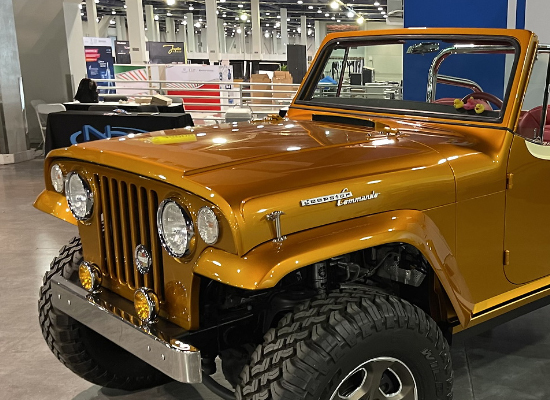
With recreational off-roading on the rise, the Jeepster Commando* stepped in to compete with the Bronco* and Land Cruiser.* The Jeepster Commando (C-101) was built on a CJ-6 chassis and used the “Dauntless” V6 engine.

Video transcript: Company of Enthusiasts: We’re Into Jeeps
I’m Tiffany Stone. I’m into Jeeps. What’s up, everybody? I’ve been trying to keep this secret in for so long, and I can no longer keep in this secret.
I’m so, so, so, so excited because I just got myself a brand-new 2018 Rubicon! So pretty much about a year ago I had an idea that I wanted to build a Jeep*, and I wanted to build a SEMA-esque type of Jeep. So I pushed myself and I made the goal, and a year later this is kind of what we have. So I’ve done a bunch of different things in a year, and actually I got the majority of it ready for my first trail to SEMA that I did in 2018.
So everybody’s at the first obstacle. They’re heading down. But it’s literally Day One, so we’ve got so much going on. So beautiful.
It’s a good day so far. So it was kind of crazy to have a stock 2018 JL. And then, you know, four months later it has a lift, exhaust. It has suspension.
We changed out the wheels and tires. Really what I love about all the Jeeps and stuff is you can have something stock and within, you know, a year you can completely transform it and make it into kind of whatever you want. The love of cars kind of evolved. You know, I worked with Toyo Tires first, and I was an umbrella girl for Formula Drift.
And then I was very fortunate to work with Chrysler. I was a presenter for about four or five years. You would come. You learn everything about the vehicles, and you would become a presenter.
Then I actually got an opportunity to work for Mopar, and that’s kind of where I got to learn about the history and the heritage. And then, fast-forward a little bit, I started understanding that there was a whole other off-road dirt motorsports circuit. I kind of went out west, and then I got into the desert scene. And once I got the taste of Ultra4s it was — I could take something like that and, you know, like a stock Jeep and build an Ultra4 vehicle that can go rock crawling, that could take me out to the desert.
So it’s kind of just started, and it kept going from here until I was like, you know what? I want to do this myself. We are at Moab Rim. Just kind of got over the first obstacle so it’s a beautiful thing.
You know, when I did Trail to SEMA, I wanted to do something that would make me feel. I wanted to do something that would make me push myself. And I am deathly afraid of heights, so when I did Moab Rim last year and when you look down and you could just fall hundreds of feet, it’s the competitiveness. It’s the adrenaline.
I thrive off that. And so I think that’s why I built a Jeep too. Plus it’s an outlet for me. What’s really cool is I interview drivers all day long.
I interview drivers about their car, their truck, their buggy, their super buggy, their side-by-sides. And, finally, what’s really cool is I get an outlet for myself. I get an outlet to be like, you know what? I wonder what that would look like on my Jeep.
I wonder what those wheels and tires would look like on my Jeep. And I think this is where I’ll just keep progressing and evolving to build that 4600 or that 4400 Ultra4 vehicle. So just walking up. Got all the Jeeps.
Let’s go see what this first obstacle’s all about. Everybody always asks, you know, what does success mean to you? What is successful? What does it mean to be successful?
And there’s a term in the Japanese culture called kaizen. There’s no best, only better. And that is something that I would like to live by because, if you do something that you love, you are always working. You’re continuously working to be better than what you were.
And that’s really what I think it is.
The AMC* Years | 1970s
By the 1970s, 4x4s were becoming quite popular and Kaiser* sold the Jeep brand to American Motors* (AMC) in 1970 for $75 million.
The Quadra-Trac* 4×4 System was released in 1972 as the first automatic full-time four-wheel-drive system. AMC brought back the Cherokee as a sporty, two-door version of the Wagoneer with featured bucket seats and sports steering wheel.
In 1976, AMC introduced the CJ-7 with a slightly longer wheelbase than the CJ-5 to allow space for an automatic transmission. The CJ-7 featured squared-off door openings compared to the CJ-5, which is a quick way to tell them apart. For the first time, the CJ-7 offered an optional molded plastic top and steel doors.
In 1978, Mark A. Smith, who is widely known as the father of modern overlanding, made history by leading a group of 13 explorers from Tierra del Fuego, Chile to Prudhoe Bay, Alaska using Jeep CJ-7s. The 21,000-mile route took 122 days to complete. AMSOIL was a part of the epic journey as AMSOIL synthetic lubricants were used to help ensure reliability and longevity of the Jeeps.