Prepare for a LSPI test for used oil.
Matt Erickson | VP, Product Development
Low-speed pre-ignition (LSPI) surfaced in the mid-2010s and caused so much trouble that the auto industry introduced an updated oil specification, API SN PLUS, just to deal with it. Well, automaker data from the field suggests it’s still a problem.
Before I dive in further, let’s refresh our memories on LSPI.
LSPI is an abnormal combustion event that results in severe engine knock. It can happen when over-sprayed fuel combines with oil along the cylinder wall, creating droplets that hide in the piston crevice.
Those droplets launch into the combustion chamber and ignite the fuel/air mixture too early. This creates a shock wave that collides with the upward-moving piston.

Video transcript: Turbo Coking Explained: Why Engine Oil Breaks Down Under Heat
Featuring John Gardner, ASE Master Certified technician, automotive technology instructor and host of Motorhead Garage, with AMSOIL Director of Product Marketing Len Groom.
You know, this turbocharger can spin up to 300,000 RPM. If your motor’s not right, the intake exhaust or the turbocharger’s not right, bam, it’s going to look like that one right there and you don’t want that. Welcome to this AMSOIL Tech Tip. We’re talking about turbochargers, but more importantly, turbocharger failure.
What’s going on? Well, you want to make sure you check the intake side of the turbocharger. A lot of times that’s the majority of the problems where you either have a dirty air filter or we’re sucking something up in there. Your fins are going to get bent and damaged.
How do you do that? Well, we got a Ford* EcoBoost* in the shop and what we did is just pulled off the intake. Make sure the air cleaner’s nice and clean. Remember, this is the part that’s actually all going into that turbocharger, so you want to make sure it’s nice and clean.
Take your ports, make sure you don’t have any looseness or any air escaping into there. Go around all the way. Remember, it’s a twin turbo, so follow both sides down to the turbocharger and make sure everything’s intact and there’s no problems. You can have what’s called overpressure, intake or exhaust blockage, starts to bend it, starts to bend the fins, overheats the bearings.
You can have what’s called over-speeding, whistling noise, loose air or leaking air coming in, wastegate problems, too much speed it’s going to spin too fast and end up damaging all the fins or come apart. You can actually have it tuned with too much boost and do the same thing. Noises, well, there’s whining, compressor side, too much play, out of balance, hissing on the exhaust, is leaking exhaust. Check engine light, man, that could be anything from erratic readings, from your map for map sensors, boost control or lack of boost.
You got a problem there as well. When it all boils down to lubrication, lubrication, maintenance and fuel, we want to make sure it’s going to blow up and it’s going to atomize right. Yeah, that’s correct. You want to make sure that the, for starters, that we just talk about the fuel because that’s what we probably, it’s one of the easiest things to look at.
Make sure that it’s clean. You want your injector spray pattern nice and consistent. You wouldn’t want to be creating lean or rich spots in the map that can, you know, induce some of those major problems that you showed. And you think about the octane as well.
This is a turbo car, it wants 91 octane. I don’t need that on a normal motor. Why so much octane? Well, because you’re pushing your limits with compression, as we all know, with a turbo, we’re forcing more air in there.
We’re raising the actual compression ratio of the motor. Higher compression ratio, higher octane. We have an octane booster that is available for that. Now, what about all the oil and problems?
Well, from the oil side, that’s a whole nother fun conversation. The turbo operates in an interesting environment. Half of it is exposed to exhaust, so we’re seeing thousand plus degree temperatures plus all those RPMs you were talking about earlier. The key there is oxidation control.
The oil gets so hot that it has tendency to oxidize. And that’s when the oil kind of reverts back or kind of mixes together and turns into something that maybe you could patch a driveway with, but you don’t want to lubricate your engine. Yeah, it’s called coking. It’s not a good thing.
Now, you don’t want your turbocharger to end up like that with proper maintenance. You can avoid this for all your maintenance needs and all your maintenance products. Just visit AMSOIL dot com.
Sometimes, drivers notice the engine idling roughly or knocking. In extreme cases, the force can break off chunks of the piston, destroying the engine – and causing expensive warranty claims the automakers don’t want.
LSPI is a cousin of traditional engine knock, which has been around since engines were invented. But it is specific to gasoline-direct-injected engines that are usually turbocharged (T-GDI) and it normally occurs under low-speed, high-torque conditions, like when accelerating from a stop.
That’s a problem because most modern engines use turbocharging and direct injection to help meet tightening fuel[1]economy and emissions requirements.
The LSPI issue was so important that the industry introduced the API SN PLUS specification in May 2018, an amendment to the API SN specification that was current at the time.
The new spec included an LSPI test in response to the rash of LSPI issues arising in the field. Everyone agreed that it was needed to bridge the gap until the introduction of the API SP specification, which included an LSPI test.
https://blog.amsoil.com/what-is-the-best-motor-oil-for-lspi/
Despite all this, some automakers are still seeing LSPI issues cropping up in the field. A recent Society of Automotive Engineers (SAE) paper indicates why.
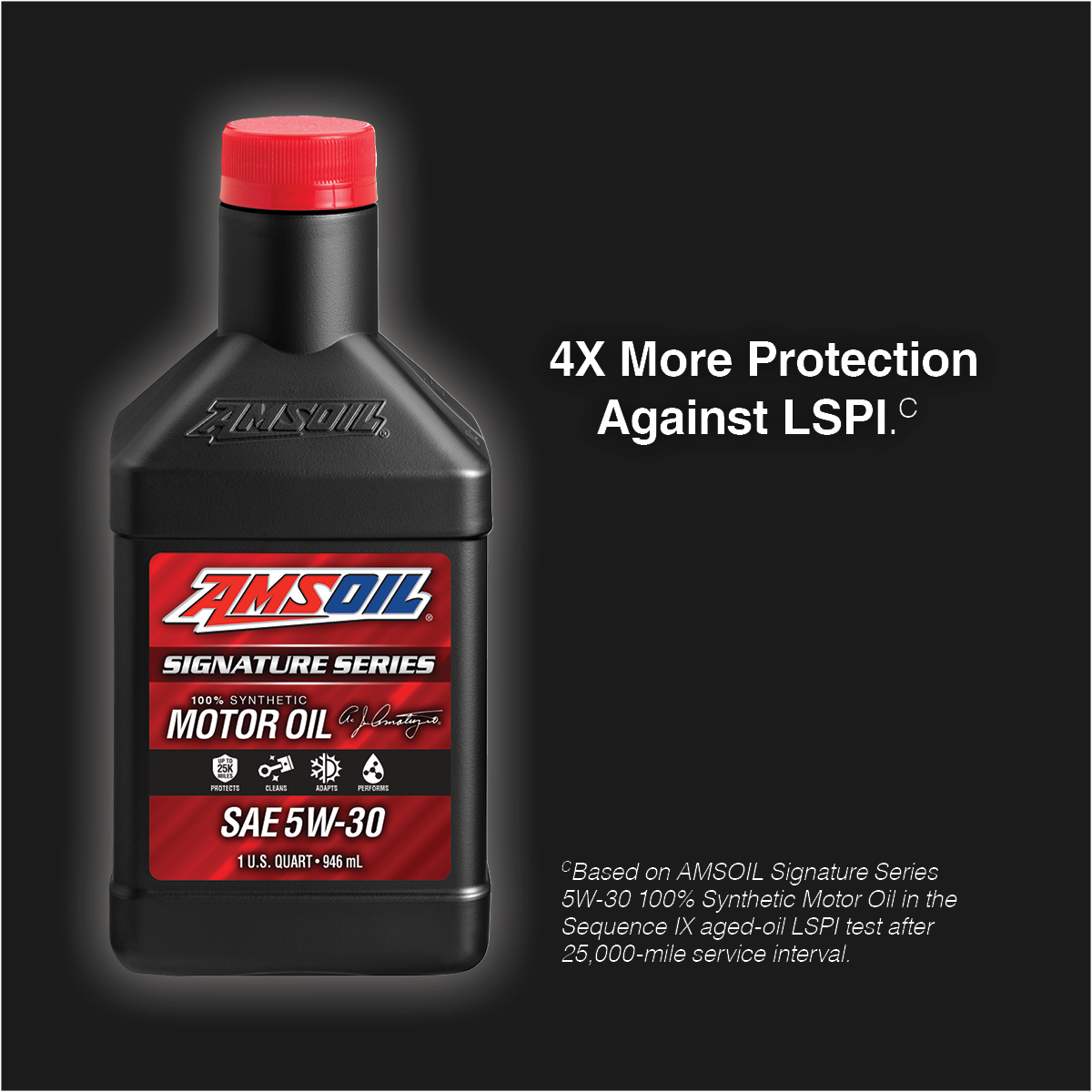
While some oils protect against LSPI when they’re new and fresh out of the bottle, their ability to protect may diminish as the oil ages in service.
In one test, administrators aged different API SN PLUS oils for 100 hours on a dyno. Then they subjected them to LSPI testing and found that some oils provided good LSPI protection when new, but not after they’d been aged.
The study found that the oil’s formulation played a role in whether it protected against LSPI after aging. Oils with the proper balance of calcium and magnesium detergents were found to perform better after aging.
The industry is now working on an LSPI test for aged oil. All signs point toward introduction of another supplemental specification (probably API SP PLUS) that will include the new test.