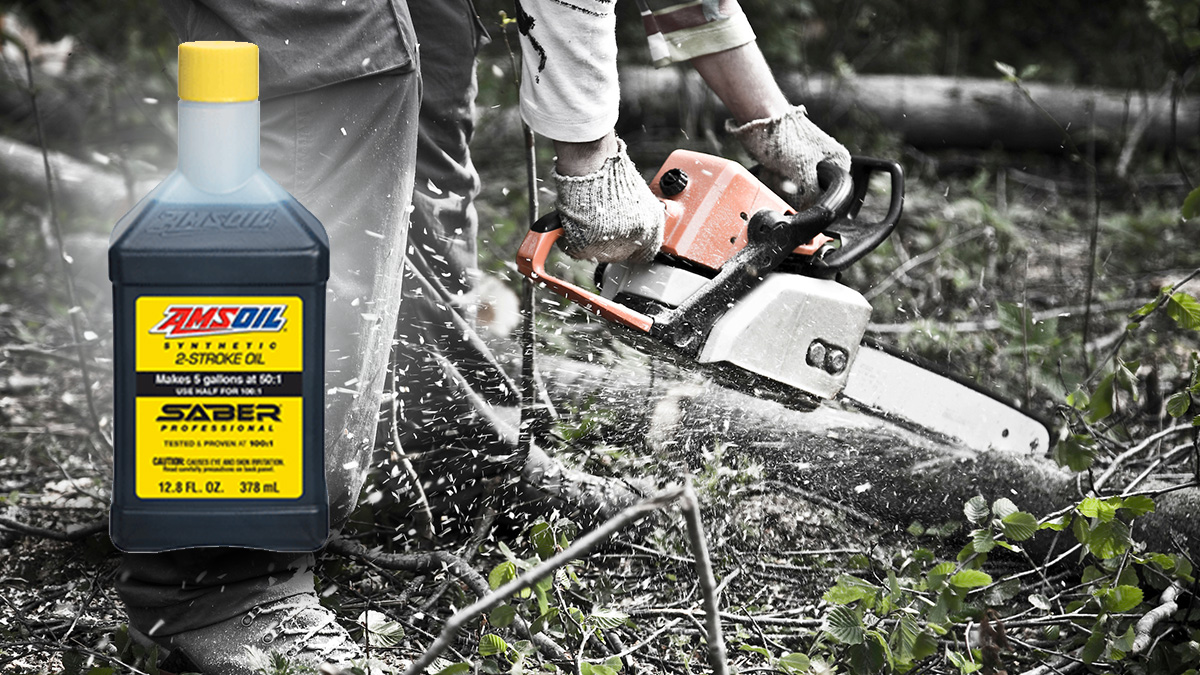

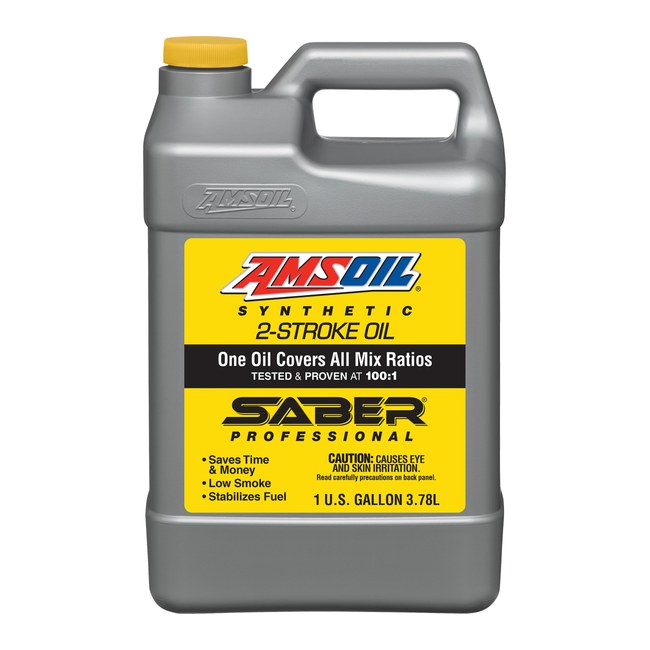

The short answer: a 50:1 mix is 50 parts gas to 1 part two-stroke oil, or 2.6 oz. of oil per U.S. gallon of gas. A 40:1 mix is richer: 3.2 oz. per gallon. AMSOIL SABER® Professional can be mixed at any ratio up to 100:1 (1.3 oz. per gallon), so one can of fuel can serve all your two-stroke equipment.
Two-stroke engines derive lubrication from the oil mixed directly into the gasoline, unlike your car engine, which lubricates itself with oil housed in an oil sump and circulated by an oil pump. Read more about the differences between two- and four-stroke engines.
Untangling different mix ratio recommendations and mixing multiple containers of fuel is a hassle, particularly for professionals who run several different pieces of equipment. What if there was one solution for different two-stroke oil mix ratios that worked in all your equipment?
Video transcript: Two-Stroke Oil Mix Ratios Made Easy
Featuring John Gardner, host of Motorhead Garage, and Leonard “Len” Groom, AMSOIL Director of Product Marketing (author profile).
Len Groom: Well, it’s the amount of oil that you’re putting in the gasoline. In the case of fifty to one, it’s fifty parts gas to one part oil.
John Gardner: That’s pretty cool. And then I got this chart off your website here. I’m looking at conventional fifty to one, and then I look down here down at the SABER fifty to one, and it looks like I’m using half the oil. Is that true?
Len Groom: Oh, that’s correct. SABER Professional is built specifically to run at leaner mix ratios. You don’t need to do it. It’ll work just fine. But we formulated that product with a very very high concentration of additives to do the job at half the amount of oil.
John Gardner: Now if we’re using half the amount of oil, can I do that in most of my lawn equipment stuff?
There’s a lot of benefit to that.
I Mean smoke being number one in my neighborhood, professionally, however.
Len Groom: That’s correct. It reduces smoke, it reduces depositing, it reduces all the bad stuff and we formulate it so that all the good stuff for the protection and the lubrication is all still there.
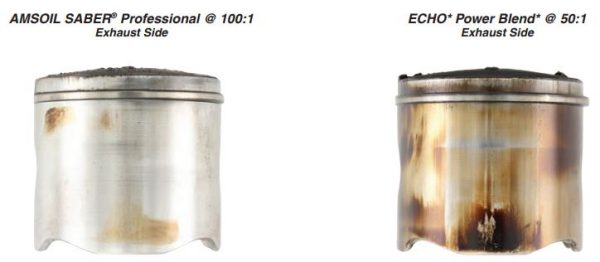
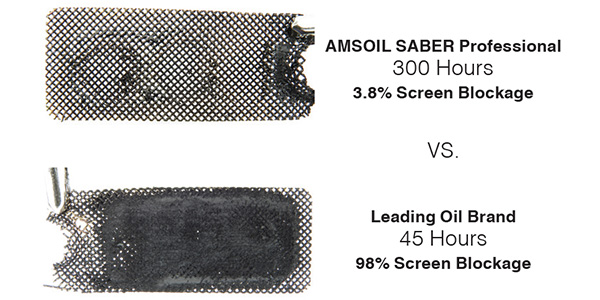
John Gardner: So use your manufacturer specification for the mix ratio, but you can cut it down to the saber here and do much better. Now, found these screens on your website and these are the exhaust screens. I mean, an engine’s a big air pump. You get it in, you have to get it out. I’m seeing they’re clogged up here. That cannot be a good thing.
Len Groom: No. And what this was was a three hundred hour test. That screen is in the exhaust stream. SABER Professional ran for three hundred hours. We got no deposit, no contamination, no buildup, and that allows that engine to breathe, retains power, keeps everybody happy.
John Gardner: And is it gonna start, man? I just don’t like pulling those things in the hot Florida sun.
Len Groom: Yes. When an engine can breathe, as you know, it will start. So it will help your start ability.
John Gardner: You gotta love that. If that alone, you guys check them out on AMSOIL.com. You can look at these products and so many more.
The mix ratio is the proportion of gas to oil, expressed as a ratio. For example, 50:1 means 50 parts gas to 1 part oil.
Oil mix ratios explained
If your manufacturer recommends a 50:1 fuel/oil mix, it means you need 50 parts of gas to one part two-stroke oil. To mix one gallon of fuel at 50:1, add 2.6 ounces of two-stroke oil to one gallon of gas, as shown in the chart below. Don’t worry, we’re going to eliminate the need for a metric chart shortly.
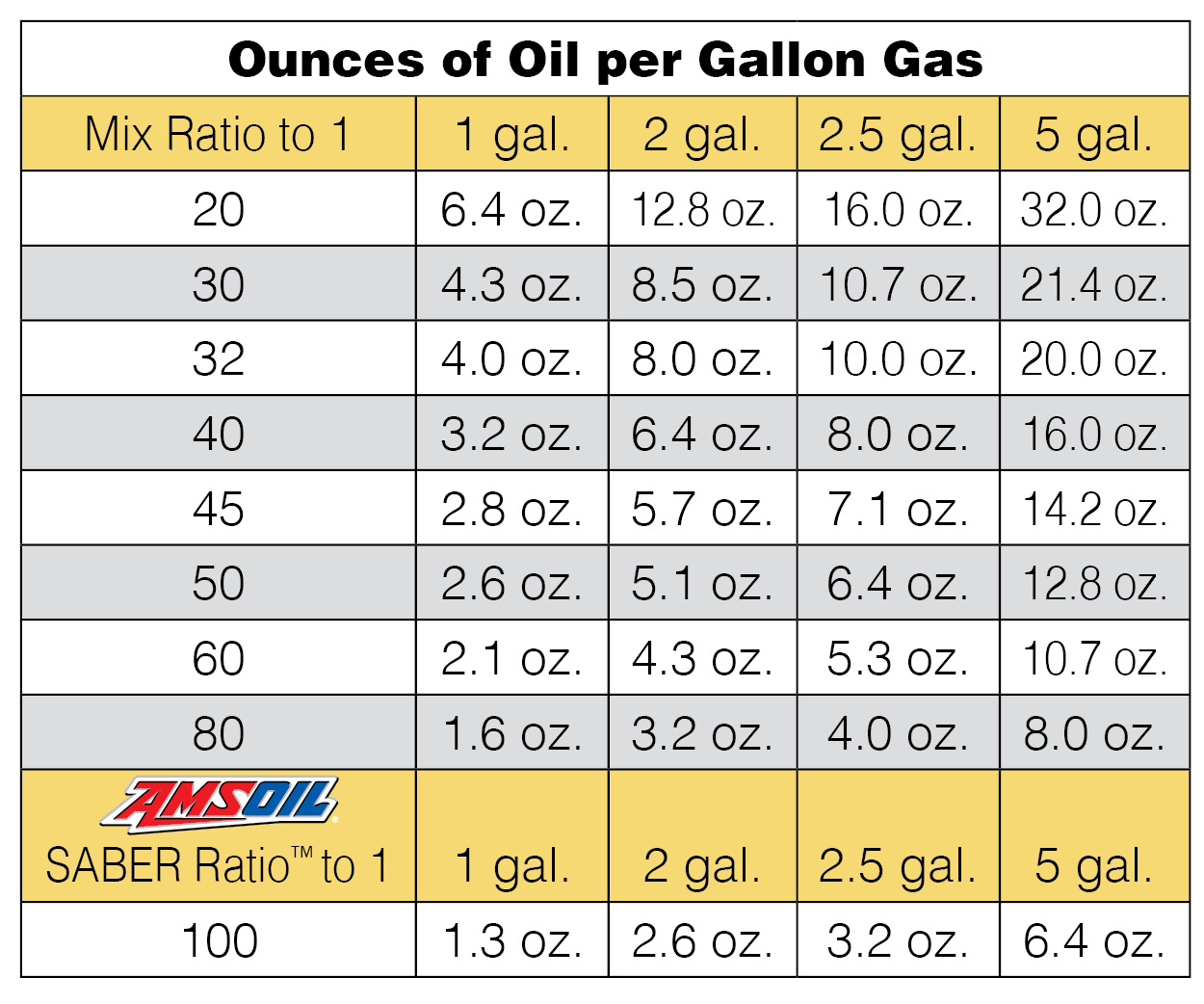
Two-stroke mix ratio chart
| Mix ratio | Oil per 1 U.S. gallon of gas | Oil per 4 litres of gas |
|---|---|---|
| 32:1 | 4.0 oz. | 125 mL |
| 40:1 | 3.2 oz. | 100 mL |
| 50:1 | 2.6 oz. | 80 mL |
| 80:1 (SABER Ratio) | 1.6 oz. | 50 mL |
| 100:1 (SABER Ratio) | 1.3 oz. | 40 mL |
For a 2.5-gallon can, multiply the per-gallon amount by 2.5; for a 5-gallon can, multiply by 5.
Different mix ratios create confusion
Different equipment manufacturers recommend different oil mix ratios, complicating matters. Most modern chainsaws, string trimmers, leaf blowers and other small-engine two-stroke equipment recommend a 50:1 oil mix ratio, but some recommend 40:1 and older two-stroke equipment might even call for 32:1. Multiple pieces of equipment with different mix ratios would traditionally require mixing and storing multiple cans of fuel. That’s not only a hassle, but it’s also a recipe for misapplication.
This scenario can be a big problem for landscapers and other professionals who operate multiple pieces of equipment under heavy use. But plenty of homeowners also maintain older equipment that call for a richer fuel mixture. It would be so much easier if every manufacturer recommended the same mix ratio…



Comments
David Hilgendorf is an AMSOIL Technical Writer who develops content for automotive, powersports and industrial audiences. His work includes technical data sheets, magazine articles, blog posts, white papers, product literature and application guidance. Hilgendorf works with engineers, laboratory personnel and technical specialists to communicate lubricant testing, product performance, maintenance practices, metalworking fluids, grease, motorcycles, marine equipment and industrial reliability.
Share: