


The UTV industry’s upward trajectory is fueled by consumer interest in their unmatched versatility and performance, passion for outdoor recreation and continued technological advancements. Innovations such as enhanced safety features, improved comfort and increased performance broaden the appeal of modern UTVs.
Turbocharging
Manufacturers lean heavily on turbos to make more efficient power. Unfortunately, turbos can spin up to 200,000 rpm, creating tremendous friction and heat that oxidizes oil and causes it to break down faster. Oxidized oil gets thicker, impairing its ability to circulate and protect against wear and deposits, which can also affect sensitive turbo bearings.
The rapid on-and-off throttle action required to push through sand dunes, climb hills and navigate corners creates severe heat cycles that invite deposits, known as turbo coking. Shutting down a hot engine and letting the hot oil bake onto the bearings has the same effect. These effects are amplified when driving in scorching summer heat.
Heavy turbo deposits reduce performance and engine life, potentially leading to costly repairs. It’s up to the oil to cool and lubricate the turbo bearings and shaft to ensure your expensive machine is protected.

Torture Testing
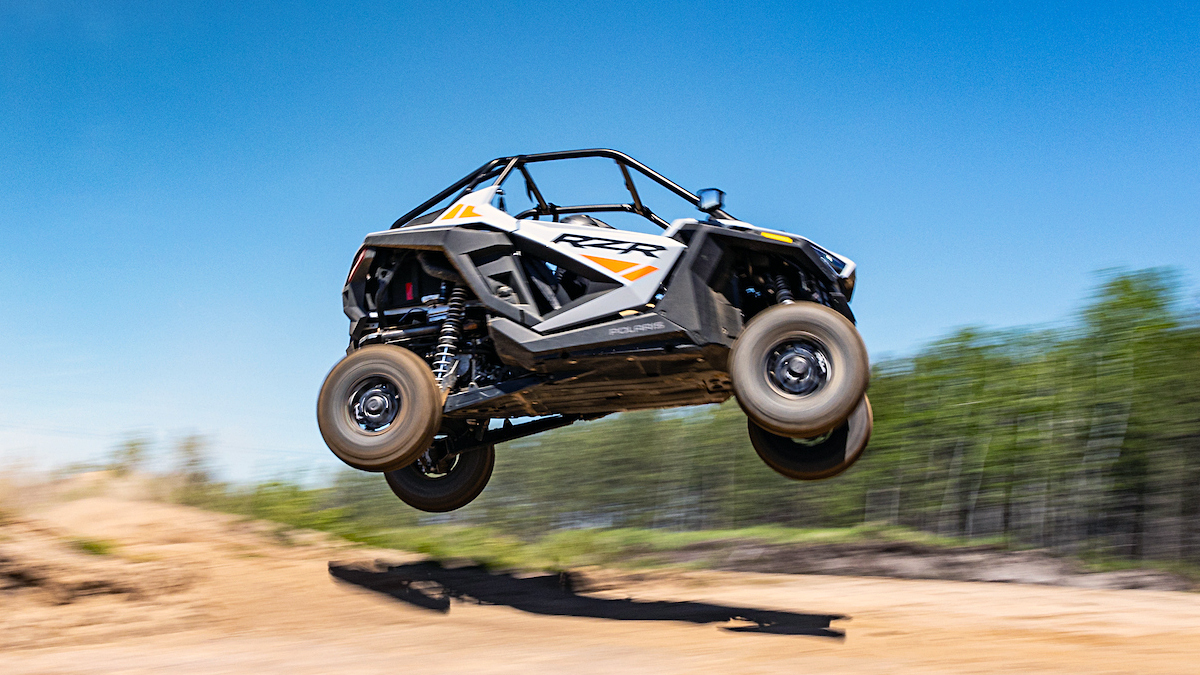
At AMSOIL, rigorous testing is a cornerstone of our commitment to quality. We recently put a 2023 Polaris Razer Pro XP Turbo through its paces using AMSOIL 0W-50 Synthetic ATV/UTV Motor Oil. The comprehensive 50-hour analysis included field data collected under normal operating conditions, followed by intensified testing on our in-house dynamometer.
Sensors were strategically placed on critical components like the oil sump, coolant, and transmission to gather precise data. Key parameters were measured, including acceleration, throttle position and oil temperatures. Our 50-hour test increased intensity by as much as 15% over the course of an entire recommended oil drain interval.

Exceptional Performance
The results of this exhaustive testing were impressive. AMSOIL Synthetic ATV/UTV Motor Oil maintained its integrity throughout the test, with no significant changes in viscosity or signs of oxidation or nitration. The engine and transmission components showed minimal to no wear, with pistons and valve guides appearing like new. Additionally, no abnormal carbon deposits were observed, demonstrating the oil’s capability to prevent performance degradation.
This level of performance indicates metal parts were not making contact. Oil analysis confirmed minimal to no wear metals, underscoring the oil’s ability to protect engine and transmission components.

Peace of Mind
The flawless performance of AMSOIL Synthetic ATV/UTV Motor Oil makes it the best choice for UTV owners who push their vehicles to the limit. AMSOIL products provide the reliable protection, optimal performance and the confidence you need to rider harder, worry-free.
Find out more about this test in the video below.
Video transcript: What happens to a UTV engine when you run it 50 hours straight?
The UTV market continues to grow and at AMSOIL we love to test. So we went out and we got a 2023 Polaris* RZR* Pro XP Turbo and we put it through its paces. We ran what we call at AMSOIL a proof of performance. That’s where we go out and we collect field data as if the machine were to be used by a normal user and then we turn up the intensity of that data and we get it on the dyno.
So we need to understand oil temperatures, acceleration rates, max throttle. We put sensors on the oil sump. We put sensors on the coolant, boost pressure, temperatures of the transmission, temperatures of the CVT belt. So we build a run profile based on the data collected in the field.
We then turn up the intensity and in this case it was turned up 10 to 15 percent depending on the run cycle. Total time for this test was 50 hours. That is the recommended oil drain interval for this machine. The oil being used AMSOIL ATV UTV 0W50.
Once the machine is on the dyno and running it’s a waiting game we get through 50 hours of testing and it’s time to take it apart and look at the results. So in this case we’ll be looking at the engine and the transmission. The pistons, crowns of the piston. Minimal depositing.
The under crown of the piston. No depositing at all. The piston looks almost new. This area gets very hot so if you’re going to see depositing that’s an area where you will see staining in a situation where the oil may not be doing its job.
So in this case they look excellent. Perfectly clean. Valve guides look excellent. No abnormal wear.
No depositing at all. The valves themselves we pull those out for an inspection. We look at the stems. We look at the seeds.
They look excellent. There’s no staining. There’s no indications that the valves were carboned up and leaking which can be the case. In certain situations where the oil may not be doing its job you can get a piece of carbon that could hold a valve off its seat and you might end up getting some kind of a leak.
You start losing performance. In this case everything looks beautiful. No issues at all. Valves were sealing perfectly.
From there you move to the cylinders. You can still see the cross hatching in the cylinders. We’re used to this at AMSOIL. We understand how these machines work.
We understand how to build oil. So it’s not surprising when we see really clean cylinders. That means that you’re keeping the oil in that cylinder to keep everything lubricated. Everything is sealing.
The engine retains the power that it had at the beginning of the test all the way through the engine’s life. From the cylinders we move to the valve train. We disassemble all the small parts of the valve train and we look at them individually. So you start with the camshaft.
There’s no sign of anywhere on the cam. The lobes look great. The bearing journals look great. We move to the intake and exhaust lifters.
They look great as well. Sometimes you’ll see staining with an inferior product, with excess heat. In this case here everything’s clean. No staining.
No wear. From there we look at bearings. These are critical areas that tell you whether or not the oil is doing its job. If you are going to see wear in a turbo application you’ll see it on the upper shell of the rod bearing because you’ve got increased pressure coming down on that from the turbo.
The case here the bearings look as good as when we put them in. Main bearings are the same case. All indications are viscosity was providing protection required to keep this motor looking excellent. We look at oil analysis throughout the test and in this case we sampled every 10 hours.
We have oil samples from 10, 20, 30, 40 and then 50 which would represent end of test. We track things like viscosity. How much does the viscosity change? We look at things like oxidation, nitrogen.
Is there a fuel buildup problem? Are there things going on in the oil that would tell us that it’s not doing its job? In this case all of the results are positive. We are not seeing excess amounts of viscosity changed.
The oil did not oxidize due to heat. We don’t have a fuel dilution problem and there’s plenty of reserve capacity for this oil to continue to protect. We look at the wear metals from the same oil samples at the same drain interval and there are no wear metals to report. So there are no metal parts touching which is the oil’s main job is to make sure no metal parts actually touch.
It’s done that here extremely well. We have virtually zero wear metals across the entire 50-hour test interval. The transmission on the Polaris is a CVT but there’s still a gearbox to move the power from the engine through the CVT out to the wheels. So we do look at the transmission on this test.
Transmission was tested the same amount of time. It was a 50-hour test and at the end we look at oil analysis and we do a full tear down same as the engine. Oil analysis on the transmission is the same story as the engine. Very little to no wear metals, very little viscosity loss indicating to us that the oil is more than up to handling the job, you know, even in this turbocharged Polaris.
So the results are in. AMSOIL ATV UTV 0W50 performed flawlessly. We showed you the test, we showed you the results and if you own one of these machines and you’re out taking it to the limit, have confidence that AMSOIL has you protected.
This article is part of our ATV/UTV Oil and Maintenance guide. See every article in the guide.


Comments
David Hilgendorf is an AMSOIL Technical Writer who develops content for automotive, powersports and industrial audiences. His work includes technical data sheets, magazine articles, blog posts, white papers, product literature and application guidance. Hilgendorf works with engineers, laboratory personnel and technical specialists to communicate lubricant testing, product performance, maintenance practices, metalworking fluids, grease, motorcycles, marine equipment and industrial reliability.
Share: