

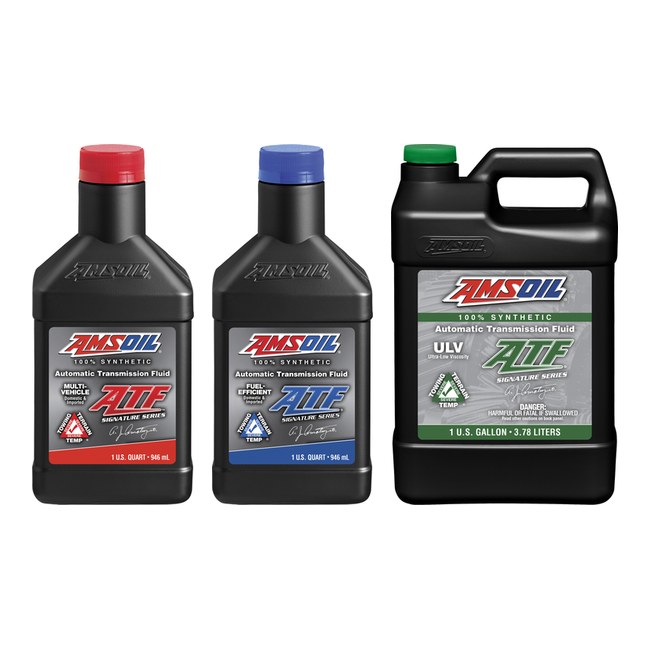
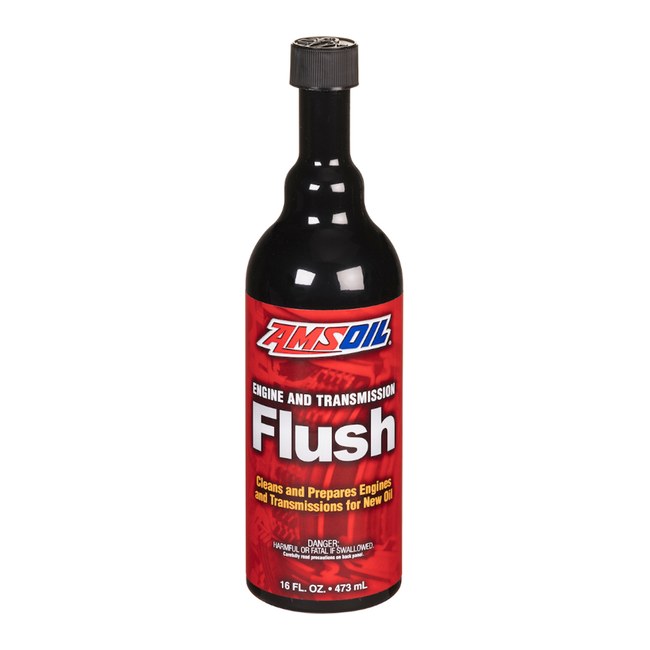

The short answer: Use the automatic transmission fluid specification your owner’s manual lists, such as DEXRON VI, MERCON V or ATF+4, because each automaker writes its own standards. A multi-vehicle synthetic ATF that lists your specification simplifies the choice. For towing, hauling and other severe service, we recommend AMSOIL Signature Series Multi-Vehicle Synthetic ATF.
Video transcript: What’s the Deal with Transmission Fluid?
Featuring John Gardner, host of Motorhead Garage, and Leonard “Len” Groom, AMSOIL Director of Product Marketing (author profile).
John Gardner: First gear, second gear, third gear, fourth gear; you get the point. There are up to 10 gears in automatic transmissions today. Welcome to this AMSOIL Tech Tip. What’s going on inside there? All kinds of stuff. It starts right here at the torque converter. Then it goes through a pump, which develops fluid pressure, and then it has to go through all these planetary gear sets and clutches in order to achieve those gears. Not an easy thing to do. Right here, you can see it. That thing is riddled with different parts inside to make these gears happen.
But the key is these clutch plates and clutch packs. What happens there? Well, they squeeze together. They’re either holding or driving some member of that transmission to achieve these gears. Len, it’s a hard job, and this thing uses line pressure to get it done. You have these steel plates and then these clutches. We put them in a clutch pack, and then line pressure, bam, squeezes them together. And we may even be holding this with a band. Think about the abuse the fluid has to take.
Len Groom: Right. The fluid is doing a couple of jobs here. It has to deal with the heat, but it’s also providing that line pressure. And as temperatures go up, fluid tends to get thin, which compounds the problem. So you have to make sure you’re using extremely solid technology, which AMSOIL does with our automatic transmission fluids, because we understand all the stuff you just talked about. We use very robust base oils that can handle the heat. We don’t want things to oxidize, so we include the proper additives to make sure the fluid will take the heat and won’t allow slipping, because we know heat and slip are what kill a transmission.
John Gardner: And you mentioned it earlier: these computers today boost line pressure. They hold it; they boost line pressure. Sometimes you don’t even feel the slip today, and then all of a sudden it just gives up. So this thing could be slipping, and you don’t know it. It’s important to change that fluid, right?
Len Groom: You want to maintain it. Check your manufacturer’s recommended interval. Of course, that’s what we recommend. Make sure your fluid is fresh, especially if you’re towing or really working that vehicle.
John Gardner: Yeah, that transmission alone could cost up to $10,000. Make sure you’re taking care of yours. For all your service needs, just go to amsoil.com.
Finding out which automatic transmission fluid you need can be challenging. Original equipment manufacturers (OEMs) each develop their own standards and naming conventions. Here are just a few of the dozens of automatic transmission fluid (ATF) specifications on the market:
-
- ATF+4 (Chrysler*)
- DEXRON VI (GM*)
-
- DEXRON ULV
- MERCON V (Ford*)
-
- MERCON ULV
- ATF-WS (Toyota*)
- DW-1 (Honda*)
It’s easy to get analysis paralysis when scanning local retailer shelves for the correct automatic transmission fluid for your vehicle. You may only need a quart or two to top-off your vehicle, but instead you must decipher a series of acronyms, or worse, risk your transmission not performing properly.
Which transmission fluid?
To answer that question, start with your vehicle owner’s manual. It will identify which transmission fluid meets the manufacturer’s performance requirements, and is likely to include one of the specifications listed above.
The most recognizable automatic transmission fluid specifications are Ford MERCON and GM DEXRON. At one time, MERCON and DEXRON ATFs dominated the market, reducing available choices to a manageable few.
Today, demand for those more standardized fluids is declining as more OEMs introduce their own, proprietary transmission fluid specs.

ATF specifications
ATF specifications are a set of performance standards from the OEM, not an actual fluid name. That means you don’t go to the store in search of MERCON or DEXRON transmission fluid, rather a fluid that meets the MERCON or DEXRON specifications.
When trying to make selection easier for consumers, many manufacturers print ATF specs in giant letters on the label. This indicates the fluid passed a series of performance tests stipulated by the manufacturer that created the particular ATF specification. However, many people end up confusing the ATF specification on the label as an OEM brand name.

Confusing specifications
It’s normal for most OEMs to author their own performance specifications, rather than recommend using a fluid that meets a different OEM’s specification. There is also a financial incentive, as the OEM wants you to buy its branded transmission fluid instead of another company’s fluid. This certainly helps explain why OEM-branded fluids are often the most expensive.
Automatic transmissions are a complex puzzle of constantly moving metal parts. Excessive heat is the number one cause of early transmission failure. New ATF specifications are driven primarily by technological advancements and fuel economy standards that cause modern transmissions to create even more heat.
For instance, an automaker introducing a 10-speed automatic transmission to improve fuel economy also needs to ensure the transmission fluid can stand up to the intense heat and stress created by churning through all those gears.
As technology advances, specifications are leveled up to match. DEXRON became DEXRON II, then DEXRON III, then DEXRON VI, to support 6-speed automatic transmissions when they were first introduced.
A higher number or letter is typically backward compatible with the prior version. For example, ATF+4 is compatible with vehicles requiring ATF+2, and DEXRON VI can be used in place of the original DEXRON. However, there are some low-viscosity and high-performance exceptions to this backward compatibility rule, which we will cover a bit later.
Cut the confusion
AMSOIL makes transmission fluid selection easy by meeting the performance demands of the most common automatic transmissions.
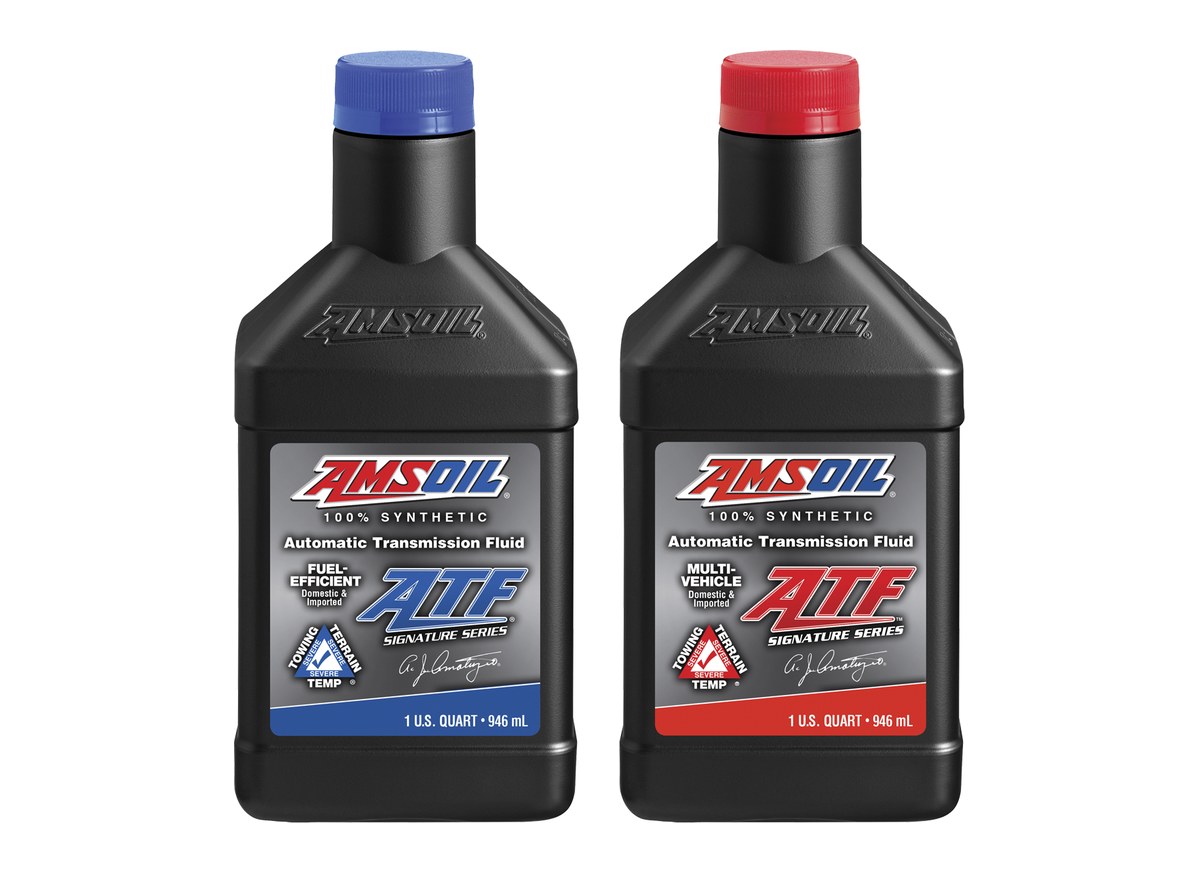
If you tow, haul, race or engage in other types of severe service, we recommend AMSOIL Signature Series Multi-Vehicle Synthetic ATF to provide the best possible protection against heat for your transmission.
For primarily freeway driving and commuting, AMSOIL OE Multi-Vehicle Synthetic ATF is a cost-effective alternative that takes the guesswork out of ATF selection. Both fluids are recommended for the most common ATF specifications and their predecessors. These specifications cover most vehicles more than 20 years old and many newer vehicles, too, including:
-
- Chrysler ATF+4 or earlier
- Ford MERCON V or earlier
- GM DEXRON III or earlier
- BMW* 7045E, 8072B, LA2634, LT71141
-
- Honda ATF-Z1
- Hyundai* Kia* Red-1, SP-III or earlier
- JASO 1A
- Mazda* F-1, ATF-MV or earlier
- Mercedes-Benz* 236.91 or earlier
- Mitsubishi* ATF-J2, SP-III or earlier
- Nissan* 402, Matic-K or earlier
- Subaru* ATF, ATF-HP
- Toyota Type T-IV or earlier
- VW* G052162, G052990, G055025
Reserve protection after 180,000-mile severe-service test
It’s easy to say AMSOIL will outperform other fluids at the above tasks, but what’s the evidence?
To demonstrate its capabilities in severe service, Signature Series Synthetic ATF was installed in a fleet of Las Vegas taxi cabs and subjected to a 180,000-mile (289,700-km) severe-service test. The vehicles routinely endured demanding stop-and-go driving while loaded with passengers and cargo in extremely hot desert temperatures, placing tremendous stress on the fluid. Following 180,000 miles (289,700 km), a transmission was selected for analysis.
After 180,000 miles (289,700 km) of severe service, an independent, third-party lab revealed that Signature Series Synthetic ATF resisted oxidation longer than required for new fluid to meet the Chrysler* ATF+4 specification.
The Aluminum Beaker Oxidation Test (ABOT), an industry-standard test used to determine a transmission fluid’s oxidation resistance, showed that Signature Series contained 83% of its original oxidation inhibitors, proving its long-lasting resistance to thermal breakdown. The graph below shows that AMSOIL ATF continued to offer reserve protection against heat after 180,000 miles of severe service.
Reserve protection against heat after 180,000 miles

Highest rating in FZG Gear Wear Test
What does AMSOIL reserve protection mean to vehicle life?
Varying speeds and loads, like those experienced by the Las Vegas taxi cabs, cause torque multiplication and extreme stress on gears and bearings. AMSOIL formulated Signature Series Synthetic ATF with high film strength and premium anti-wear/extreme-pressure additives to help prevent wear during tortuous service. Did we succeed? We put our ATF to the test to find out.
Used oil from the 180,000-mile Las Vegas taxi-cab severe-service test was subjected to the industry-standard FZG Gear Wear Test, which measures a lubricating fluid’s ability to resist gear-tooth scuffing. AMSOIL Signature Series Synthetic ATF passed all 12 progressively difficult stages with no noticeable difference in wear protection between new and used fluid.
The used oil still exceeded the Ford* MERCON V and Chrysler ATF+4 specifications for new fluid.
Notice in the images below that, even after 180,000 severe-service miles (289,700 km), the transmission’s valve body was clean and virtually sludge-free. The clutch plates demonstrated only trace discoloration and earned a rating of “good,” the highest possible designation for deterioration and wear.


Outstanding friction durability
AMSOIL Signature Series Synthetic ATF is formulated with friction-modifier additives that deliver outstanding clutch-holding capacity (static friction), torque-transfer ability (dynamic friction) and anti-shudder properties (slipping torque-converter clutches).
Analysis reveals that after the 180,000-mile severe-service test (289,700 km), Signature Series Synthetic ATF provided nearly identical friction properties as new fluid for smooth, reliable shifts.
Outstanding cold-weather performance
If you live in a cold climate, performance at startup can be an issue.
Signature Series Synthetic ATF resists thickening in winter weather, allowing for fast, reliable shifts during cold starts. Its excellent low-temperature fluidity also maximizes fuel efficiency. How can that be? Unlike conventional oils, Signature Series Synthetic ATF contains no wax, which helps improve shift response, energy efficiency and warm-up times.
Reliable leak protection
Formulated with seal conditioners, Signature Series Synthetic ATF helps prevent seals and gaskets from drying out and cracking, reducing the risk of fluid leaks.
Extended drain intervals for severe-service vehicles
Because Signature Series Synthetic ATF resists oxidation and shearing, vehicles used for severe service can double the OEM’s recommended severe-service drain interval, saving you time and money.
Easy-pack design
Sometimes packaging is more than window dressing. The innovative AMSOIL easy-pack flexible-package design promotes less waste and easier fills, especially as fill ports become harder to access. As one customer put it, the easy-pack is a “game-changer” by eliminating the mess and waste that occurs with traditional ATF packaging.
Ultra-low viscosity
In 2017, Ford and GM collaborated on the ultra-low viscosity (ULV) automatic transmission fluid specifications to help meet aggressive global fuel-efficiency standards. These ATFs were introduced along with newer 10-speed automatic transmissions, which are common in modern Ford Mustangs, Ford F-150s, Chevy Camaros, Cadillac Escalades, and other recent models from these marques.
These newer high-performance and high-efficiency transmissions use ultra-low-viscosity transmission fluid to help reduce energy lost to friction to help maximize fuel economy.
Although MERCON ULV and DEXRON ULV are not backward compatible with earlier versions of their respective ATFs, AMSOIL Signature Series Fuel-Efficient Synthetic Automatic Transmission Fluid is suitable for use in applications that require MERCON ULV, DEXRON ULV or any of the following fuel-efficient specifications:
- Chrysler MOPAR* x5AA, x5AB, SP-IV
- Ford MERCON SP, LV, ULV
- GM DEXRON VI, HP, ULV
- BMW 83220142516, 83222152426
- Honda DW-1, Type 3.0
- Hyundai/Kia NWS-9638, SP-IV series
- JASO 1A-LV
- Mazda ATF FZ
- Mercedes-Benz 236.12, 236.14, 236.15, 236.41
- Mitsubishi SP-IV, ATF J3, ATF-PA, ATF-MA1
- Nissan Matic-S, Matic-W
- Toyota WS
- Volvo 31256774
- VW/Audi G055005, G055162, G 060162
How to check transmission fluid
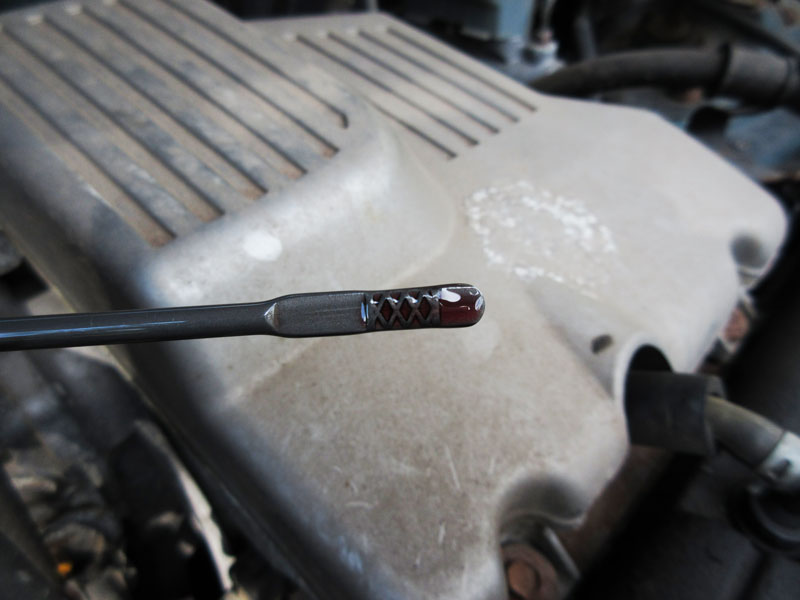
It’s a good idea to check your vehicle’s transmission fluid several times a year to monitor fluid level and condition. Check the fluid immediately if your transmission jerks, hesitates or shifts hard. Here’s how:
- Warm the transmission
Obtaining a correct reading on the dipstick requires the fluid to be warm and the engine to be running. Park your vehicle on a flat surface, apply the parking brake and idle the engine until warm. It helps to drive the vehicle first to raise the temperature quickly. Some OEMs also recommend shifting through the gears to circulate the fluid prior to checking, so consult your owner’s manual. - Locate the dipstick
Pop the hood and locate the transmission fluid dipstick, which serves double duty as the fill tube. It’s often located near the back of the engine compartment and shouldn’t be too tough to find. You can always check the owner’s manual for the location if it proves elusive. - Check the fluid level
Pull the dipstick and wipe with a clean rag. Insert the dipstick until it’s completely seated. Withdraw it and check the fluid level. The dipstick may have a cross-hatch pattern in which the fluid level should fall. Others may have “hot” and “cold” line markings. The fluid should be close to the hot line. - Add fluid if neededIf the fluid is low, add the recommended transmission fluid to bring it to the correct level. Use a long-neck funnel with a small diameter opening to make the job easier.
Comments
David Hilgendorf is an AMSOIL Technical Writer who develops content for automotive, powersports and industrial audiences. His work includes technical data sheets, magazine articles, blog posts, white papers, product literature and application guidance. Hilgendorf works with engineers, laboratory personnel and technical specialists to communicate lubricant testing, product performance, maintenance practices, metalworking fluids, grease, motorcycles, marine equipment and industrial reliability.
Share: