


What is oil viscosity?
The short answer: Viscosity is a fluid’s resistance to flow, its internal friction. It’s measured as kinematic viscosity (flow under gravity, in centistokes) and dynamic viscosity (resistance under force, in centipoise), and viscosity index describes how much it changes with temperature. Oil that’s too thin invites wear and consumption; too thick raises friction and temperature and slows cold-start flow.
The physical properties of lubricants are measured by characteristics like viscosity, shear stability, high- and low-temperature performance, water resistance and volatility. Lubrication science seeks to optimize a lubricant’s performance by managing these properties using different base oils and additives. A lubricant’s viscosity and how it changes under different temperatures and operating conditions is one of the most important properties that determines lubricant performance and protection.
When external forces such as gravity act on a fluid, the molecules within the fluid begin to move against each other, resulting in molecular-level friction that resists flow. The greater the internal friction, the higher the viscosity of the fluid. How the viscosity of a fluid reacts to changes in temperature and pressure determines how well a fluid can perform the basic functions of a lubricant.
Lubricant base oils thicken as they cool and will solidify when the temperature drops below a certain threshold, called pour point. Thickening increases the lubricant’s load-carrying capabilities, but its ability to circulate becomes significantly impaired. On the other hand, lubricants get thinner when heated, decreasing their ability to carry a load and prevent metal-to-metal contact.
Extreme pressure can also lower viscosity, called mechanical shear, decreasing the lubricant’s film strength and ability to prevent metal-to-metal contact and wear. However, attempting to counter this by choosing a higher viscosity can cause oil starvation as it won’t flow freely through smaller passages. Proper viscosity for the intended application is critical to ensure oil circulates properly and provides adequate film strength under pressure.
Video transcript: Understanding Motor Oil Viscosities
Featuring John Gardner, ASE Master Certified technician, automotive technology instructor and host of Motorhead Garage, with AMSOIL Director of Product Marketing Len Groom (author profile).
John Gardner: So many motor oils, so many types of motor oils, and so many different viscosities when it comes to motor oils. Which one should we put in our vehicle? Welcome to this AMSOIL tech tip. It’s all about motor oil and viscosities, and I brought in Len an expert.
Why do we have an expert? Well, Len, I kinda got a rudimentary experiment when it comes to oil and how to explain viscosity. And what we did a little bit earlier is we took some twenty w fifty weight oil and we dropped a ball in it. And it’s all kind of controlled.
The temperature’s controlled. You can see the ball going kind of slowly down there in that little vial as it drops down because that oil’s thick. That’s what viscosity means to me. Then we went ahead and got the zero w twenty oil, and we did the same test.
We dropped the ball in, and when we dropped the ball in, man, you can see that one’s running right down. Kind of a controlled environment, but it seems a lot thinner. I know that’s kind of rudimentary, but take us through that viscosity as an expert.
Len Groom: That gets you there as a test. That’s why I kind of like that. It gives you a real down and dirty look at what viscosity actually means. But in actual terms, multi viscosity oil, meaning oil that has two numbers.
Generally, the first number would be your cold temperature, pumpability number. So generally taken at, you know, room temperature or lower in most cases, zero w, ten w. That’s your low temperature number. So how is the oil going to act when it’s cold?
The other number is the interesting part. The other number is the oil’s actual weight, but that weight is only accurate at two hundred and twelve degrees f, also known as a hundred Celsius. Okay. That is a standard at which all motor oils are graded in their weight.
So if we have a zero w twenty, it’s only a twenty weight at a hundred c or two hundred and twelve f. All oils, all synthetic oils are not created equal. The better the base oil that you start with in the product with the less additives that you have to add, you’ll see more consistency. You’ll see more consistent pressure across a wide temperature band.
Those are the those are the products that we use in our in our signature series product.
John Gardner: Just too easy. Go to AMSOIL.com.

Measuring viscosity
In simple terms, viscosity is the measurement of the internal friction of a liquid, or its resistance to flow. A lubricant’s viscosity range is typically indicated using a kinematic and dynamic grading system, such as those established by the Society of Automotive Engineers (SAE) or the International Organization for Standardization (ISO).
Requirements for gasoline and diesel motor oils include the SAE J-300 Engine Oils Viscosity Classification and the American Petroleum Institute (API) Service Classification, among others. These tests are designed to replicate specific operating conditions, allowing formulators, original equipment manufacturers (OEMs) and consumers to understand each lubricant’s functional characteristics and limitations.
- Low-viscosity fluids may be described as thin and light.
- High-viscosity fluids may be described as thick and heavy.
- Low-viscosity motor oil (0W-20) flows faster than high-viscosity oil (20W-50).

Kinematic viscosity
Kinematic viscosity is the lubricant’s resistance to flow and shear due to gravity. To illustrate, imagine pouring two containers, one filled with water and the other with honey. Each fluid’s kinematic viscosity governs the rate at which it flows. Since the kinematic viscosity of water is lower, it flows faster.
Kinematic viscosity, measured using ASTM D445 methodology, determines an SAE oil’s high-temperature or operating temperature viscosity rating — the “30” in 5W-30 motor oil.
The kinematic viscosity test attempts to simulate viscosity at normal operating conditions for a passenger car or light truck. The test is performed at 100°C (212°F) and/or 40°C (104°F), depending on the grading system being used.
The value at 100°C is used to determine the SAE viscosity grade, by measuring how long the oil takes to completely flow from a viscometer device heated to 100°C. The elapsed time in seconds is converted to centistokes (cSt). Lower values reflect lighter-viscosity oils.
Dynamic (absolute) viscosity
Dynamic viscosity is defined as the lubricant’s resistance to flow measured by resistance. Imagine the amount of energy required to move a solid object through the fluid. It takes less energy to stir water compared to honey because the dynamic viscosity of water is lower.
Dynamic viscosity is measured by the Cold Crank Simulator (CCS) test (ASTM D5293). Dynamic viscosity determines an oil’s low-temperature, winter or “W” viscosity rating — the “5W” in 5W-30 motor oil. The lower the “W” rating, the faster the oil flows when cold and the easier it is for the engine to turn over when starting.
The CCS viscosity test evaluates the amount of energy it takes to start an engine at a specified temperature; the lower the viscosity grade, the lower the temperature at which the test is performed. The test assigns a value in centipoise (cP), used to determine the viscosity grade.
Using Signature Series 5W-30 as an example, its viscosity at -30°C (-22°F) can be no greater than 6600 cP to receive a 5W grade. Lower values reflect lighter-viscosity oils.

Viscosity Index
The Viscosity Index (VI) of a lubricating fluid refers to how much the viscosity of the fluid changes due to temperature. A high VI (above 95) indicates the fluid undergoes little viscosity change due to temperature fluctuations, while a low VI indicates a relatively large viscosity change.
Fluids with a high VI provide more protection to critical components over a wide range of temperatures by maintaining fluid thickness and the necessary fluid barrier between parts. The Viscosity Index Test (ASTM D2270) is based on the kinematic viscosity of the fluid at 40°C (104°F) and 100°C (212°F).
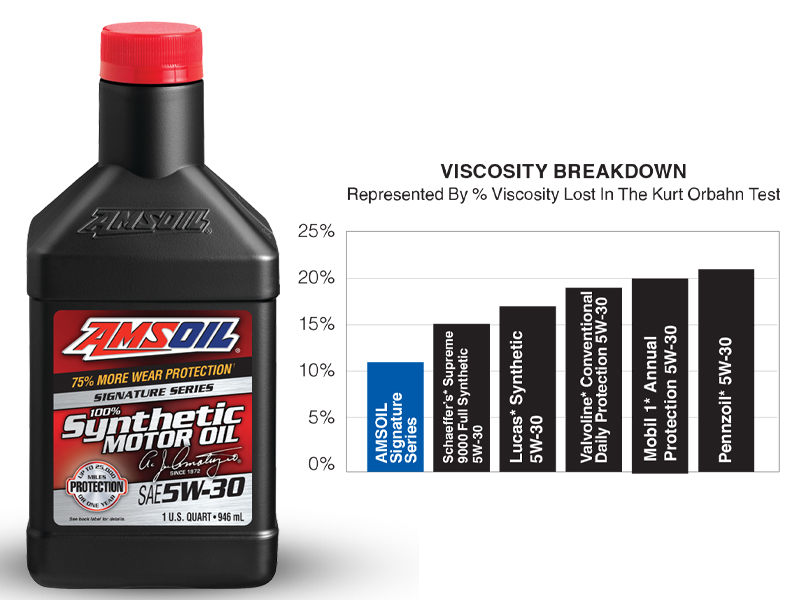
Synthetic fluids typically have much higher VI numbers compared to conventional fluids, meaning they provide improved protection to critical components over a wider range of temperatures.
AMSOIL synthetic lubricants boast high VI numbers, meaning they’re more stable than competing lubricants under extreme temperatures and pressures, so you can count on them to deliver outstanding protection, even under unpredictable operating conditions.




Comments
David Hilgendorf is an AMSOIL Technical Writer who develops content for automotive, powersports and industrial audiences. His work includes technical data sheets, magazine articles, blog posts, white papers, product literature and application guidance. Hilgendorf works with engineers, laboratory personnel and technical specialists to communicate lubricant testing, product performance, maintenance practices, metalworking fluids, grease, motorcycles, marine equipment and industrial reliability.
Share: