

Motor oil has drawn more than its fair share of myths. Its central role in vehicle longevity and performance has been understood since the beginning of the auto age. But, as generations have passed, motor oil myths have been born and survived, even as vehicle and motor oil technology have evolved. Some persist to this day. Here are the most common motor oil and car maintenance myths followed by our mythbusting facts of each case.
Video transcript: Vehicle Myth Busting: Car Batteries & More
Featuring John Gardner, host of Motorhead Garage, and Leonard “Len” Groom, AMSOIL Director of Product Marketing (author profile).
John Gardner: Well, you ever heard that before? Went out to start your car? Probably have a dead battery most likely. Welcome to this AMSOIL tech tip.
Yes, we’re talking about batteries. What do they do? Well, they supply all the electrical need when the car is not running. The alternator is supposed to supply when it’s running.
Well, with all the heavy demands today, the battery is gonna take the brunt of it all. So here’s the deal. When we talk about batteries, we have to look inside. Different cells, they’re built up with elements, the grids, the plates, they put them together and what you get is you get a little cell here.
There’s one, two, three, four, five, six cells and a 12 volt battery, each one of them producing 2.1 volts which gives you that 12.6 volts. Actually have one right here on the table for you.
You can see it right there. The cells are located right here. There’s one of them. Then there’s two, three, four, five, six throughout this battery.
And that’s what’s making the pressure, the electromotive force. The battery is the pressure maker. Now this kind of staggered me a little bit when I looked at it because it shows us a fully charged battery is 12.6 volts and then believe it or not, a 25% charged battery is 12.06
volts. It just can’t push the amperage. An OCV, open circuit voltage, well that’s real simple. Just take a voltmeter, go across the two terminals, make your reading, and you can determine the state of charge of the battery.
Now, if you have a battery that’s a maintenance battery where you can get in there and service it, well, you can take a hydrometer like this and you can read it. Inside of a battery is sulfuric acid and water that makes up electrolytes. The more sulfuric acid, the more charged it is. The more water, the less charged it is.
You can also use a refractometer like this. Just put a drop on there, look through it, and what are you looking at? Well, you’re looking at the specific gravity there. Anything good 1.30
or higher, you’ve got a lot of sulfuric acid, you’ve got a pretty good charge. And that’s it for your battery, Len. Have you ever heard a couple of myths when it comes around the batteries, like you can’t leave it on the concrete, it’s going to discharge?
Len Groom: Yep, I’ve heard that one.
John Gardner: Yeah, you know, that’s actually debunked because here’s the deal, they’re old tar cases, the polypropylene don’t do that. Now I know there’s a lot of myths that revolve around oils too. You as the expert, wonder if you can help us with some of this here.
Len Groom: I can try.
John Gardner: Awesome. The first one says motor oil must be changed once it’s turned black.
Len Groom: That is not true. The motor oil turning black is the motor oil doing its job.
The only way you would know for sure is to run an oil analysis.
John Gardner: Awesome. What about this one, the myth? You must change your oil at every 3,000 miles.
Len Groom: That is also not true, and that’s been proven not true by the OEMs. Most of them are five to 7,500 miles now on your minimum oil changes.
John Gardner: Now, AMSOIL, you guys got a product that goes way beyond that.
Len Groom: We do. We have product that’ll go up to 25,000 miles. We also have products that’ll do just the OEM change intervals. It’s basically what you’re comfortable with.
John Gardner: Man, it’s my favorite oil. What about this one? You can’t mix synthetic with conventional oil.
You can do it. We don’t recommend that you do it.
Len Groom: Most of the time, we run the testing to make sure that they’re compatible.
We don’t recommend it because things that can happen, additive concentrations can change. There isn’t a real risk of damage, we just don’t recommend it.
John Gardner: And plus synthetic’s the best, why would you want to?
Len Groom: Exactly.
John Gardner: Here’s the other last one here. Once you switch to synthetic oil, you can’t go back.
Len Groom: That is not true. The engine doesn’t know what you’re putting in it, so you can run a synthetic and you can run a conventional without any issues. We, of course, recommend staying with a synthetic because it provides, you know, such superior wear protection.
John Gardner: Absolutely. Now that we debunked Oil Myths, jump over to amsoil.com and you can shop with confidence.
Myth 1: Motor Oil Must Be Changed Once It’s Turned Black
Fact: Not necessarily. Motor oil naturally darkens due to heat cycles as your engine runs. Additionally, the detergent and dispersant additives hold contaminants in suspension and prevent them from adhering to engine parts, which can turn the oil black.
In fact, motor oil that has turned black can be a sign that the additives are doing their job. Follow the oil-change guidelines for your vehicle to know when to change oil. If you want to be more precise, used oil analysis will also tell you precisely when the oil needs to be changed.
This post explains why motor oil turns black and whether that signals the time for a change.
Myth 2: You Must Change Oil Every 3,000 miles (4,800 km)
Fact: Quick-lube chains adopted and amplified this message in the 1970s to keep customers coming back.
Today, motor oil and engine technology are far more advanced.
Just like you no longer change ignition points or add water to your battery, you no longer need to change oil every 3,000 miles (4,800 km).
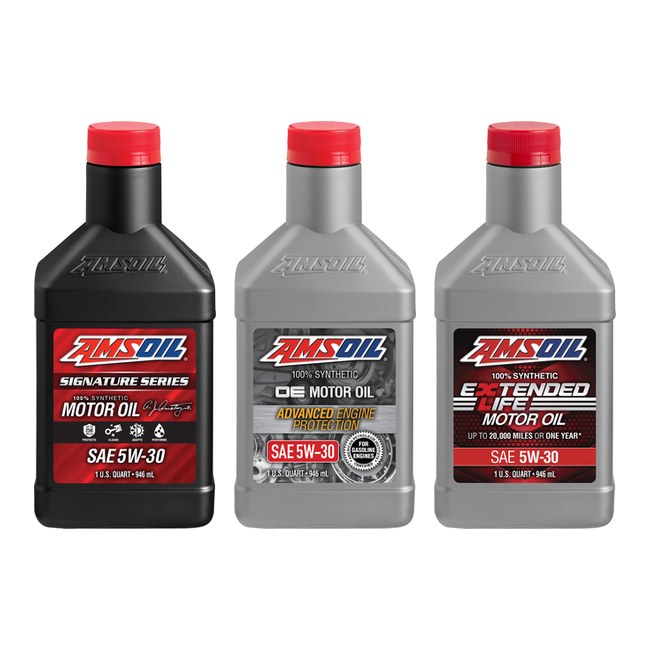
Automakers recommend longer oil-change intervals, with many up to 10,000 miles (16,000 km) and longer, thanks to oil-life monitoring systems. And premium synthetic motor oils, like AMSOIL Signature Series Synthetic Motor Oil, last up to 25,000 miles (40,000 km) or one year.
Check out this post for more about the 3,000-mile oil-change myth.
Myth 3: You Can’t Mix Synthetic and Conventional Oil
Fact: Synthetic and conventional motor oil are made of the same basic components: base oils and additives.
Although the base oils and additives in synthetic oil are superior to their conventional counterparts, they are compatible and can safely be mixed. In fact, that’s what synthetic-blend motor oil is – synthetic and conventional oil already mixed for you.
While safe, we recommend avoiding it if possible; mixing the two detracts from the performance of the synthetic oil.
This post provides a deep dive on whether it’s safe to mix synthetic and conventional oil.
Myth 4: Once You Switch to Synthetic Oil, You Can’t Go Back
Fact: It’s perfectly safe to switch from conventional oil to synthetic oil and back again. The two are compatible and doing so won’t harm your engine.
A better question might be: after using synthetic motor oil and experiencing its improved performance capabilities, why would you switch back?
Myth 5: Synthetic Oil Causes Engines to Leak Oil
Fact: In older, poorly maintained engines, deposits and varnish can “paper over” worn, cracked seals. The improved detergents in synthetic oil sometimes remove these deposits and expose the worn seals underneath.
In some instances, that can lead to leaks. Here’s the distinction: the oil didn’t cause the problem, rather the worn-out seals did. In fact, a good synthetic oil, like AMSOIL synthetic motor oil, conditions seals to help them remain pliable to prevent leaks. Therefore, the best solution is to use a quality synthetic motor oil before seals reach that condition.
Myth 6: You Must Use the Dealership to Keep Your Warranty
Fact: You do not. What matters is that scheduled maintenance is performed on time and documented, not who performs it. Keep records and receipts for the work and any qualified shop will do.
Myth 7: Inflate Tires to the Pressure Shown on the Sidewall
Fact: That number is the tire’s maximum pressure, not the recommended pressure. Use the figure on the placard in the driver’s door jamb or in the owner’s manual.
Myth 8: Warm Up Your Engine for Several Minutes Before Driving
Fact: On a modern engine, extended idling wastes fuel and delays the warm-up it is meant to help. Give it about 30 seconds, then drive gently until it reaches operating temperature.
Myth 9: Running the Air Conditioning Hurts Fuel Economy
Fact: At highway speed the penalty is small, and open windows add enough drag to cost about as much. Use the air conditioning when you need it.
Recommended AMSOIL products
Start with AMSOIL synthetic motor oil and find the exact AMSOIL products for all your vehicles with the AMSOIL Product Guide.