
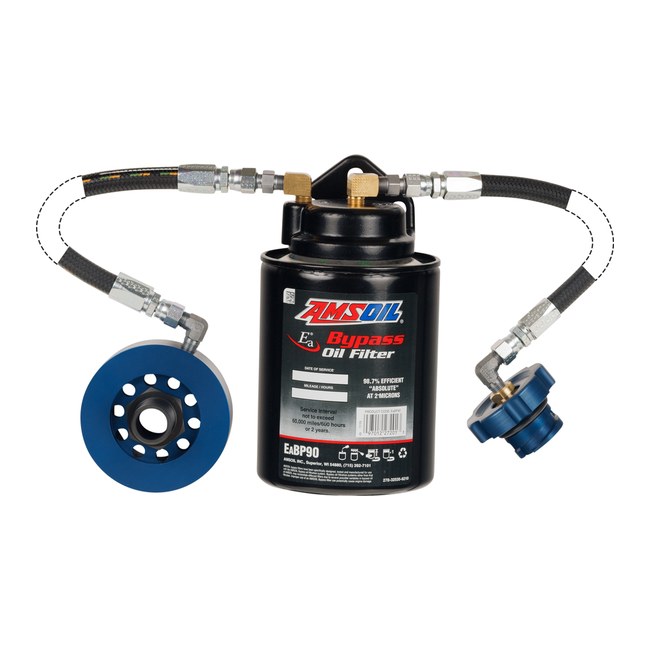
Our research has shown that a majority of engine wear comes from particles from 5µ to 30µ in size. The problem that arises is that the average full flow oil filter doesn’t efficiently filter smaller particles no matter the brand. This means that all those small particles can pass though the filter and cause wear to your engine. This is where an AMSOIL BYPASS SYSTEM comes into play. Installing a Bypass System on your vehicle will help efficiently filter particles down to 2µ in size, effectively reducing the wear on your engine.
What are the benefits of using an AMSOIL Bypass System?
- Efficient small particle and soot removal
- Equipment constantly runs on clean oil
- Helps increase engine efficiency
- Helps significantly extend engine life
- Increased filtration capacity and life
- Improved oil cooling
- Increased fluid system capacity
- Dramatically extends oil drain intervals
How does bypass filtration work?
Bypass oil filtration features a secondary oil filter that is used in conjunction with your existing full flow oil filter. This bypass filter helps by filtering small particles that your full flow filter can’t and eliminates nearly all contaminants from motor oil. Bypass oil filters have high capacities and eliminate much smaller particles than full-flow filters, including soot which can be a major problem in diesel engines. Bypass filters reduce engine wear and increase oil volume, but their high efficiencies mean they also have higher restriction and must be used in conjunction with a full-flow filter.
Bypass filters operate by filtering oil on a “partial-flow” basis. They draw approximately 5% of the oil pump’s capacity at any one time and trap the extremely small, wear-causing contaminants that full-flow filters can’t remove. Bypass filters have a high pressure differential, causing the oil to flow through them very slowly and allowing for the removal of smaller contaminants. It is called bypass filtration because the oil flows from the bypass filter back to the sump, bypassing the engine. This continual process eventually makes all the oil analytically clean, reduces long-term wear and can dramatically extend oil drain intervals. If you extend drain intervals, use oil analysis to confirm the oil is still in good condition.
What is the difference between Single Remote vs Dual Remote Systems?
AMSOIL offers two types of bypass systems: single-remote and dual-remote. The systems are equally efficient, and the only real difference is the full-flow filter’s location.
Single Remote System
The AMSOIL Single-Remote System is convenient to install; it does not require relocating the full-flow filter. It also takes up less space, which is often the biggest issue when installing any bypass system. With the Single-Remote System the oil is diverted from its normal circuit:
- From a pressurized oil port or
- Through a filter adapter/oil filter cap (available for purchase for specific applications)
The oil is then pumped through the bypass filter and returned to the oil pan. There are two ways to return the oil to the pan:
- Drill into either the oil pan or the rocker arm/valve cover to return the oil or
- Modify an oil filler cap/purchase a replacement oil filler cap from AMSOIL (available for purchase for specific applications)
During normal engine operation, tiny airborne dirt and internally generated metal particles elude even the most efficient full-flow oil filters. Wear particles can reduce fuel efficiency through a variety of scenarios.
Anti-wear Additive Depletion
Anti-wear additives guard against metal-to-metal contact if a full lubricating film either does not develop or ruptures. These instances may occur at startup or during periods of heavy load, especially in the contact areas between cam lobes and lifters, and piston rings and cylinder liners. In diesel applications, high wear particle levels in the oil can impair the performance of zinc anti-wear additives. Some industry research suggests that soot and dust particles display polar absorbencies that can tie up anti-wear additives, hindering their ability to control friction, which leads to reduced fuel efficiency.
Energy Lost to Friction
Under normal engine operation, some of the energy created during the combustion process is lost to friction. However, when wear particles breach the clearance between moving parts and rupture the oil film, friction worsens. The problem especially affects the piston ring/cylinder wall contact areas where the oil film can be as thin as three microns.
Oil Thickening
Wear particles contribute to oil thickening, especially in diesel applications where soot is more prevalent. The thicker oil increases internal fluid heat, which can prematurely degrade oil additives and accelerate oxidation. Thicker oil also requires more fuel to circulate, reducing efficiency.
Stiction Losses
Particles can agglomerate with soot and sludge to create deposits in the microscopic clearances between valves and guides. Called stiction, the process interferes with the timing of the port openings and closings, causing incomplete combustion and power loss. Stiction can lead to burned valve seats and reduced fuel efficiency.
Combustion Efficiency Loss
Wear particles can scour away piston liners, cam lobes, piston rings and other engine parts, reducing combustion efficiency and causing the engine to burn more fuel to produce maximum horsepower. Wear in the valvetrain can disrupt timing and valve movement, while ring, piston and liner wear reduces volumetric compression and contributes to blow-by.
Bypass filtration that removes particles smaller than 10 microns directly correlates to reduced engine wear and optimum efficiency. In the article “Clean Oil Reduces Engine Fuel Consumption” on Machinery Lubrication magazine’s website, the author surveys a number of studies that confirm this. Studied over 50,000 miles of service, buses fitted with Cummins* six-cylinder 8.3-liter turbocharged engines achieved 2% to 3% gains in fuel efficiency while operating with six-micron bypass filtration. A second study of a six-cylinder diesel engine saw dramatic improvements after installing a bypass filter rated 75% efficient at six microns: oil contamination dropped 98%, friction decreased 2.9% and fuel economy increased 5%.

Fine-Particle Filtration Down to Two Microns
Offering even greater efficiency, AMSOIL Bypass Oil Filters feature synthetic media to reduce engine wear and increase engine efficiency. By filtering oil on a “partial-flow” basis, they draw less than 5% of the oil sump’s capacity at any time and trap the extremely small, wear-causing contaminants that full-flow filters can’t remove, delivering fine-particle filtration down to two microns.
AMSOIL Bypass Oil Filters typically filter all the oil in the system several times an hour, so the engine continuously receives analytically clean oil. The proprietary high-efficiency media also removes soot particles two microns and larger, eliminating the abrasive wear caused by soot agglomeration.

Dual Remote System
The AMSOIL Dual-Remote System is convenient for servicing filters, placing both the full-flow filter and bypass filter on the same dual-mount. If you have the room in your engine compartment, this is a good option as long as you keep the dual remote system close to the pressurized oil to avoid oil pressure issues. A spin-on filter adapter fits onto the full-flow filter, through which the oil is both taken and returned. The oil flows through both filters, and the oil returns to the system through the filter adapter.

What is a Full Flow Filter vs Bypass Filter?
Full-flow filters are more open and free-flowing than bypass filters so they are able to support the flow of oil that lubricates the engine. Because they are freer flowing, they are less efficient at removing small particles.
Bypass filters only filter a small percentage of the system’s oil at any given time. Denser, more efficient filtration media provides improved small-particle removal. AMSOIL Bypass Filters efficiently remove contaminants down to 2 microns.
Used together, full-flow and bypass filters provide comprehensive wear protection against both large and small particles, as well as both short-term and long-term wear. In addition, filter capacity is increased, and the life of the filters is extended.
Installation Example
AMSOIL Bypass Oil Filtration Systems are a valuable asset to prolonging the life of your engine. They are also fairly easy to install, only requiring tools that you would find in a common garage. Bypass systems can be installed on many applications with the same basic installation principles.
What are common mistakes?
No installation is fool-proof, and some practices should be avoided because they can be harmful in the long run.
- Be sure to choose the optimal bypass filter location
- Make sure the Bypass System is not mounted in harm’s way especially from road debris or off-road travel that could damage the system.
- Make sure the mounting structure is solid and adequate to carry the weight of the filtration system. Areas with high vibration or moving parts could cause the systems or mounting bracket to break.
- Make sure the Bypass System and hose is not mounted next to the exhaust. The high temperatures of the exhaust could cause damage to the system and hose.
- The mount should be located as close to the existing full-flow filter as possible to limit possibilities of leaks or pressure loss.
- Mount as close to the engine as possible
- Choose the correct-sized Bypass Filter for the application.
Most popular bypass systems
- BMK27: Duramax* 6.6L Dual-Remote Bypass System
- BMK28: Power Stroke* 6.7L Dual-Remote Bypass System
- BMK30: Heavy-Duty Bypass System
- BMK34: Cummins* 5.0/5.9/6.7L Single-Remote Bypass System
Recommended AMSOIL products
Start with AMSOIL synthetic motor oil and find the exact AMSOIL products for all your vehicles with the AMSOIL Product Guide.

Comments
Joel Youngman is Lead Technical Writer at AMSOIL and associate editor of AMSOIL Magazine. He develops and edits content covering lubricant technology, product testing, vehicle systems, maintenance practices and equipment applications. Youngman also coordinates magazine articles and Tech Talk columns, working with engineers, product specialists and Communications personnel to maintain technical accuracy, editorial consistency and clear customer communication.
Share: