Automotive oils are designed to protect road vehicles, but boat engines face sustained load, high rpm, water exposure and long storage intervals. Here’s why marine oil matters.
Can You Use Car Oil in a Boat?
You should always use an oil that meets the specifications recommended by the engine manufacturer. In many four-stroke marine engines, that means using a marine oil that meets NMMA FC-W or NMMA FC-W Catalyst Compatible requirements, not an automotive oil.
High-quality automotive oils may be excellent engine lubricants, but marine engines operate under heavier continuous load, spend their lives around water and humidity and often sit unused for long periods. Those conditions demand different formulation priorities.
“Water is the primary cause of damage to boat engines.”
– Len Groom


Rust and Corrosion
Marine engines face humid air, condensation, lake water, river water and saltwater environments. During engine operation, a layer of oil coats engine parts and the crankcase walls. The lubricant film protects against rust and corrosion as long as it remains in place. However, after shutdown, gravity draws the oil back down into the oil sump, leaving internal surfaces unprotected during storage.
The longer the engine sits, the more likely rust and corrosion will form. Since cars and trucks are typically driven daily, rust and corrosion largely isn’t a concern. Therefore, most automotive motor oils don’t contain sufficient rust and corrosion inhibitors for marine engines.
Once rust begins to form, it doesn’t stop. Rust can slowly spread to the crankshaft journals, cylinder wall, piston rings and other areas. Rust acts like sandpaper and scours metal surfaces until engine failure results. Rust can also prevent the piston rings from forming a good seal against the cylinder wall, which reduces compression and leads to power loss.
Aluminum parts may not rust, but they can corrode, especially in marine engines that are constantly exposed to moisture. Damp air that infiltrates combustion chambers can cause aluminum pistons to corrode. Corrosion on piston crowns can cause pre-ignition detonation, where the fuel/air mixture sporadically ignites, which can lead to catastrophic engine failure.
Motor oil does not naturally prevent rust and corrosion. Instead, corrosion inhibitors must be added to the formulation to provide the required protection. This is the primary reason to use a marine-specific oil in your boat or personal watercraft engine.
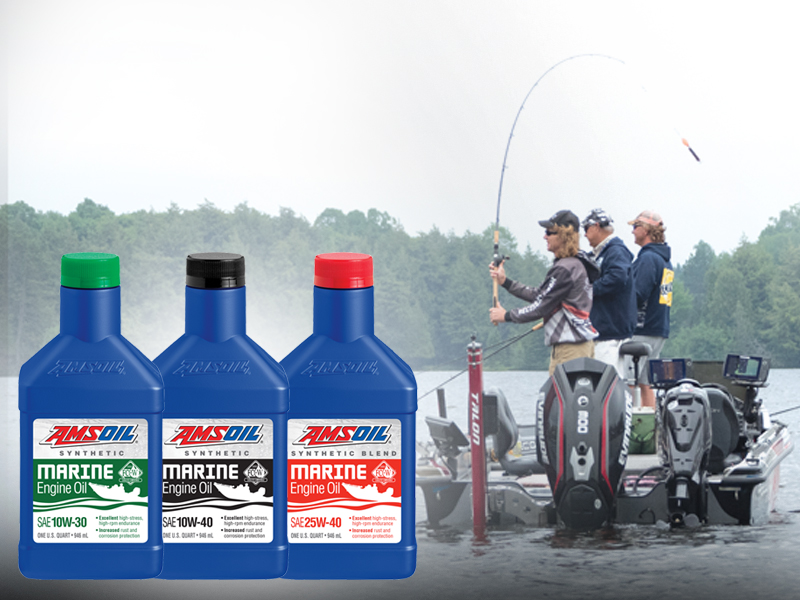
AMSOIL Marine Engine Oil is formulated with advanced rust and corrosion inhibitors to help protect bearings, cylinder walls, piston rings and aluminum parts in harsh marine environments.


Dilution
Fuel and water leaking into the oil sump is especially problematic in outboard motors and personal watercraft that use lake or river water for cooling. When started, these engines draw water into the cooling system and circulate it throughout. Water-cooled engines typically take longer to warm up than engines with a closed cooling system that uses a radiator and coolant.
A cold engine can prevent the rings from sealing completely. More clearance between the ring and cylinder wall allows fuel to leak into the sump, diluting the oil and reducing its ability to protect against wear. AMSOIL Marine Engine Oil resists water and fuel dilution, maintaining a strong oil film that helps keep marine engines lubricated for maximum protection and performance.
“Lubricants specifically engineered for marine environments are an absolute must for boat owners.”
– Len Groom


Marine Engines Work Harder
Adding to the challenge, marine engines are constantly under load, which can physically damage the molecular structure of conventional motor oil and reduce its ability to protect against mechanical wear. For example, cars cruise at highway speed with relatively light throttle once moving, but boats must push through water. That extreme resistance keeps the engine under load the entire time, often at sustained high rpm.
Consider that a typical marine engine propelling a boat at 30 mph operates around 5,000 rpm. Compare that to an automotive engine, which runs about 2,000 rpm at 60 mph. Unlike automotive engines, which shift gears to reduce engine speed and rpm, boat engines only run in forward or reverse, putting more stress on the oil’s ability to both cool and lubricate the engine under load.
The added heat and mechanical stress of operating under constant load can shear regular oil, reduce its viscosity and weaken its lubricating film.
AMSOIL Marine Engine Oil is specifically formulated to meet manufacturer-recommended NMMA FC-W Catalyst Compatible requirements for superior protection of marine engines operating in wet environments under heavy loading at high rpm.

“For boat owners, water is one of the primary causes of damage to their boat’s powerplant. With tens of thousands – up to millions – of dollars invested in watercraft, proper maintenance with lubricants specifically engineered for marine environments is an absolute must for boat owners who want to be out on the water versus in the shop.”
– AMSOIL Powersports Product Marketing Director, Len Groom