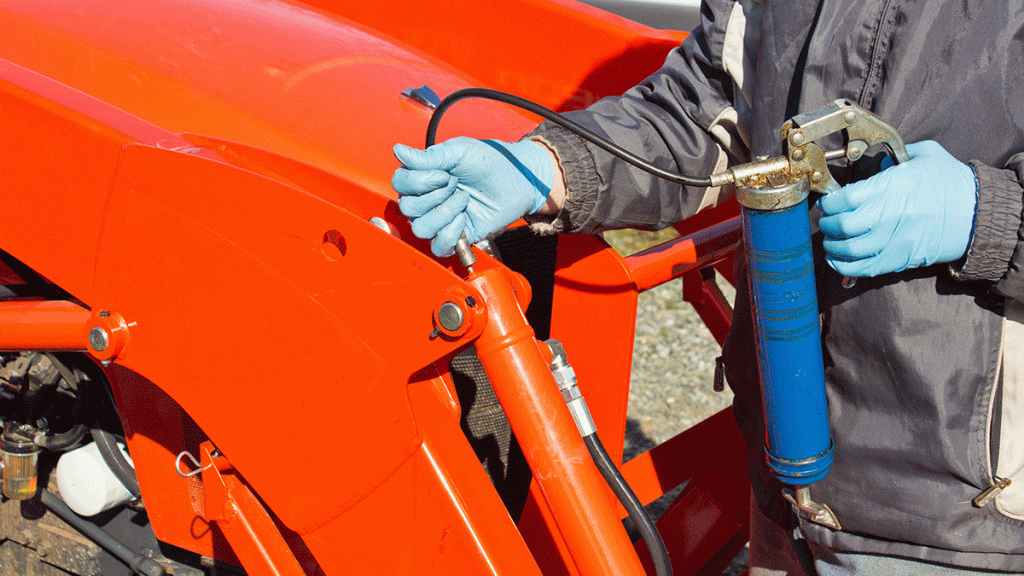
To avoid damage, frustration and waste, learn how to choose and apply the correct grease with these step-by-step instructions.
How to use a grease gun
First and foremost, make sure the grease you’re using meets the specifications given in the owner’s manual or service manual. Most applications specify either NLGI #1 or NLGI #2 grease. NLGI #1 is typically reserved for cold-weather applications since it’s a little softer and easier to pump.
Your application may also specify using a grease that meets the GC-LB specification, which is a common spec for automotive bearings.

Different greases use different base oils and thickeners, which can be incompatible. Mixing incompatible greases can cause the grease to break down and fail to provide adequate lubrication. When changing greases, clean the equipment of the old grease when possible or flush it with a liberal amount of fresh grease while the mechanism is in operation. Closely monitor the system for any inconsistencies.
How to load a grease gun
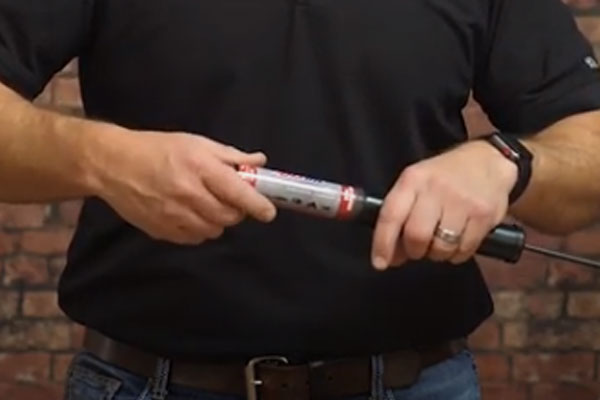
Most grease guns load from a standard 14-ounce cartridge. To load one:
- Pull the plunger handle all the way back and lock it in the slot at the end of the barrel so it can’t spring forward.
- Unscrew the head from the barrel and remove the empty cartridge tube.
- Remove the plastic cap from the new cartridge and slide the cartridge into the barrel, open end first.
- Peel the metal seal off the exposed end of the cartridge, then screw the head back on hand-tight.
- Release the plunger handle from the slot and push it in. The spring now pushes grease toward the head.
- Pump the handle until grease flows from the coupler. If it pumps air, loosen the head about one turn, or press the air-bleeder valve if your gun has one, until a little grease seeps out. Then tighten the head.
Some guns can also be filled from a bulk can by suction or with a loader pump. Follow the gun maker’s instructions, and keep dirt out of the grease while you fill it.
Keep it clean
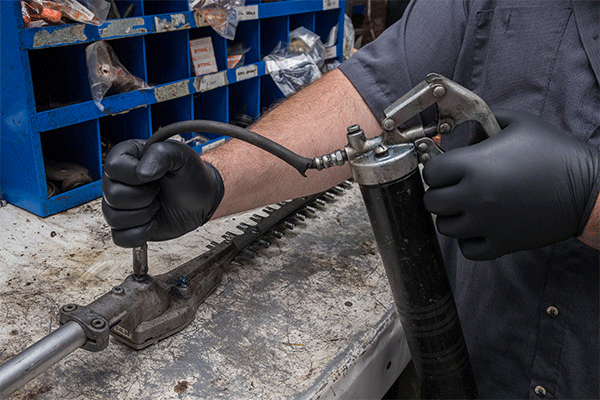
Maintaining a clean work environment is important when greasing equipment. Wipe grease fittings clean prior to injecting grease to prevent contaminant ingestion. Wipe the fitting after greasing, too. Finally, wipe excess grease off the gun nozzle and cover it with a cap to keep it clean during storage.
Avoid over-greasing
Proper greasing requires little or no weight behind the grease gun handle. As soon as you feel backpressure, stop greasing. Backpressure means the cavity is close to, or completely full. Adding a few extra shots of grease typically does more harm than good.
Some grease guns are capable of producing pressures as high as 15,000 psi. This greatly exceeds the pressure most bearing seals are designed to withstand. Over-greasing can easily rupture seals, which leads to increased friction, heat and, eventually, expensive maintenance and downtime.
Some greases are harder to pump than others by design. And some applications, like pins and bushings, require more force to push the grease into place. However, if you have to stand on the handle or get a cheater bar, something is wrong with your system.
Use high-quality grease
Finally, make sure you use a high-quality grease, like AMSOIL synthetic grease. We formulate our greases with durable synthetic base oils and high-quality thickeners so they provide excellent adhesion and wear protection. They withstand heavy loads, remain in place despite rigorous use and fight corrosion to promote long component life.
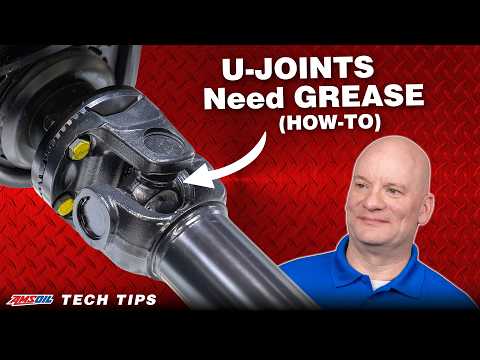
Video transcript: How to Lubricate Driveshafts and U-Joints
Featuring John Gardner, ASE Master Certified technician, automotive technology instructor and host of Motorhead Garage, with AMSOIL Director of Product Marketing Len Groom (author profile).
John Gardner: Well, you’re looking at a bunch of pictures of driveshafts that probably didn’t get lubed. What am I talking about? The U-joints have a zerk fitting, and they need lubrication. Why? Look inside. You see all these little needle bearings? Each one of them has to be lubricated, or you’re going to end up like that. Not a good thing. Welcome to this AMSOIL Tech Tip. We’re talking about driveshafts and U-joints.
What do you want to look for? Obviously, dry universal joints, like I said, or bent driveshafts. That’s pretty easy to check: put a dial indicator under there, spin it around and see if you have any problems. As a matter of fact, we did one. Get under the car safely on jack stands and make sure everything’s good. Just grab it, wiggle it and push up and down on it. Watch your U-joints right here; you’ll see them start to pop or move. Sometimes when you put the vehicle in gear or take it out of gear, you get a clunk. That can be a good indication.
I’m going to sand it down a little with some emery cloth or sandpaper to get some of the rust off, and then it’s as easy as setting up a dial indicator. Once you set it up, spin the shaft around. What are you looking for? Massive runout. There’s a spec for each vehicle, but you don’t want to see a wobble. That’s going to cause all kinds of clunking or vibration in the vehicle.
If you have to take it out, that’s easy, too. Get some MP, spray it in there and lube up the clip so you can get it off. Then you use a special tool, a U-joint press. Each one is a little different. Some have plastic in there from the factory that you have to heat to get out. Some are just clipped in, some on the inside and some on the outside. Follow the manufacturer’s specifications. Get it pressed out and match up the new joint. Make sure you can see the zerk fitting so it’s going to get greased, along with all your needle bearings. Take the caps off, put the joint in, then put the caps back on, kind of reversing the procedure. You’re not going to be able to push it in until you put the caps on. Once it’s in, take the press and press it back in. Make sure it’s secure, put your clips on and reinstall the driveshaft.
Len, this guy here didn’t grease it. Actually, what is grease?
Len Groom: You know, that’s an interesting question, and there are some cool things in there people don’t know. What’s doing the work in grease is still oil. You and I have had many conversations about oil and all its benefits, and all of those still apply to grease. What we add to a grease is something called a thickener. Thickeners can be made from different things; you hear calcium, or they can be made from lithium. But they’re all doing the same job: holding the oil in position where it can do its job. So in the U-joint you’re talking about, the thickener holds the grease in place, and the oil does the work.
John Gardner: Do you have any other tips when it comes to greases?
Len Groom: Yeah, here’s one. Say you’ve had a tube of grease sitting on your shelf for years, and you finally decide to lube those U-joints because you watched John and Len do a Tech Tip. If you see oil bleeding out of that grease tube, or you open it up and oil pours out, the grease has separated, and it won’t do its job anymore. You’d just be pumping thickener in there, and that won’t work. So if you see that, it’s time to toss it and get some new stuff.
John Gardner: Absolutely. Get the new stuff. They have a whole line of greases and lubricants. It’s as easy as going to amsoil.com.
Consult AMSOIL Technical Services (tech@amsoil.com or 715-399-TECH) to identify the correct AMSOIL grease for your specific applications.
This article is part of our Grease guide. See every article in the guide.