

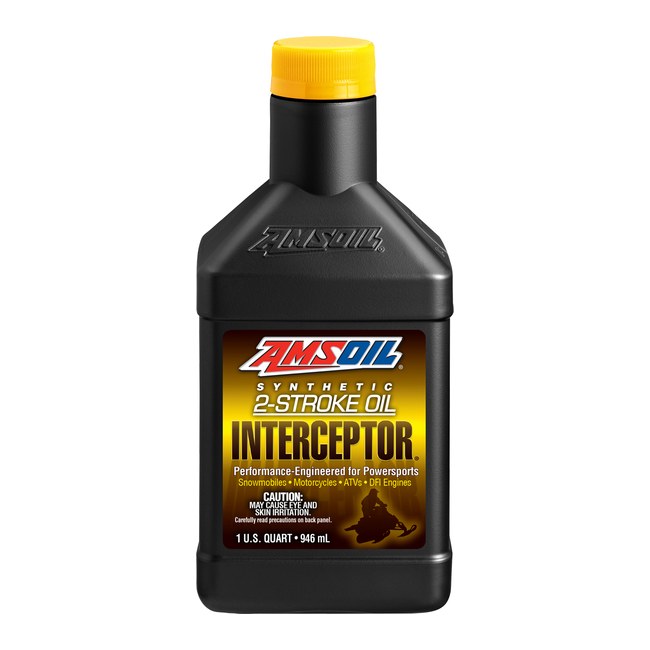
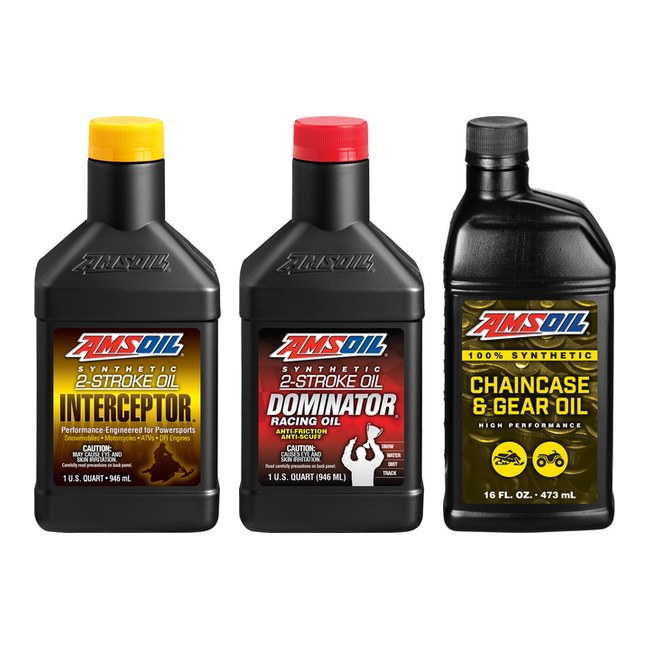

We think AMSOIL INTERCEPTOR® Synthetic 2-Stroke Oil is the best all-around snowmobile oil. We also think it’s the best snowmobile oil for power valves.
For the proof, scroll down and take a look at the test results.
What must snowmobile oil do?
First, though, let’s take a look at the three areas where an oil needs to excel to achieve the title “Best Snowmobile Oil.”
Modern sleds deliver power, performance and efficiency not thought of years ago. With each new model, original equipment manufacturers (OEMs) seem to push the limits of performance even further, allowing you to ride faster and push your sled harder, while using less gas and oil and producing fewer emissions.
This translates into an epic ride for you, but brutal operating conditions for your sled. In addition to having to protect a hotter, more powerful engine, today’s direct-injection engines use less oil than older sleds to help curb emissions.
The Polaris* RMK 850 is a prime example of the state of the industry. Its two-stroke engine can make nearly 170 horsepower. Think about that for a second. That’s more power than some cars on the road today, like the entry-level 2021 Toyota* Corolla.
This underscores the need to use a durable, high-quality oil that’s proven to stand up to the punishment doled out by modern engines. For maximum engine performance and life, two-stroke oils should focus on three performance areas:
- Wear protection
- Exhaust power valve cleanliness
- Cold-flow properties

Wear protection
The intense heat and friction inside a snowmobile engine can overwhelm inferior oils, leading to piston scuffing and wear. Excellent lubricity – a term that refers to the oil’s ability to reduce friction – is essential for maximum wear protection.
Exhaust power valve cleanliness
High heat and increased power can also cause deposit formation on exhaust power valves, which can lead to sticking. The power valves automatically open or close based on operating conditions to increase throttle response at low rpm while maximizing top-end power. They expand the sled’s powerband, delivering a better experience for the rider.
But their location in the exhaust port exposes them to hot gases, which can lead to deposits that cause them to stick, reducing performance.
Good cold-flow properties
To top it off, today’s snowmobile engines direct less oil to critical components, through narrower passages, for longer distances. Oils that don’t remain fluid in sub-zero cold can fail to reach components at startup, promoting wear.
The best snowmobile oil
That’s brings us back to the business of demonstrating why we think AMSOIL INTERCEPTOR is not only the best snowmobile for power valves, but the best snowmobile oil, period.
We formulated INTERCEPTOR with today’s sleds in mind. It remains fluid down to -69°F (-56°C) to ensure oil reaches critical components in the coldest weather, keeping your engine protected.
This snowmobile oil comparison shows how INTERCEPTOR stacks up to the competition when it comes to cold-flow.
The oil also delivers exceptional wear protection and exhaust-power-valve performance. To demonstrate, we tested INTERCEPTOR in a 2019 Polaris RMK 850 used in a rental fleet in the Canadian Rockies. The sled was flat-out abused, with riders pinning the throttle through deep powder day after day for an entire riding season.
Afterward, we disassembled the engine and, as the images show, the piston contained virtually no scuffing and the power valves were in great shape and didn’t stick.

Check out the video of the Grizzly Lodge Rental Torture Test below.
Video transcript: Grizzly Lodge Rental Torture Test
This sled is part of a cooperative effort between AMSOIL and Grizzly Lodge. We wanted to torture a snowmobile, and there’s no better way to do that than embed it in a rental fleet and put it in the mountains. A day in the life of a rental sled here specifically, they put on a pile of trail miles going down to our staging area which varies from 20 to 30 kilometers away to pick clients up. Clients are strapping their big bags on the back of these things, hauling their bags up here back up the trail so they’re running hot sometimes.
Next morning it’s up the mountain and into the mountains on the pin all the time. People like to ride hard, and they seem to like to ride rental sleds even harder. We also use them to tow each other up and down the hill sometimes when we have to deliver a bunch of rental sleds to our staging area. We don’t have the space to keep them all in a heated shop, so they all live outside.
We have often minus 35 in the wintertime. That means a lot of cold starts so lubrication is extremely important. If the sled fails, that’s something we don’t want to see. If it fails on the trail or if it fails in the mountain, either way it’s inconveniencing the customer.
And, basically, we need to find a way to get another sled up to them or they need to find a way to get back down to us, and it costs them a day of riding. So when you’ve come for three nights and two days riding and one of those days is taken up by rescuing a machine out of the backcountry, we really want to avoid those things at all cost. So it’s really, really important to us to keep them running in as top-notch condition as we can keep them. All of our rentals take a great deal of abuse during the season, but we specifically made sure this sled got most of the abuse.
Grizzly Lodge has rented this sled. They’ve guided on it. They’ve done all kinds of terrible things to it. We’re going to take it apart.
We’re going to show you how great Interceptor performed under those extreme conditions. You can see these are moving all the way open and then all the way closed which indicates that the power valves are free and working. The cylinder head looks beautiful. There’s no sign of any major carbon deposits on there.
There’s a little bit of coloration around the exhaust port but, other than that, it looks really good. So we’re checking the rings, and the rings are free, indicating there’s no carbon buildup in the lands. The pistons look good. You can see the skirts are not scuffed.
We’re going to check the rod bearings and make sure that there’s no axial play, there’s no lateral movement of the rod bearings. Crank still turns freely so everything looks good as far as the rod bearings go. I mean, the cross hatches are still in the cylinder. There’s no excess carbon depositing on the crowns.
It’s a very, very thin layer of carbon which is normal. You can tell that it’s thin because of the fuel wash bands on top of the piston. It gives you kind of an idea of how thick that carbon is and it’s very, very thin. So that’s a good sign.
Under crowns of the pistons don’t show any excess staining, and generally that’s a sign of how much heat that piston is seeing. Oil without enough detergency will generally put a black stain on the bottom of that piston. We’re not seeing that here. Overall I’d say this engine for a field engine with this amount of time on it, this thing looks good.
In all three critical areas, INTERCEPTOR delivers the level of performance you need to get maximum performance and life from your sled.
We’re so confident in its performance, we back the product with our Runs on Freedom™ Limited Snowmobile Warranty, which covers repairs to qualifying parts in current-model-year and newer sleds that use INTERCEPTOR exclusively for up to two years or 5,000 miles (8,000 km).
That’s why we think INTERCEPTOR is the best snowmobile oil for power valves…and the best snowmobile oil, period.


Comments
David Hilgendorf is an AMSOIL Technical Writer who develops content for automotive, powersports and industrial audiences. His work includes technical data sheets, magazine articles, blog posts, white papers, product literature and application guidance. Hilgendorf works with engineers, laboratory personnel and technical specialists to communicate lubricant testing, product performance, maintenance practices, metalworking fluids, grease, motorcycles, marine equipment and industrial reliability.
Share: