

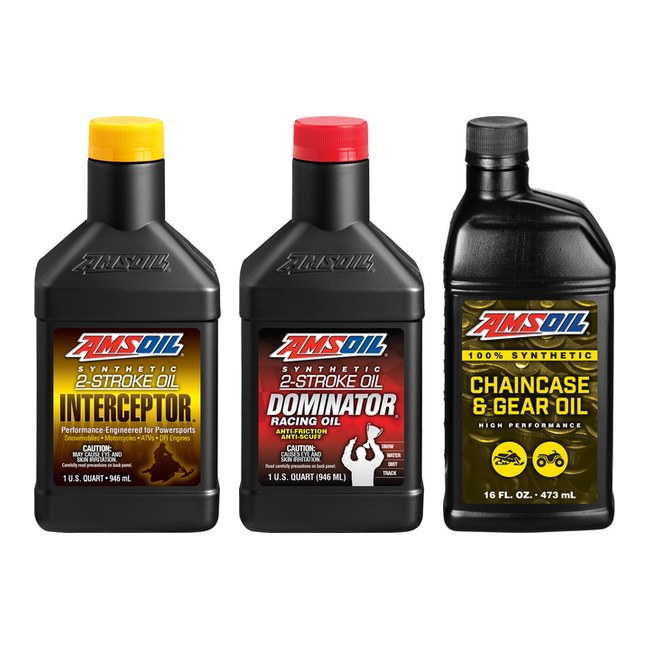
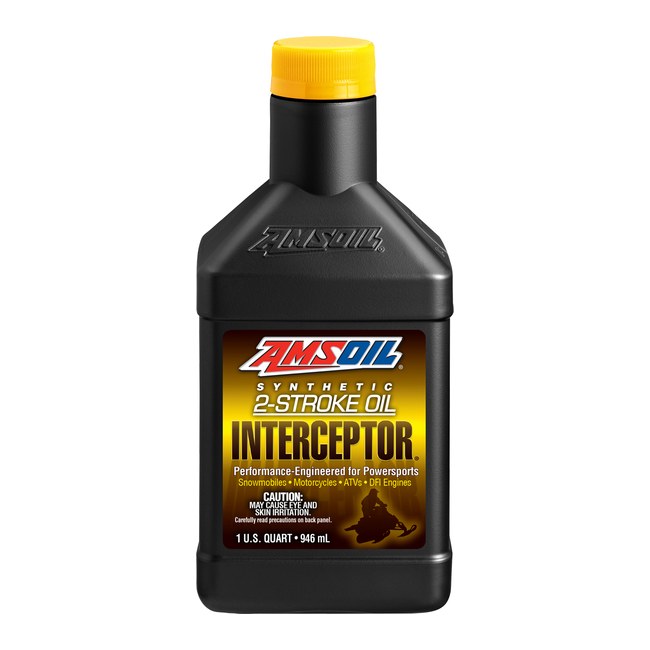

When Arctic Cat released its new 858 C-TEC2* engine with an updated crankcase, air intake system, exhaust valve, and increased displacement and power, we immediately tested one to make sure AMSOIL INTERCEPTOR Synthetic 2-Stroke Oil performs the way it should.

We ran AMSOIL INTERCEPTOR in an Arctic Cat ZR 858 R-XC on our dyno for 50 hours, or the equivalent of more than 2,000 trail miles. We measured parameters like jackshaft speeds, throttle position and exhaust gas and coolant temperatures. Then we disassembled the engine and looked at the pistons, cylinders and power valve.

Piston Cleanliness
Carbon buildup is expected in a two-stroke engine because oil is consumed as part of the combustion process. Therefore, piston cleanliness is extremely important and the first thing we look for. Piston rings that move freely and have minimal carbon deposits and a clean piston crown indicate that the oil has good detergency and is doing its job.

Exhaust Power Valves
The power valve helps optimize two-stroke power delivery by varying the size of the exhaust port to maximize throttle response and torque at low rpm while delivering high-revving horsepower at the top end. However, the power valve is in the exhaust stream and also subjected to fuel and oil combustion byproducts, so oil detergency is critical to keeping power valves clean and moving freely.

Cylinder Wear
You want to see the crosshatch pattern from the machining process when looking at a cylinder. When an oil is not doing its job, the crosshatch is worn away by the piston rings and disappears. Any deposits on the cylinder heads should be able to be wiped away with a rag, with no hard carbon deposits. We also look for discoloration and other indicators of heat buildup, including on the smaller connecting parts like rods, roller cages and wrist pins.

As seen in the pictures above, AMSOIL INTERCEPTOR performed exceptionally well in all the tests. We saw minimal carbon deposits and the exhaust power valve continued to move freely and work correctly. Cylinder crosshatches were visible with no abnormal deposits, and the engine made good compression and power. There was no sign of heat-related galling, sticking or discoloration in the wrist pins and roller cages. All the critical areas were protected and kept clean, which is exactly what you want out of your two-stroke oil.
Watch the video below for a deeper dive into the test results and grab some AMSOIL INTERCEPTOR to maximize performance in your two-stroke sled.
Video transcript: Arctic Cat ZR RXC 858 Proof of Performance
We ran AMSOIL Interceptor in an Articat RXC858. Let’s see how it performs. Articat came out with a new engine. It was an 858.
And the first thing we do at AMSOIL when that happens is we want to test it. We want to test the proper product. We want to make sure that it’s performing the way that it’s supposed to. So that means that we get it into our protocol called a proof of performance.
So the sled was ridden in the field to establish this program and we looked at all these different parameters like coolant temp, jack shaft speeds, throttle position, exhaust gas temp. All of these things were looked at to build this profile. The goal of the profile was to put 50 hours or 1,000 miles on this snowmobile on the dyno in controlled conditions. So, we hit that 50 hour mark and we pull the sled out of the dyno and we take apart the engine.
We look at all these key pieces. We’re looking at pistons, power valves, cylinder head, and cylinders. Those are our key areas that we like to look for a two-stroke snowmobile engine. The first thing you’re going to notice about the pistons is that they’re very clean.
You move to the rings and you can see that the ring lands are very free. You’re looking for any type of carbon buildup. None of that was seen here. There is some carbon on the crown of the piston, but that’s to be expected in a two-stroke engine where the oil is consumed as part of the combustion process.
So, you’re looking for excess buildup. We didn’t see any of that. We saw normal amounts of carbon on the top of the piston. You flip the piston over, you look at the under crown.
That’s an indicator of your detergency. The piston is extremely clean, indicating that the oil is doing its job from a detergency standpoint. It’s really important in a two-stroke to keep it clean because you don’t want the rings to jam up. You don’t want carbon deposits.
You don’t want issues like that inside of an engine. So, looking at this piston in general, not only are we protecting, but we’re also keeping it clean. Exactly what you want out of your two-stroke oil. Okay.
Next, you move to the power valve. The power valve in a two-stroke engine is used to get low RPM power out of a two-stroke engine. So, you vary the size of the exhaust port. That allows you to have real good throttle response and torque down low in the RPM band.
And then the valves open and that gives you your traditional two-stroke, high revving real fun factor power out of this engine. And that’s what the power valve does. The problem is is that the power valve lives in the exhaust stream. And as I said earlier, in a two-stroke engine, you’re consuming fuel and oil as part of the combustion process, and it all goes past the power valve.
So your detergency package is critical. So, we look at the power valves for deposits. Do we want them free of deposits? No.
You want them clean and free moving. So, if there’s some deposit on the valve, that’s perfectly okay as long as the valve continues to work and move through its travel as it’s supposed to. In this case, the power valves look great. When we took them out of the snowmobile, they came out freely.
They moved freely inside of their travel, indicating no issues with the detergency package of this oil. The cylinder and cylinder head is where we move next. When you look down the cylinder, you’re looking for that crosshatch pattern that indicates we don’t have any wear. And that is the case here.
You can see the cross-hatch pattern from the machining process of building the cylinder is still visible. If you have an oil that’s not doing its job, what can happen is you see that crosshatch disappears. That shows you that the oil is not doing its job. In the case here, crosshatches are still visible.
Engine is making good compression and good power. When you look at the cylinder heads, you look at the types of deposits. When you’re looking at a cylinder head, can it be wiped away with a rag? That is what you’re looking for because the cylinder head won’t be completely clean.
There’ll always be some type of deposit on it because we’re burning the fuel and the oil. It’s part of the combustion process. In this case, cylinder head looks really good. No abnormal deposits.
There’s no flaking. There’s no hard carbon. Cylinder head is good to go. From there, you start looking at smaller pieces, but still very important pieces like rods, roller cages, wrist pins.
You’re looking for any type of discoloration, any type of heat buildup. In this case, we are not seeing any of that. The roller cages look great. The wrist pins look great.
There’s no sign of any type of gallling or sticking or discoloration that would be considered heat related in those pins. So when you look at the entire package, AMSOIL Interceptor performed exceptionally well. All of your critical areas were protected. All of your critical areas were kept clean, giving you the confidence to use AMSOIL Interceptor in your Articat 858.



Comments
David Hilgendorf is an AMSOIL Technical Writer who develops content for automotive, powersports and industrial audiences. His work includes technical data sheets, magazine articles, blog posts, white papers, product literature and application guidance. Hilgendorf works with engineers, laboratory personnel and technical specialists to communicate lubricant testing, product performance, maintenance practices, metalworking fluids, grease, motorcycles, marine equipment and industrial reliability.
Share: