

Store shelves contain several coolant additives that promise to reduce engine heat, control overheating and fight corrosion.
Do coolant additives work? And, if so, are they necessary?
Video transcript: How to Check Your Engine’s Coolant System
Featuring John Gardner, host of Motorhead Garage, and Leonard “Len” Groom, AMSOIL Director of Product Marketing (author profile).
John Gardner: We were rolling along on our way here to the shop, and look what we found. A vehicle broken down. Fortunately, we had our tools with us, so we went up under the hood and we found a coolant failure. One of the hoses actually blown off.
Welcome to this AMSOIL Tech Tip. Yeah. It’s all about the coolant system. And if we get into the coolant system, we have to look at how it functions.
And you can see here, it starts at the bottom there with the water pump. It’s gonna actually take the fluid up to the water pump through the block. Once it goes through the block, out a thermostat, and then returns back to the radiator. It’s all about that law of thermodynamics, and I have it for you right here.
You can actually see it. If I fire it up, I said it starts at the water pump, and then what’s happening here is it’s coming in through the bottom and out through a thermostat, which we don’t have on this motor, so it’s allowed to flow here and return to the radiator. I’m taking the heat from the motor, taking it to the outside air, boom, getting rid of it. Once again, that law of thermodynamics.
But you’re going to have to have a thermostat, and you can see a thermostat right there on this graphic. It’s actually open or closed. When it’s closed, it’s going to bypass and let the engine get up to temperature very quickly, kind of in emissions reasons. I got one right here and you can see it.
So when it opens and closes, hey, better yet, I can actually show it to you opening and closing. What we did is we took one of these thermostats and with temperature, we went ahead and boiled it. And once we boiled it, we got it above the temperature of where it needed to be open. You see the gap right there?
Well, that’s actually an open thermostat. So what do we do with it? Well, we put it in cold water. And once we put it in that cold water, you can actually see it start to close.
That’s pretty cool. Anytime you do any coolant repair, you want to have a thermostat. Now to check the coolant systems, you can do a couple things. Up on the screen, I got a refractometer.
You just look through it. You can see the glycol level. You can see if your coolant’s good. You can do test strips or you can do a hydrometer.
But Len, the deal is there’s all collage there of different color coolants. Manufacturers use specific coolant. That’s important with the vehicles today.
Len Groom: Right. There’s not just one or two types of coolant anymore. And the reason for the dye is to their specific type of coolant. But the reasoning behind that is the metals that we’re using to build the components, the engine block, the cylinder heads, the radiator aren’t just a couple different types of metal anymore. They’re aluminums. They’re alloys. There’s all different kinds and we need to be providing protection.
John Gardner: Now AMSOIL has that coolant for multiple engines?
Len Groom: That’s correct. We’ve got coolant for all your needs. Just got to look it up, what it fits, and go from there.
John Gardner: Now also tell me about this. This holds it looks pretty good, Len, but if you look inside, man, it’s totally rotted out and deteriorated. Right. Here’s a water pump right here. The fins are totally missing. That’s not going to produce any flow, man. Corrosion, big problem.
Len Groom: Right. Dissimilar metals, corrosion. It’s basically the coolant reacting with the engine block or the heads or the water pump, and that reaction creates corrosion. Metal can actually be stripped away.
John Gardner: Len, that’s incredible, and that’s why it’s so important to use AMSOIL coolant. You know, maintenance, maintenance, maintenance. You got it? Whether it’s your coolant system or any other system on your vehicle, AMSOIL has you covered. For a comprehensive and simple to use website, just go to AMSOIL.com.
What is Antifreeze & Coolant?
Like motor oil, antifreeze & coolant consists of a base component mixed with additives. The base, either ethylene glycol (EG) or propylene glycol (PG), helps regulate engine temperature, lowering the freeze point of water to protect the engine during winter while raising the boiling point of water to help prevent engine overheating in the summer. It must first be mixed with distilled or high-purity water (usually 50/50), either by the antifreeze manufacturer or the consumer, before it goes into the vehicle’s radiator.
- Ethylene Glycol is the more common of the two. Compared to PG at a similar mix ratio, it offers a slightly better freeze point and heat-transfer ability. Plus, it’s less expensive.
- Propylene Glycol formulations are required by some racetracks and off-road parks.
Antifreeze & coolant must provide more than just freeze and boil protection. It also must guard against corrosion, cavitation, scaling and additive drop-out, and it’s up to the additives to achieve these tasks. There are three essential categories of additives, and any of them can be blended with the two glycols mentioned above.

It’s tough to top good ‘ol H2O
First of all, why use coolant additives in the first place?
Straight water is the best coolant one could use. It absorbs and transfers heat better than any other liquid. So, why not just pour purified water into your coolant system and call it done?
The answer is obvious for those of us who drive in snow six months a year and those of you who face triple-digit temperatures all summer.
Water freezes at 32°F (0°C) and boils at 212°F (100°C).
Clearly, coolant formulators must add something to antifreeze & coolant to expand its application to areas where the weather isn’t perfect 365 days per year. Otherwise your engine would freeze in winter and your cooling system would overheat in summer.

Corrosion control
Not only that, but water corrodes metal.
Running straight water in your vehicle’s cooling system would eventually lead to scale buildup that would plug the heater core and ruin the system.
It can also hasten corrosion in aluminum components, like radiators and cylinder heads, at an alarming rate. Corrosion can eat through an aluminum radiator until coolant leaks on the ground.
At the very least, drivers in the perfect climate still need to add corrosion inhibitors to straight water to properly cool an engine.
In fact, many racers do this with good results; racetracks typically don’t allow antifreeze & coolant since leaks are difficult to clean up and make the track slippery.
A good antifreeze & coolant hits the mark
A high-quality antifreeze & coolant contains the chemistry needed to deliver protection against freezing, boil-over and corrosion.
A word of caution, however: Avoid the conventional “green” coolants readily found at parts stores and other retailers.
They contain inorganic salts (phosphate, nitrate, nitrite, silicate, borate, amine), which are responsible for almost all cooling-system scaling problems.
Plus, they deplete quickly, often in two years or less, and can lead to sludge or slime in your radiator, which clog passages and create all sorts of problems.
AMSOIL antifreeze/coolants, on the other hand, deliver durable, long-lasting cooling-system protection.
Additive Types
- Inorganic salts, such as nitrites, phosphates and silicates, are used in the “green” conventional coolants traditionally found at most retailers due to their low price.
These additives work by forming a protective layer on metal cooling-system components, which helps prevent corrosion. Because these additives are depleted by forming a protective layer, conventional green coolants require regular changes, typically every two years.
Once depleted, these additives become the source of common cooling-system problems, like scale deposits. They can also be incompatible with each other, sometimes leading to drop-out in the form of an abrasive or slime. For these reasons, most manufacturers have moved away from inorganic salts.
- Organic acids, often referred to as OATs (organic-acid technology) or POATs (poly-organic-acid technology), are much more robust and longer-lasting. Unlike organic acids that coat metal surfaces, organic acids provide corrosion protection by chemically interacting at the metallic corrosion sites.
They’re only used when needed, meaning they last much longer. They virtually eliminate drop-out, scaling and compatibility issues inherent to inorganic salts. This type of coolant can be used in a wide variety of applications, even mixing with other coolants as a top-off.
- Hybrid-organic-acid technology, often called HOATs, is a combination of inorganic salts and organic acids. They work in tandem to minimize some of the issues with inorganic salts while relying on the organic acids to boost performance.
Incompatibility of Inorganic Salts
As mentioned, mixing coolant types that contain inorganic salts can alter the formulation enough to reduce protection. This can reduce the service life of both the coolant and the cooling-system components, leading to the following maintenance issues:
- Corrosion of metals in the cooling system, which can lead to failure of the water pump, heater core, radiator and other components.
- Scale deposits can form on metal parts, which reduces heat-transfer ability and contributes to overheating.
- Additive drop-out, which can occur when incompatible inorganic salts are mixed. An abrasive or slime forms and is deposited throughout the cooling system, leading to poor performance and eventual failure.
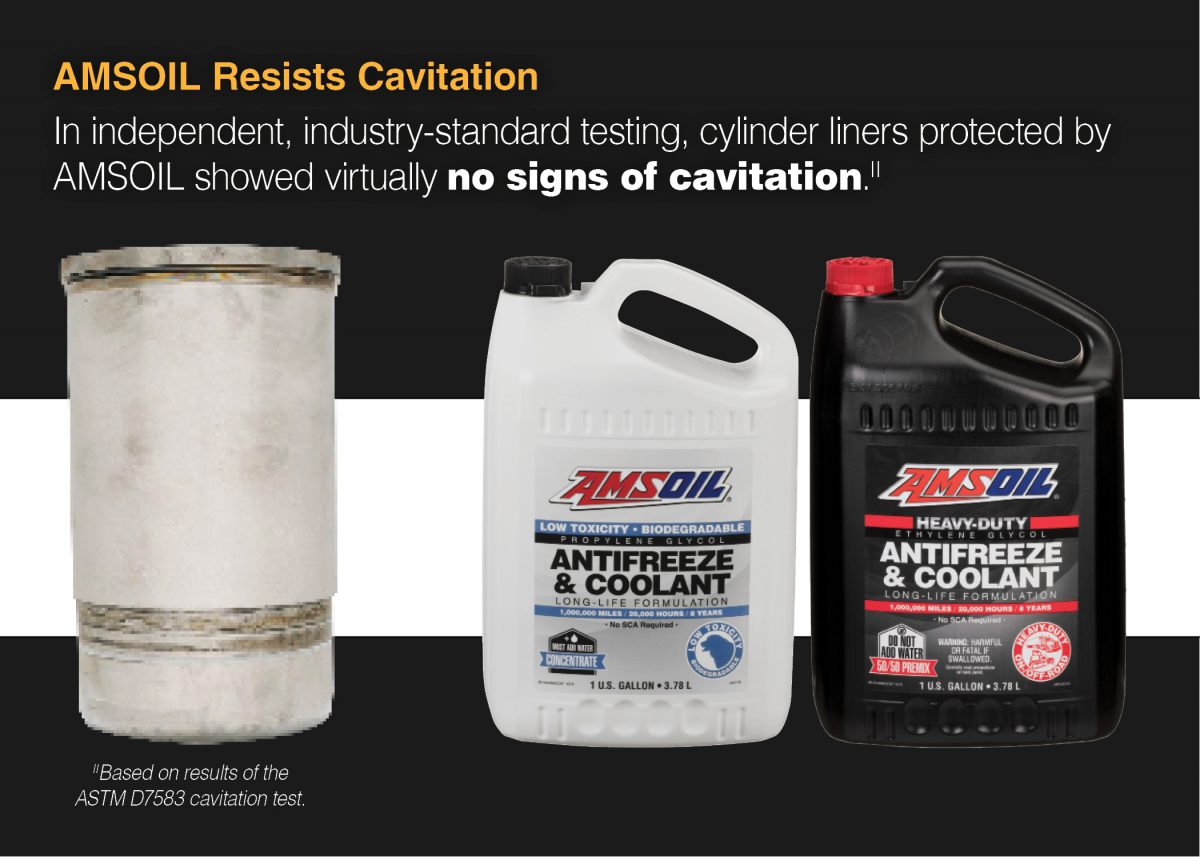
- Cavitation, or the erosion/corrosion of the cylinder liner, can occur if the coolant provides insufficient protection. Cavitation often results in internal coolant leaks, which can lead to engine failure.
Many of the issues outlined here can be resisted or prevented completely by using an antifreeze & coolant with organic-acid technology. While all coolants that pass relevant industry-standard testing provide a minimum level of protection, a properly formulated coolant using organic-acid technology provides the longest-lasting and best protection without the incompatibility issues that come with the inorganic salts found in “green” and hybrid coolants.
Water Quality is Critical
Low-quality or hard water is a leading cause of cooling-system problems. Minerals found in hard water, including magnesium and calcium, react with inorganic salts, like phosphates, found in conventional and hybrid coolants.
The byproducts form scale deposits on engine surfaces, reducing heat-transfer ability and contributing to damaging corrosion. For best performance, use only high-quality distilled water when mixing coolant. For maximum convenience, use a coolant pre-mixed with high-purity water.
AMSOIL Antifreeze & Coolant
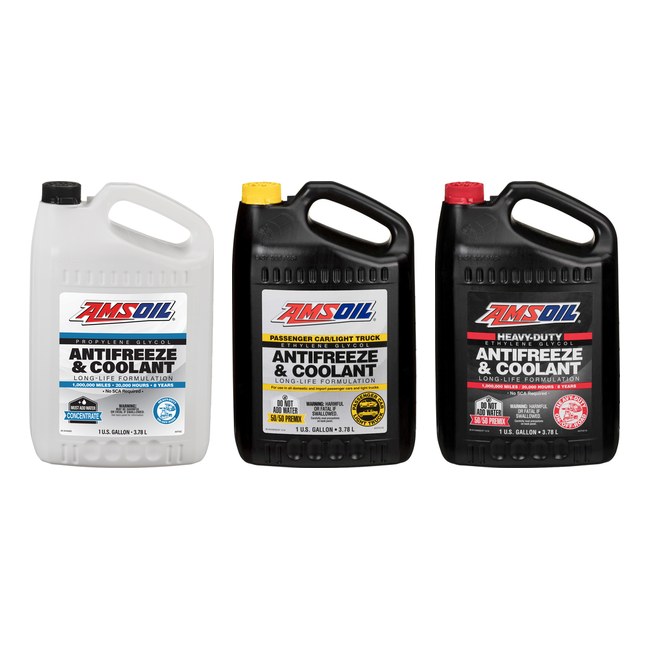
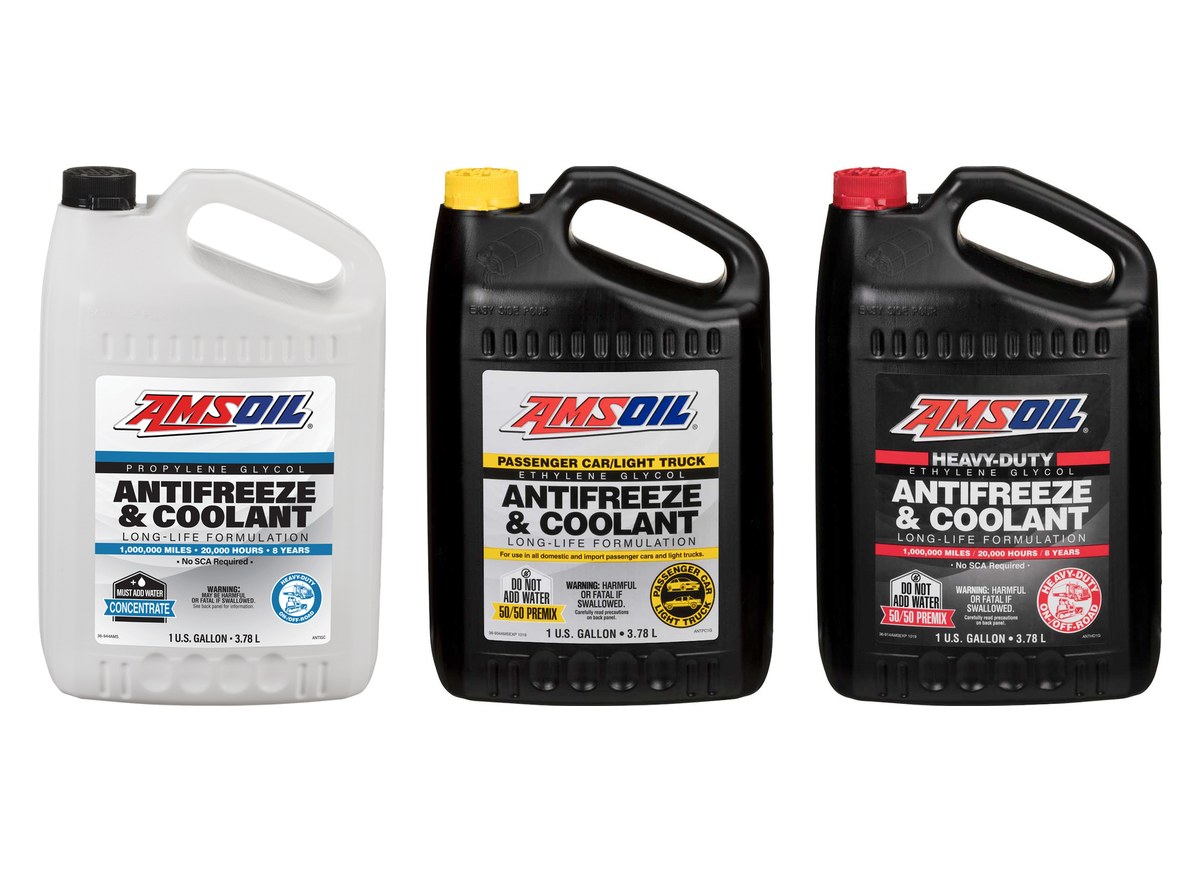
AMSOIL offers four coolants, all of which offer a unique blend of organic acids. AMSOIL uses di-acid technology, which means both ends of the organic acid are active. This makes them work faster and form stronger bonds for enhanced protection.
Passenger Car & Light Truck Antifreeze & Coolant is formulated for all passenger vehicles. It is premixed 50/50 with high-quality water and ethylene glycol and compatible with all other antifreeze and coolant colors.
Heavy-Duty Antifreeze & Coolant is dialed in for the unique needs of on- and off-road heavy-duty applications. It is premixed 50/50 with high-quality water and ethylene glycol and compatible with all other antifreeze and coolant colors.
Propylene Glycol Antifreeze and Engine Coolant is a 100% propylene glycol formulation. It is a concentrate that requires mixing with distilled or high-quality water and is compatible with all other antifreeze and coolant colors.
Powersports Antifreeze & Coolant is an extended-life formula good for up to five years in hot-running, high-revving powersports applications. It is available by the quart premixed 50/50 with high-quality water and ethylene glycol. It is safe for copper, brass/bronze alloys and aluminum and is widely compatible with other coolants.

So, why use coolant additives?
If a good antifreeze & coolant works so well, why bother with coolant additives that promise reduced engine temperatures and added corrosion resistance?
Because racers, competitors and enthusiasts want every advantage they can get to enhance engine performance. And a good coolant additive can provide that edge.

Reduced engine temperatures
An engine has a temperature “sweet spot” in which it produces maximum power and efficiency. Excessive heat reduces efficiency. It can cause metal parts to expand too much and contact each other, causing wear.
Competitors have a big incentive to tame extreme engine temperatures to protect their expensive engines and maximize their chances to win.
A good coolant additive can help by reducing the surface tension of water and allowing it to more efficiently absorb and transfer heat from the engine.

What are surfactants?
Coolant additives use chemicals called surfactants.
When water is agitated or heated, surface tension holds bubbles together before they burst. Since bubbles are filled with air, they reduce the water’s heat-transfer ability.
Imagine thousands of bubbles in the coolant passages of your engine as it runs. Eliminating these bubbles will allow the water to more closely contact metal, increasing its ability to absorb heat, thereby reducing operating temperatures and increasing efficiency.
Surfactants reduce the water and antifreeze’s surface tension so it can more effectively absorb and transfer heat from the engine.
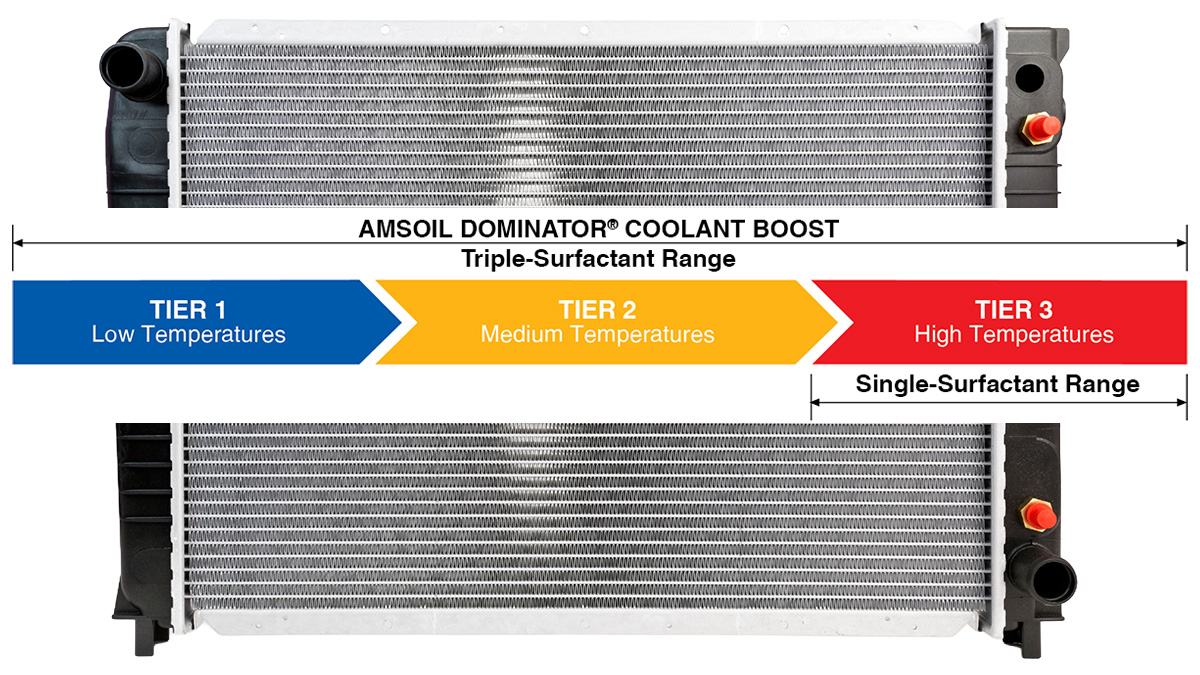
Many leading coolant additives, however, contain only one surfactant, limiting their temperature ranges and effectiveness.
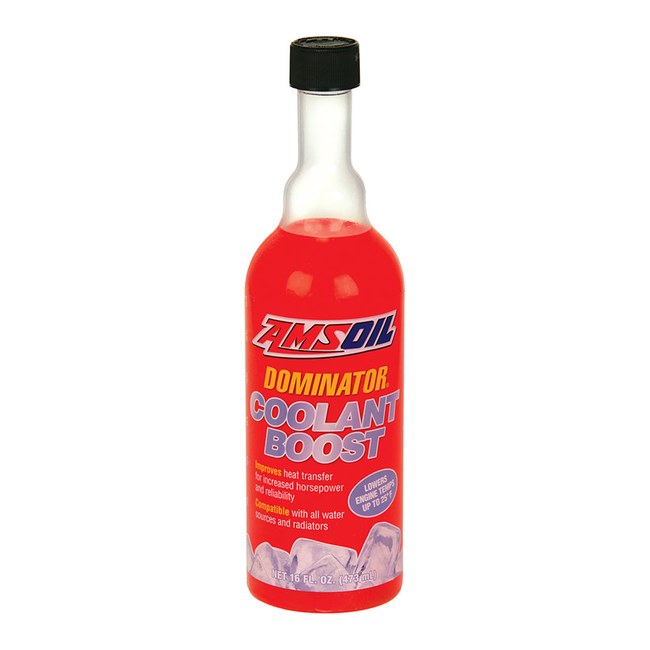
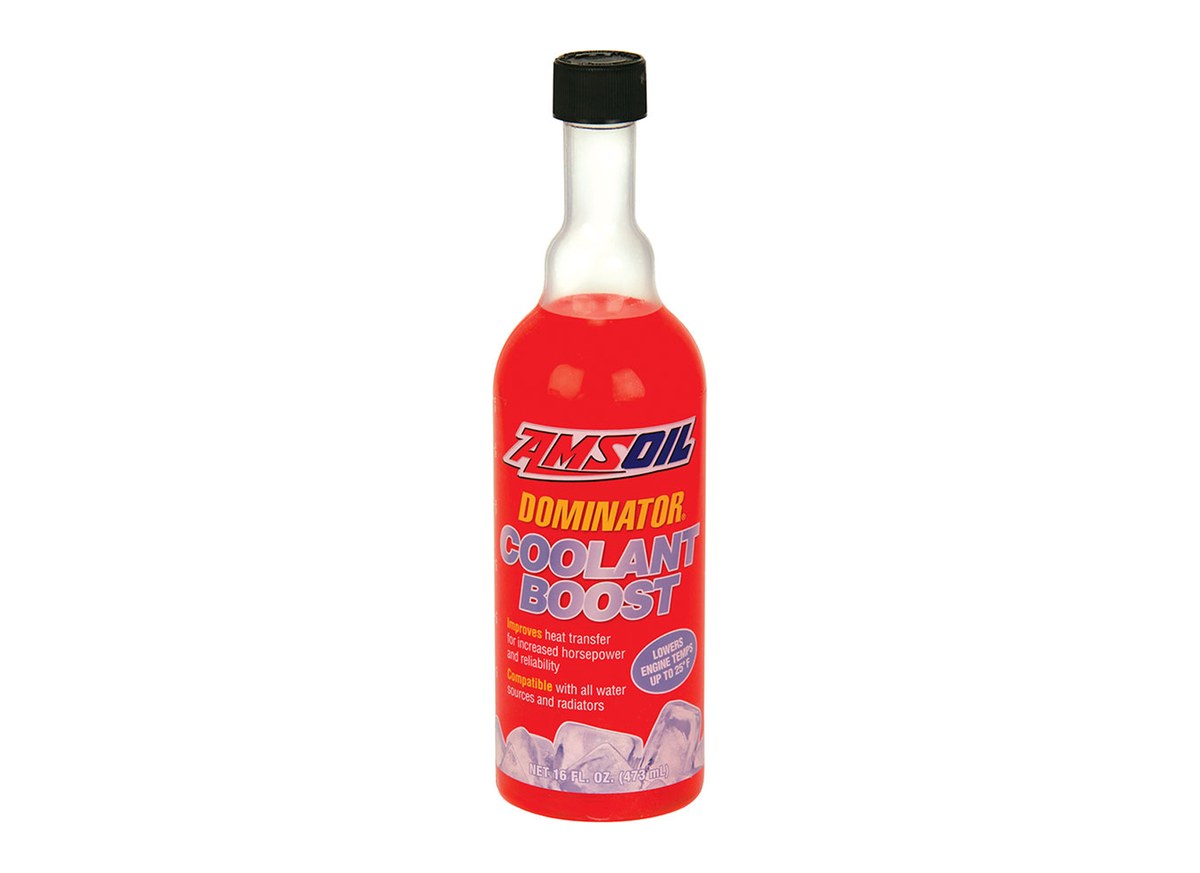
AMSOIL DOMINATOR Coolant Boost uses three surfactants, each designed to operate in a different temperature range to increase liquid-to-metal contact from the time the vehicle starts to the time it reaches operating temperature.

As a result, it reduces engine temperatures up to 25°F (14ºC) in straight-water applications.
This helps racers and competitors achieve maximum efficiency and horsepower.
Faster engine warm up
More efficiently transferring engine heat also helps DOMINATOR Coolant Boost warm the engine an average of 54% faster.
Racers appreciate this since they waste less fuel warming their engines.
Motorists in cold climates like it because it boosts driver comfort on cold mornings.
Improved corrosion resistance
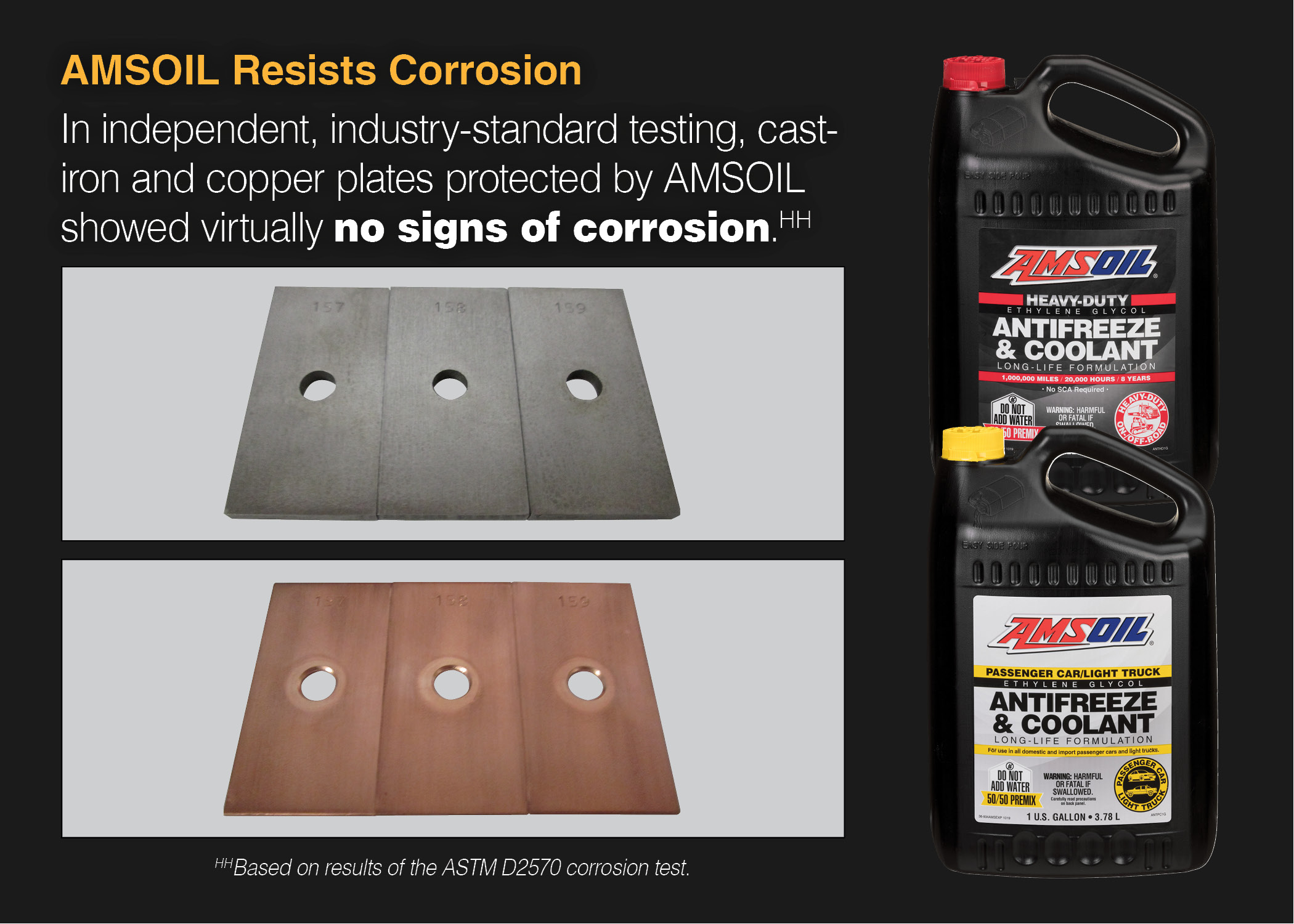
DOMINATOR Coolant Boost also delivers outstanding corrosion protection. In industry standard testing, it limited corrosion to the six metals most commonly found in cooling systems (copper, solder, brass, steel, cast iron and cast aluminum), easily passing both tests.
Check out the full results here.
This article is part of our Battery and Cooling System Care guide. See every article in the guide.

Comments
Brad Nelson is an AMSOIL Technical Writer II who develops content about lubricant technology, product performance and vehicle maintenance. He works with engineers and product specialists to translate testing, application requirements and approved performance claims into clear customer guidance. Nelson’s work includes AMSOIL Blog articles, AMSOIL Magazine features and technical explanations concerning motor oils, gear lubricants, vehicle systems and maintenance practices.
Share: