


 Battling a clutch that feels too “grabby” or too loose can ruin a race or a day of riding. Getting it just right depends on the frictional properties of your motor oil.
But first, a quick refresher on clutch basics.
As shown in the images, the clutch (from a Honda* CRF450) connects the engine and transmission via a series of alternating friction and steel plates.
To illustrate, imagine sitting aboard your bike in the starting gate with the clutch lever depressed. The friction and steel plates are separated, allowing the engine to run without the bike moving. The gate drops and, as you let out the clutch lever, the plates squeeze together. The transition from the friction and steel plates spinning independently to becoming locked together is an example of dynamic friction. Once the plates are locked together and spinning in unison, they’re subject to the principles of static friction.
Grab your chemistry set
Motor oil plays a vital role in both areas. The formulation influences the dynamic friction you experience, which is best thought of as clutch feel. Oils with incorrect frictional properties can result in inconsistent or loose clutch feel. This negatively affects your ability to confidently start quickly and grab the holeshot in a race, or maneuver around obstacles on the trail. The oil also contributes to the holding power, or static friction, between the plates once the clutch lever has been let all the way out and you’re riding. Oils with incorrect frictional properties can allow the plates to slip in some circumstances, which you’ll feel as lost power to the ground.
The oil’s additive chemistry has the greatest effect on performance. Friction modifiers, added to some passenger car/light truck motor oils to maximize fuel economy, can decrease the coefficient of friction within the clutch pack and result in excessive slippage. Extreme-pressure additives, commonly used in gear lubes to protect against shock loads and intense pressures, can cause excessive clutch slippage and related damage.
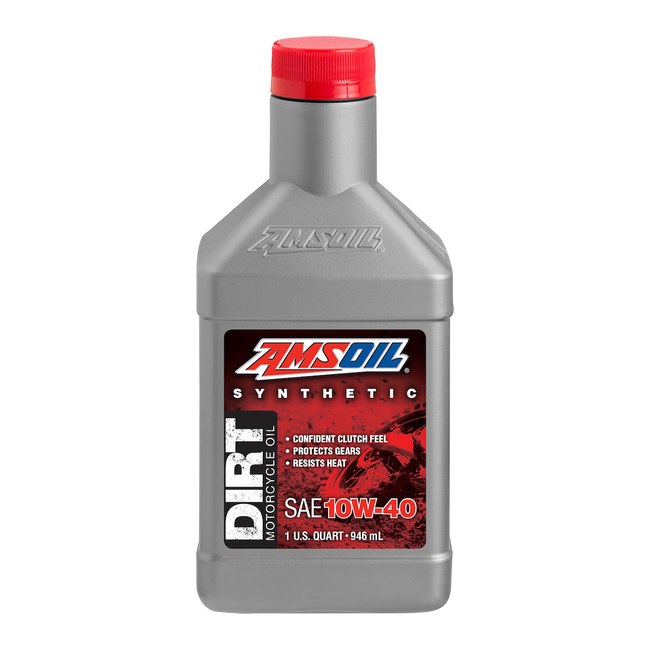
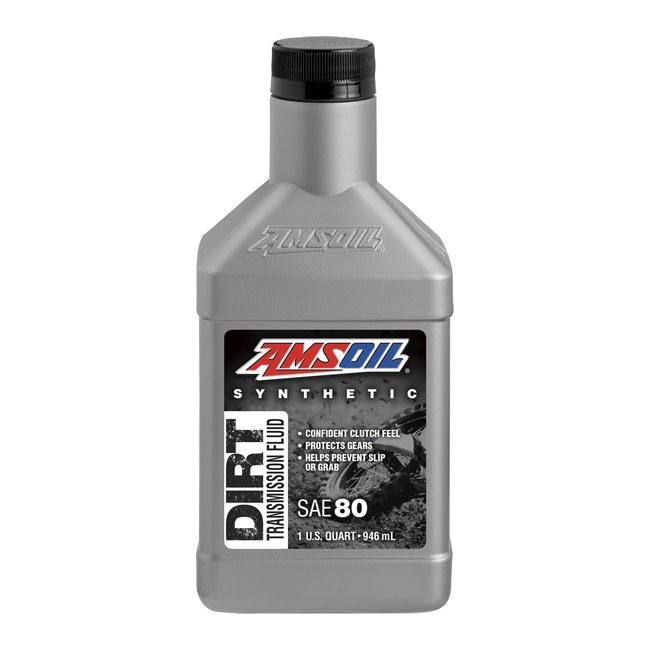
The key is to use a lubricant specifically formulated for wet clutches. AMSOIL Synthetic Dirt Bike Oil and Synthetic Dirt Bike Transmission Fluid contain no friction modifiers or extreme-pressure additives. They’re dialed-in with the correct frictional properties to promote smooth shifts and consistent clutch feel while guarding against wear for long clutch life.
That translates into consistent, confident shifts on the track or the trail.
Video transcript: How to Improve Dirt Bike Clutch Feel
Featuring John Gardner, host of Motorhead Garage, and Leonard “Len” Groom, AMSOIL Director of Product Marketing (author profile).
John Gardner: One engine and two wheels and a ton of fun. Pop the clutch and you’re off. Welcome to this AMSOIL tech tip. Now I said pop the clutch and you’re off.
That’s a perfect scenario. Why? Because we’re talking about the wet clutch system. You can see it right here.
It’s actually like an automotive clutch. What you have is you got some steels and some fibers in between here and a big spring that’s holding pressure on it. Goes inside of this basket. So when you push in the clutch, you’re actually gonna push in on these springs and then what that’s gonna do is free them up.
And when it frees it up, you’re not transferring any energy to the rear wheel. You let go of the clutch, bam, they squeeze together in the perfect scenario, you’re off and running. But with that comes some issues. Now the clutches themselves.
Inside the clutches, you have these plates and you have these steel things right here, these fibers. And what happens is it starts to wear out over time like this. And fluid plays an important role. But, Len, even more important, fluid plays a role in driver feel with that clutch.
This is huge.
Len Groom: It is a big deal. And we’ve spent a ton of time testing on this. The rider input is big on a dirt bike. You really need to have the lever feel to be consistent.
Meaning, want the lever to be somewhat progressive, but not super grabby so the bike takes off from underneath you. So the way you can influence that, there’s a couple different ways. Viscosity will play into that. The thicker the oil, the more progressive the the clutch feels.
The thinner the oil, the more grabby the clutch will get. It’s frictional characteristics that are kinda depicted in this chart. This is a real complicated way of putting numbers to lever feel.
And what they do is they classify it in different ways. So there’s a JASO MA, MA1, MA2, and then MB being the slipperiest. Our dirt bike oil is an MA1 [the current data sheet lists JASO MA]. That’s a perfect blend of additive and base oil to provide the rider with a consistent lever feel.
John Gardner: So what you’re saying, if it’s really thin, I may be able to slip the clutch a little bit. If it’s thick, perhaps I could stall it.
Len Groom: That’s correct.
John Gardner: That’s cool. Now that also has to do a big job. We’re talking about the transmission. We’re talking about all the engine components and the wet clutch in one system. So make sure you go to their website at AMSOIL.com. Check out these products and so many more.
This article is part of our Motorcycle Oil and Maintenance guide. See every article in the guide.
Recommended AMSOIL products
Start with AMSOIL synthetic motor oil and find the exact AMSOIL products for all your vehicles with the AMSOIL Product Guide.

Comments
David Hilgendorf is an AMSOIL Technical Writer who develops content for automotive, powersports and industrial audiences. His work includes technical data sheets, magazine articles, blog posts, white papers, product literature and application guidance. Hilgendorf works with engineers, laboratory personnel and technical specialists to communicate lubricant testing, product performance, maintenance practices, metalworking fluids, grease, motorcycles, marine equipment and industrial reliability.
Share: