

Lubricant-additive manufacturer Infineum* found that less than 60% of motorcyclists use a motorcycle-specific oil in their motorcycle. Clearly, many riders are unaware of the importance of using an oil formulated specifically for its intended application. In this post, we’ll look at motorcycle oil vs car oil and provide insight into why you should always use motorcycle oil in a motorcycle engine.
1) Motorcycles Run Hotter
In general, automotive engines are water-cooled. A typical automotive engine can reach 235°F (113° C) during operation, which is plenty hot.
Motorcycles, however, run even hotter, particularly big, air-cooled V-twins. For example, bikes made by Harley-Davidson* rely on air flowing across the engine for cooling, which is inherently less efficient at dissipating heat. This configuration poses additional challenges in stop-and-go traffic when there’s little airflow, especially on hot summer days. In fact, during testing in the AMSOIL mechanical lab, the rear-cylinder temperature of a 2019 Harley-Davidson Street Bob* with a Milwaukee-Eight* 107 engine surpassed 420°F (216°C).
Heat that intense causes some oils to thin and lose viscosity, which reduces wear protection. High heat also hastens chemical breakdown of the oil (called oxidation), which requires you to change oil more often. In extreme cases, the bike’s temperature sensors can shut down the engine if it gets too hot.
2) High rpm Destroys Lesser Oils
Motorcycles tend to operate at engine speeds significantly higher than automobiles. The average sport bike easily eclipses 10,000 rpm. Some have even pushed 20,000 rpm. Your car or truck’s redline doesn’t even come close. High rpm places additional stress on engine components, increasing the need for wear protection. It subjects oils to higher loading and shear forces, which can rupture the lubricant film and reduce viscosity, both of which increase wear. High rpm also increases the likelihood of foaming, which can reduce an oil’s load-carrying ability, further inviting wear.
3) Increased Power Density = Increased Stress
Motorcycle engines produce more horsepower per cubic inch than automobiles. They also tend to operate with higher compression ratios. Increased power density and compression lead to higher engine temperatures and increased stress. This places greater demands on motorcycle oil to fight wear, deposits and chemical breakdown.
4) Must Also Protect Transmission
Many motorcycles have a common sump supplying oil to both the engine and transmission. In such cases, the oil is required to meet the needs of both the engine and the transmission gears.
Transmission gears can shear the oil as it’s squeezed between gear teeth repeatedly at elevated rpm, causing some oils to lose viscosity. Many motorcycles also incorporate a wet clutch within the transmission that uses the same oil. Motorcycle wet clutches require a properly formulated lubricant that meets JASO MA or MA2 frictional requirements.
AMSOIL resists viscosity breakdown 6X better than Harley-Davidson SYN3* for improved protection against compensator and transmission gear wear.1
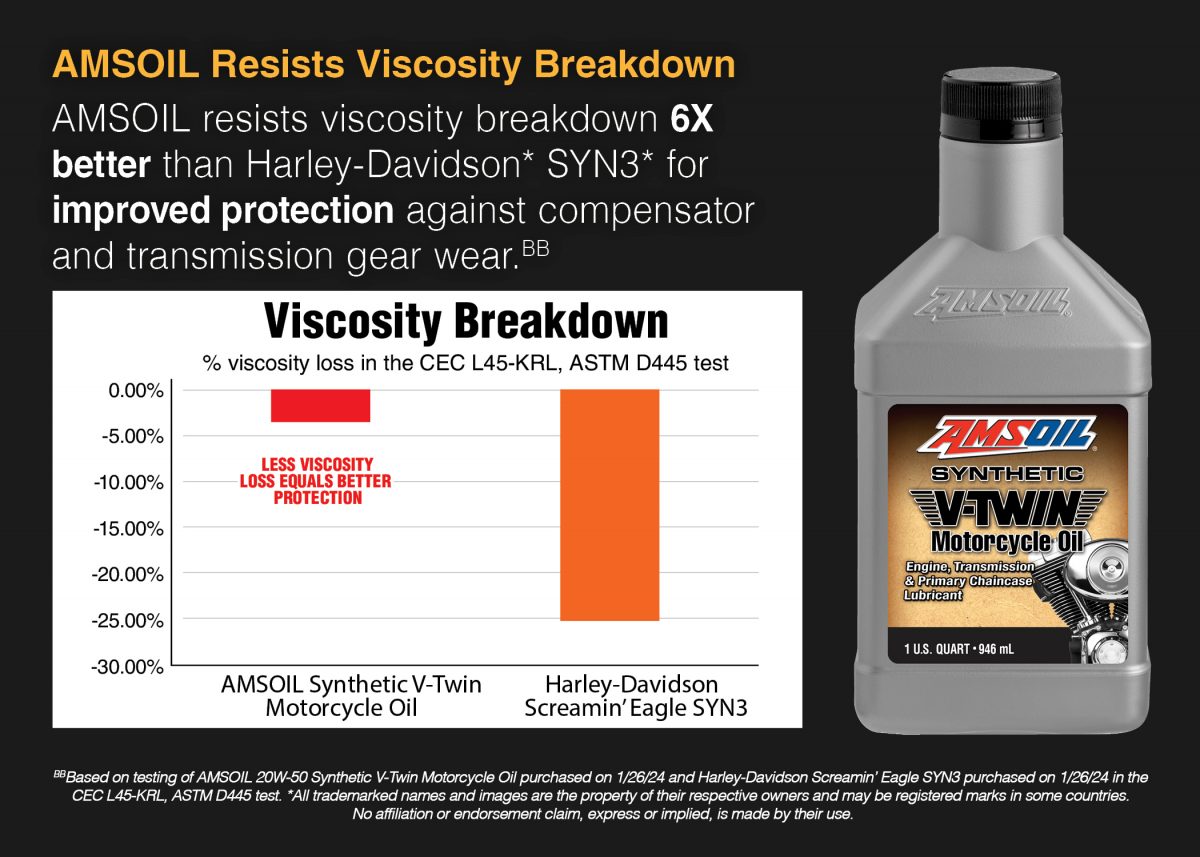
1Based on testing of AMSOIL 20W-50 Synthetic V-Twin Motorcycle Oil and Harley-Davidson Screamin’ Eagle SYN3 purchased on 3/19/19 in the CEC L45-KRL, ASTM D445 test.
5) Storage Invites Corrosion
Whereas cars and trucks are used almost every day, motorcycle use is usually periodic and, in many cases, seasonal. These extended periods of inactivity place additional stress on motorcycle oils. In these circumstances, rust and acid corrosion protection are of critical concern.
Motorcycle oil vs car oil
While a good passenger-car motor oil (PCMO) hits many of these performance areas, it doesn’t get them all. PCMOs usually contain friction modifiers to help boost fuel economy. Furthermore, PCMOs don’t meet JASO MA or MA2 requirements. If used in a motorcycle, they can cause slippage that prevents smooth clutch engagement.
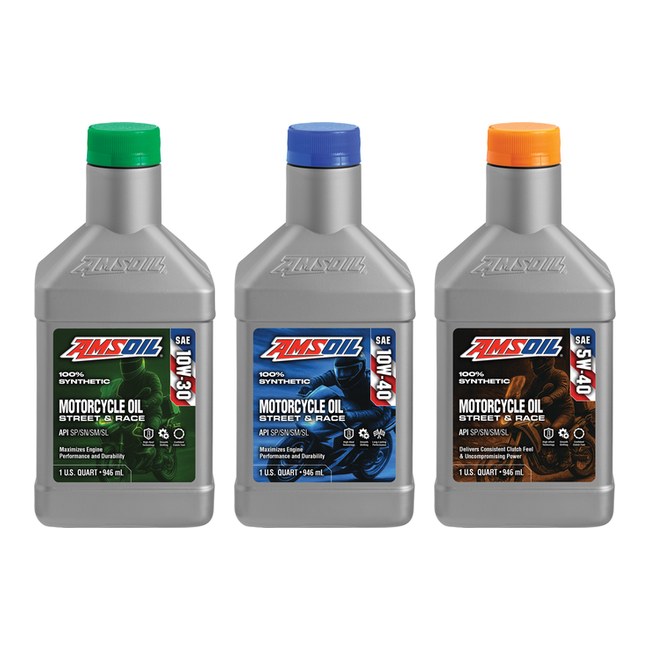
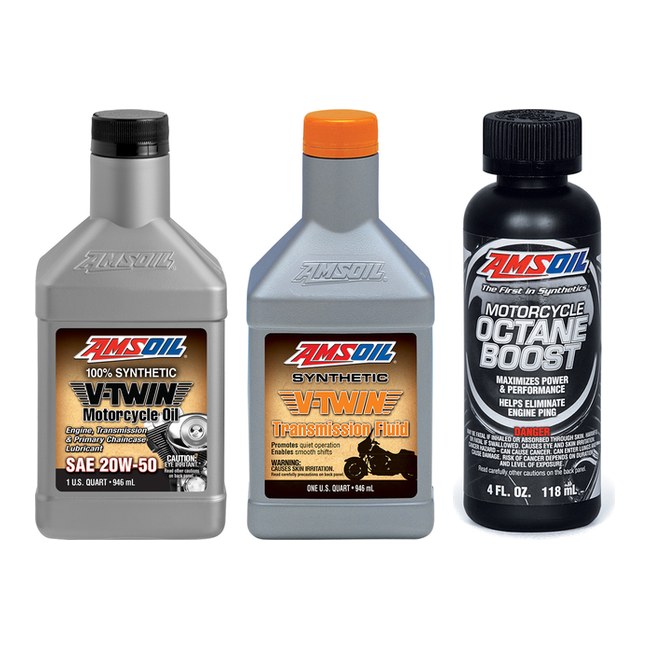
AMSOIL Synthetic V-Twin Motorcycle Oil and AMSOIL Synthetic Motorcycle Oil are designed for the unique demands of motorcycles. They are formulated without friction modifiers for precise, smooth shifts. They also contain a heavy dose of corrosion inhibitors to protect your engine against rust during storage. And they’re designed to resist viscosity loss due to shear despite intense heat and the mechanical action of gears and chains. AMSOIL synthetic motorcycle oils are engineered to deliver the protection and performance your bike deserves.
Video transcript: How Your Vehicle Uses Thermodynamics
Featuring John Gardner, ASE Master Certified technician, automotive technology instructor and host of Motorhead Garage, with AMSOIL Director of Product Marketing Len Groom.
John Gardner: Nothing better than some ice cold water. Now is it really cold? Is the cold going into my hand or is the heat going into the bottle? Welcome to this AMSOIL Tech Tip.
It’s all about the law of thermodynamics. That’s how vehicles work. Let’s take a look at a couple of coolant systems. Now you can see this first one here.
This is actually like your vehicle. This is a liquid cool system, and the law of thermodynamics says heat moves from hot to an area of less heat. So think about this. The coolant’s going into your engine about two hundred degrees, then your cylinder’s firing at about seventeen hundred degrees.
So while thermodynamics, bam, the heat’s gonna jump from the cylinder to the coolant, take a ride all the way up to the radiator. Now we’re at about two twenty, two thirty. The outside air is at eighty, seventy, sixty. Guess what? The heat jumps off to the outside air. We’re removing the heat from the block. Boom. Throwing it outside.
Now you can see it over here. This is a coolant system on a motorcycle here. We’re dealing with some Harley* products today and this is pretty cool. On this one, it’s firing. You don’t have that liquid cool. You just have air cooled. So you got that huge temperature inside of here and then you’re at the mercy of these fins here for heat transfer to the outside air. Actually, I have the cylinder right here.
You can see it, which is really cool, and my little piston. So what’s happened is the piston’s going up and down in there, firing, and then we’re getting that massive amount of heat, and we’re at the mercy of these fins to cool it. Len, that makes for problems. That’s a lot of heat and you actually have some proof here. Walk us through this clip.
Len Groom: It does. This is an air cooled engine that we had on the dyno here. We were simulating what this bike would see in like what we call a parade cycle where you take away all of the cooling air and just let the engine get very hot. As you can see, the oil temperature jumps to three hundred degrees very quickly.
John Gardner: Now that’s huge. I mean, we’re talking about Harleys and that twin cycle and all that thing going on in there. There’s a massive amount of heat. You guys got a product that’s gonna combat that or actually deal with that. Talk about it.
Len Groom: When you’re building something for an air cooled engine, it’s important that you look at viscosity breakdown as it relates to heat. So you wanna use a real robust base oil, high end synthetic type stuff to avoid that breaking down. And then this chart we’re showing here, you can actually see where the OEM product actually lost more viscosity than ours did six times more, actually.
John Gardner: Yeah. And AMSOIL actually says that that’s six times better than the OE oil. So go to the website at AMSOIL.com. Check out their Harley products and so much more.
This article is part of our Motorcycle Oil and Maintenance guide. See every article in the guide.


Comments
AMSOIL Staff articles draw on the combined expertise of AMSOIL engineers, chemists, Technical Services specialists, technical writers and product marketers. Content is developed from AMSOIL data sheets, laboratory and field testing, oil-analysis results and more than 50 years of synthetic-lubricant development. Topics span automotive, diesel, powersports, marine, small-engine, agricultural and industrial equipment, covering lubrication fundamentals, maintenance practices, product selection and real-world customer experience.
Share: