The short answer: To check power steering fluid, find the reservoir (usually a small translucent tank with a black cap), wipe the cap clean and read the level against the dipstick or hot and cold marks. Top off with the fluid your owner’s manual specifies. Change it on the manual’s schedule, or sooner if it looks dark and dirty; worn fluid wears the pump and makes it whine.
Checking power steering fluid is a simple task anyone can do. Yet, it’s often overlooked until the signs of low power steering fluid emerge, such as the pump whining and making noise. In this post, we’ll explain how to check power steering fluid and how to change it.
First, check your owner’s manual for recommendations on how often to check power steering fluid.
Since it’s so simple, I generally check power steering fluid anytime I check my oil level or before long trips.

Video transcript: How to Check Your Car’s Power Steering Pump
Featuring John Gardner, ASE Master Certified technician, automotive technology instructor and host of Motorhead Garage, with AMSOIL Director of Product Marketing Len Groom.
John Gardner: Let me get the cruise control set here. Alright, well, you’re going down the road. You turn the wheel to the right. Turn the wheel to the left.
You want two things to happen. First and foremost, you want the wheels to turn. Second, it would be nice if they would do it easily. Welcome to this AMSOIL Tech Tip.
It’s all about the power steering pump. Have one right here on our cutaway. You can see it. What’s going on?
Well, you got a low pressure side coming in here, and then you’re developing high pressure. How are you doing it? Well right in here inside the pump as it spins around. This is an engine driven pump.
Now you can have several types. Right here on the first one down there you have a rack and pinion. So you have a power steering pump going down to a rack and pinion. Old school cars well they used to use a gearbox like that but you still had a power steering pump going down to it you know new cars they have electric power steering pumps you don’t even have a steering pump anymore but there’s a few things you have to keep in mind if you do have a power steering pump. First of all, could have a roller, a vane, a slipper type pump.
There’s all different types but there’s tight clearances inside that pump to make the massive amount of pressure. Now to test it, well that’s pretty simple. You can get your gauge and you can go in with the power steering pump on the high pressure side. Make sure it’s a high pressure gauge.
Crank up the vehicle. You see you got about eight hundred psi there. That’s a lot. But what you want to do is turn the wheel to the right or to the left.
That’ll generate that maximum pressure from stop to stop.
Maximum pressure. You see it here on the gauge. It’s going to jump up. It’s going to skyrocket fourteen hundred.
You can develop about sixteen hundred PSI. You can also deadhead the pump by closing it. You want to make that pressure and that pressure has to be right, Len. But the fluid takes a beating in there as well.
Len Groom: It does. The and the thing of it is, is that you can’t cheat and have a really heavy fluid in there because heavy viscosity a lot of times provides you with that cushion and it’ll help the protection. But in this case, you can’t do it. The pump has to be fast. Thin fluid is what you want here because you need your steering to be responsive. So what happens is the tendency for wear inside that pump becomes pretty great. So you really have to watch it and make sure that you’re using all the good stuff in the power steering fluid to keep wear from occurring.
John Gardner: Yeah, and that’s what’s happened. And this is a centrifugal pump called a vein pump. It’s flinging around and centrifugal force is sending these veins out and these veins are running on this outside chamber. You can see somewhere in there, right Len?
Len Groom: Right, yeah. It’s a metal on metal surface. The only thing providing the protection is the oil. That’s it. So if it fails, the pump fails real quick.
John Gardner: And fluid is important. So is that the filter. If you have any kind of failure, let’s say that rack and pinion to gearbox blows into pieces or your pump you’re setting metal around there so it’s a good idea to flush your fluid. Hey this is a maintenance item as well people should go in there and flush their fluid once in a while right?
Len Groom: Yeah you should I mean it is a maintenance item follow your recommended intervals for that but yeah it’s a good idea.
John Gardner: Having steering is a must, but having power steering? Well, that’s even better. Make sure all aspects of your vehicle are operating at their best, and you can do that by going to AMSOIL.
Step-By-Step: How To Check Power Steering Fluid
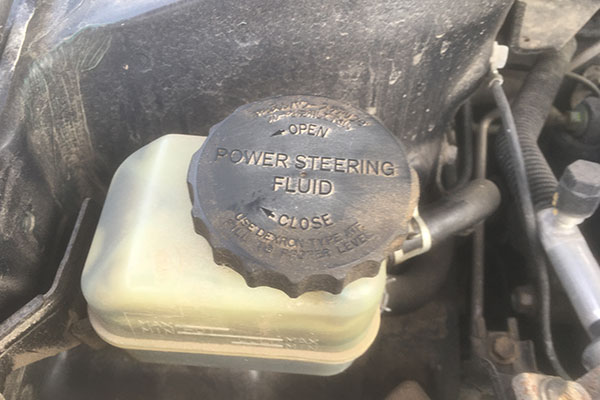
1. Locate the Power Steering Fluid Reservoir
Its location differs for every vehicle. It’s usually a small, clear container with a black cap. Many vehicles have marks on the outside of the reservoir to indicate “MAX” or “MIN.” Ensure the fluid level is above the “MIN” mark but not overfilled.

2. Check Dipstick (If Equipped)
Other vehicles have marks on the dipstick, similar to an oil dipstick. In this case, remove the cap and wipe the dipstick clean. Reinstall the cap, ensuring it’s completely seated.
3. Remove Cap Again And Check Fluid Level
Ensure it’s at the appropriate level. You may see marks for “full hot” and “full cold,” so ensure you’re referencing the correct mark depending on whether the engine is hot or cold.
4. Add Power Steering Fluid
Top-off the reservoir if needed to fill to the appropriate level.
When Do I Change Power Steering Fluid?
Check the owner’s manual for recommendations on how often to change power steering fluid.
However, if it’s been a while (like, never) and the fluid appears dark and dirty, go ahead and change it.
This image shows the dramatic difference between old and new power steering fluid.

Like any other lubricant, power steering fluid accumulates wear material, moisture and other debris. The fluid also wears out due to oxidation. Worn out power steering fluid can cause the pump to whine and make noise.
It’s a good idea to change power steering fluid before you end up replacing the pump, which is far more expensive.
How Do I Change Power Steering Fluid?
The process differs depending on your vehicle. Check your owner’s manual or a service manual for instructions specific to your car or truck.
In general, though, most power-steering systems have the same configuration.
A high-pressure hose carries fluid from the power-steering pump to the steering rack. A low-pressure hose returns the fluid back to the reservoir. The cycle repeats as the engine is running.
Flushing The Power Steering System
Completely flushing the power steering system requires some technical know-how and can be a mess. It’s also helpful to have a helper on hand.
- Disconnect the low-pressure return hose and direct it into a bucket or drain pan. You probably will need a length of hose to reach the pan.
- Then, have someone start the engine and turn the steering wheel as far as it goes in both directions. This will pump old fluid into the drain pan.
- To prevent air from entering the system, have a helper near the reservoir with a couple bottles of new power steering fluid. Add fluid as needed to prevent the reservoir from running dry.
- Once your helper sees new fluid draining into the pan, shut off the engine and reconnect the hose.
Avoid allowing air into the system so you don’t have to bleed it.
An Easier Way To Change Power Steering Fluid
While flushing the system completely is best, you’ll inevitably run into hurdles.
- Rust on the hose clamps will likely prevent removal without breaking them./li>
- The hose you’ll need to disconnect to drain the system will inevitably be buried at the bottom of the engine bay; you may need to recruit Plastic Man to reach it.
- And, of course, you’ll likely mess up your garage floor with power steering fluid.
The “Poor Man’s” Power Steering Flush
While this procedure won’t remove all the old fluid, like flushing the system will, it will remove most of it. And it’s much easier and cleaner.
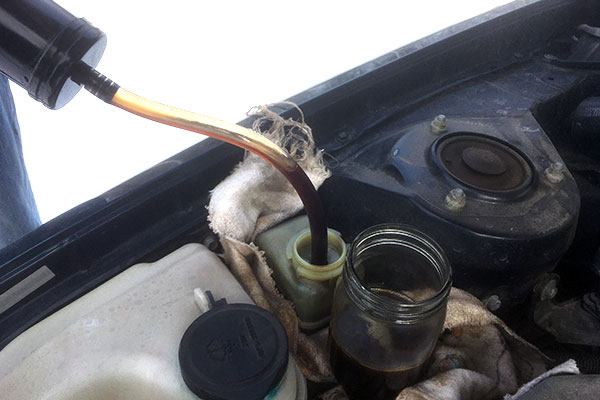
- Place some rags around the fluid reservoir and place a catch can nearby.
- Using a fluid extraction pump or turkey baster, remove the old fluid and empty it into the catch can. Leave enough fluid in the reservoir to cover the hose inlets. This prevents air from entering the system.
- Add new fluid to the reservoir and run the engine. Turn the wheel from side to side as far as it goes a few times.
- Turn off the engine and repeat the first three steps until the fluid is clean.
You can also drive as normal for a day or two and repeat until you’ve cycled most of the old fluid through the system.
This simple procedure removes much of the old fluid quickly and easily. I’ve performed it on a couple different vehicles with good results.