

We conducted a two-stroke snowmobile oil comparison to see how some of the top snowmobile oils on the market handle -40º temperatures.
That’s because oil cold-flow is vital for good wear protection in modern two-stroke sleds.
The same demands driving changes in the automotive market are influencing two-stoke engines as well. The government requires reduced exhaust emissions, yet you don’t want any sacrifices in power and fuel efficiency.
Play nice, kids
What’s a two-stroke engine manufacturer to do?
These three areas – reduced emissions, increased fuel economy and maximum performance – don’t play well together. It’s extremely difficult to build an engine that hits all three targets given the constraints of two-stroke engine design.
Because they don’t contain intake and exhaust valves like a four-stroke engine, controlling emissions in two-strokes is a big challenge.
One strategy in today’s oil-injected engines is to adjust the fuel/oil ratio to use less oil.
While this reduces emissions, it comes at a cost since using less oil increases operating temperatures and invites several problems.
A pair of popular snowmobile engines offer great examples of the innovation we’re seeing in the market.
Arctic Cat* C-TEC®
The Arctic Cat C-TEC engine uses electronics that adjust the fuel/oil ratio depending on operating conditions. In one promotional Arctic Cat video, we’re told to expect fuel/oil ratios as high as 65:1 in the C-TEC2 engine, depending on conditions.
Less oil means lubrication becomes more challenging. What little oil is available to protect critical engine parts must reach components quickly, particularly in sub-zero cold.
Go with the cold-flow

The C-TEC uses an interesting configuration to deliver oil to the wrist pin and bearing.
The fuel/oil mixture is injected into the boost-port side of the cylinder. At higher rpm, oil is also injected into the crankcase through a slot in the piston. The setup, according to Arctic Cat, improves performance, emissions and fuel economy.
Ski-Doo* E-TEC*
Ski-Doo’s E-TEC engine offers another example.
Like many cars and trucks today, the E-TEC uses direct injection. Placing the fuel injectors directly in the combustion chamber allows precise control over the injection event, which improves power and reduces emissions.
This arrangement, however, comes with challenges.
In a traditional two-stroke engine, fuel and oil are mixed prior to entering the engine, which helps the oil flow at lower temperatures since fuel reduces oil viscosity.
In the E-TEC, fuel and oil are mixed only in the combustion chamber, so the bottom end of the engine – the crankshaft and rods – are lubricated by oil alone, making the oil’s cold-flow properties critical.
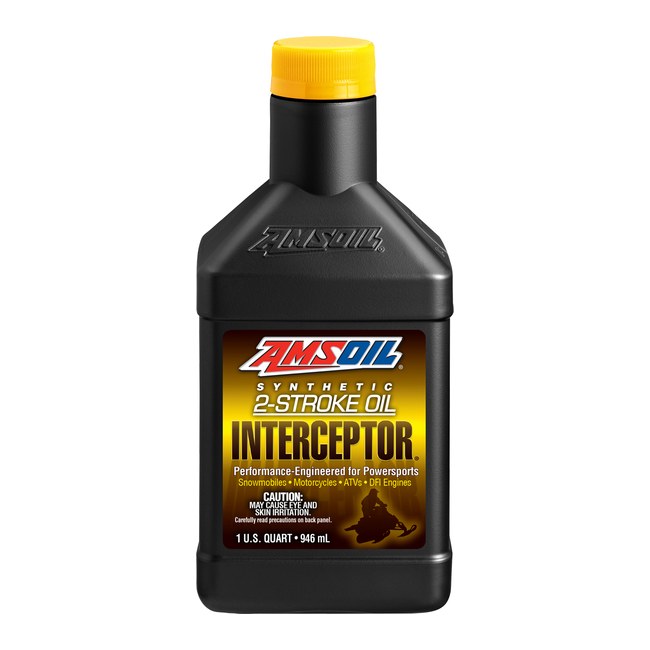
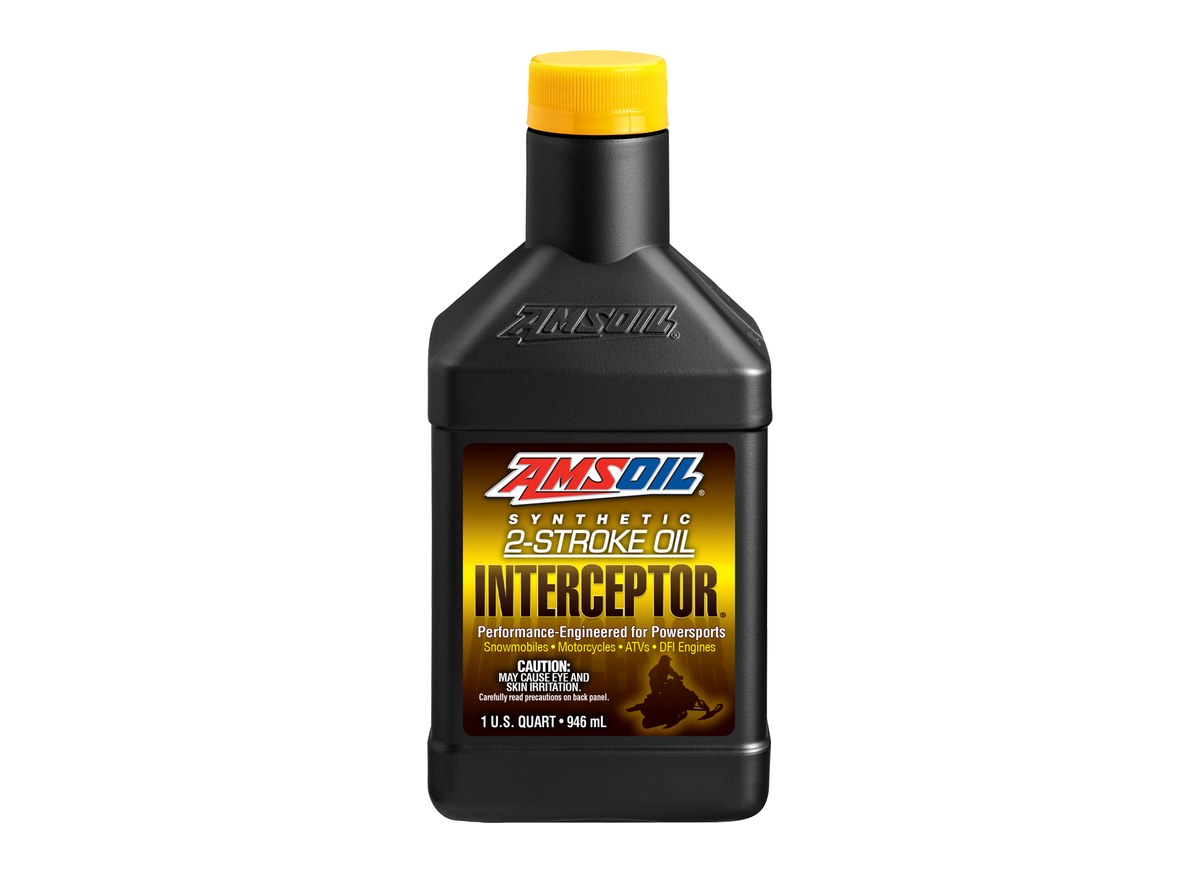
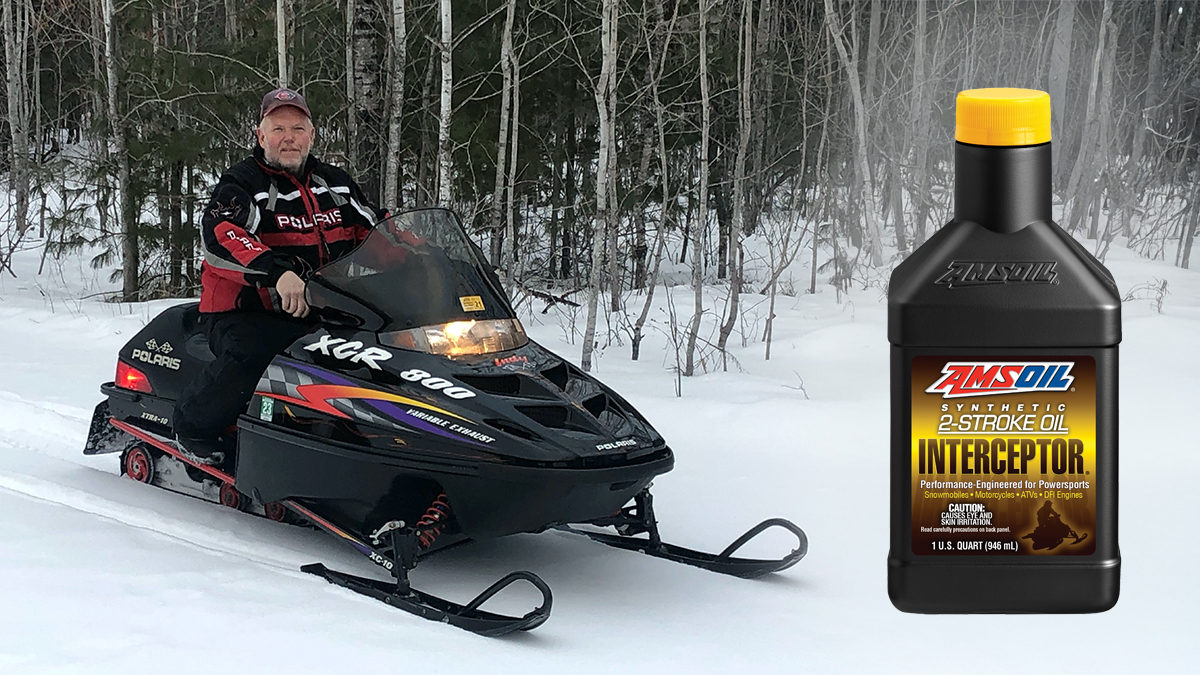
We thought it might be interesting to run a two-stroke snowmobile oil comparison using our best all-around snowmobile oil – AMSOIL INTERCEPTOR® Synthetic 2-Stroke Oil – and the three top sled manufacturer’s oils:
- Ski-Doo XPS* 2-Stroke Synthetic Oil
- Arctic Cat 2-Cycle Synthetic CTEC-2® Oil
- Polaris* VES* Full Synthetic 2-Cycle Engine Oil
Two-Stroke Snowmobile Oil Comparison
How does INTERCEPTOR’s cold-flow match-up? Check out the video to find out.
Video transcript: INTERCEPTOR Cold Flow Test
As snowmobile season approaches, the question always comes up: Does the oil work well in the cold? And we’ve been hearing from the manufacturers of all the major snowmobiles that the oil needs to perform well in the cold. Now, even though INTERCEPTOR has always done well, we felt that we needed to prove it. So we took INTERCEPTOR to the AMSOIL lab.
We put it in a freezer. We took the temperature down to minus 40F, and we put INTERCEPTOR in a pour test against each one of the major competitors. Our first candidate was the Ski-Doo* XPS synthetic product. As you can see here, when we pour it, the AMSOIL starts to come out a little bit before the Ski-Doo product.
Next up was the Arctic Cat* C-TEC2 product. Now, Arctic Cat has been talking a lot about cold temperature performance. Their engine design dictates that the oil move quickly when you start the snowmobile. So, as you can see here, the AMSOIL INTERCEPTOR pours very well when put up against the Arctic Cat C-TEC2 product.
Last up was the Polaris* oil. This is the Polaris VES 2. This is Polaris’ synthetic recommendation. Again, it was in the freezer at minus 40F, the same amount of time that the AMSOIL INTERCEPTOR was in there.
You can see we start to pour, and the AMSOIL outperforms the Polaris oil by quite a lot here. What that means is, when you go to start your snowmobile in some very, very cold temperatures, that the AMSOIL product will get to the critical parts of the engine faster. So, as you can see, AMSOIL INTERCEPTOR holds up pretty well against the OEM’s products. What does that mean?
It means that you should have the utmost confidence when you pour INTERCEPTOR into your snowmobile. It also means less wear, better performance and more fun on the trail for you.
This article is part of our Snowmobile Oil and Maintenance guide. See every article in the guide.
Recommended AMSOIL products
Start with AMSOIL Snowmobile Oil and check out the AMSOIL Product Guide to find additional AMSOIL products specifically designed for your sled.
Interesting comment, given that only AMSOIL offers an engine protection guarantee when you exclusively use their oil. No manufacturers do that. In addition, every manufacturer is buying their oil from someone….they do not make it just specify what additives they want in it. Why not just buy it direct from the manufacturer…….whoever that is.
Bobby R I can see that you do not have a clue what you are talking about.
I have been riding since the mid-70s. When I lived in Northern Michigan I rode at -28 many times. AMSOIL performed perfectly!
With a miserable 100c visc at 6.4, and a low VI, what else do you expect it to do….
Interesting…scared to put my comment on your site?
Your comment is awaiting moderation.
Please shoot me a list of all the people riding at -40! Amsoil is a great oil in conditions that no one will ever ride. How does it stack up during normal riding conditions?
Would an OEM really spend all the time and money developing an oil that wasn’t the best for their machines? Keep building your pyramid schemes!
jb
Hi jb,
No, we’re not scared to post your comment.
If AMSOIL INTERCEPTOR works that well at -40º, imagine how it performs at warmer temperatures.
Even so, you’re under no obligation from us to buy or use it. If you’re happy with your current oil, great.
Thanks for reading.
Actually with a 100c at 6.4, and a very low VI, blended off a run of the mill POA??? Coming out of the bottle is the only place it performs at all….