

Synthetic oil is the best winter motor oil.
We’re done here.
If only it were that simple. But most people want empirical data to support such claims.
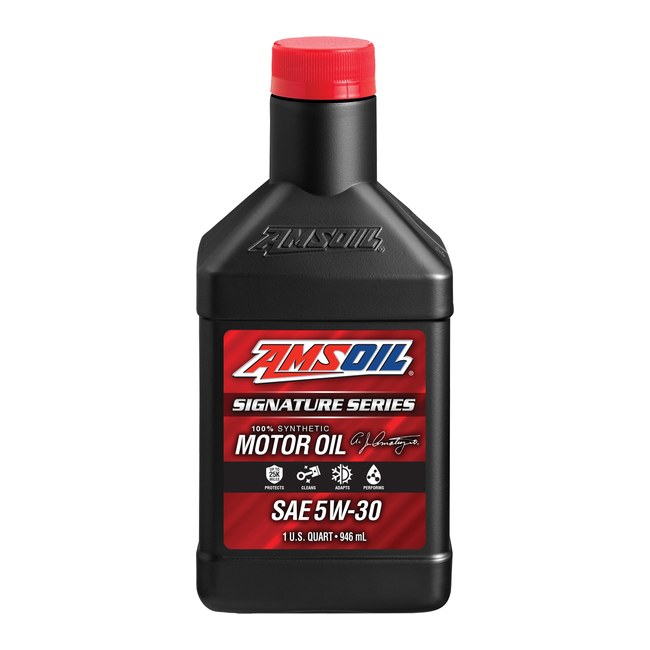
Well, take a look at the video. We cooled a conventional 5W-30 motor oil and AMSOIL Signature Series 5W-30 Synthetic Motor Oil to -40º.
As you can see, the conventional oil thickened so much that it barely flowed from the beaker. The AMSOIL product, on the other hand, flows almost immediately.
Video transcript: Cold Pour Test: AMSOIL Synthetic Oil versus Conventional Oil
One of the key indicators of lubricant quality is its ability to flow at low temperatures. Liquid lubricants thicken as the temperature decreases until they reach a point at which they are no longer liquid. As they thicken, their ability to circulate is significantly impaired. To demonstrate this, let’s compare two different 5W30 motor oils and see how they perform at very low temperatures.
The oil on the left is a leading conventional motor oil, and the one on the right is AMSOIL Signature Series synthetic motor oil. Both oils were chilled to a harsh 40 degrees below zero Celsius before being placed in the transfer device you see here. Look at the glasses as they are tilted forward to allow each oil to drain. Extreme cold is no problem for AMSOIL Signature Series synthetic motor oil.
Almost instantly, AMSOIL begins to flow from its glass in a continuous and steady stream. Note that the regular product barely moves. Even after a full minute, the grease couldn’t flow out of the glass. Up to 60% of total engine wear occurs during cold starts, before the oil has time to circulate through the engine.
Minimizing this delay significantly reduces the likelihood of wear and helps extend the life of the oil. This also helps the engine start quickly and reliably at low temperatures. Low-temperature performance is another area where AMSOIL synthetic motor oils help protect your engine.
Why the dramatic performance difference? In answering that question, I’ll also answer the question hoss61761 poses on social media:

Conventional oils contain waxes that solidify when the temperature drops.
This severely impairs the oil’s ability to flow when you crank your engine.
In some cases, the oil can thicken so much that it prevents the crankshaft from spinning fast enough to start the engine.
Prior to using AMSOIL, I had a Cutlass Ciera that was notorious for refusing to start on our cold Minnesota mornings. The dirt-cheap big-box-retailer oil I used back then thickened so much the engine would barely turn over.
Why synthetics are a better winter motor oil
Synthetics, in contrast, don’t contain waxes due to the chemical-reaction process used to construct synthetic base oils.
As a result, synthetics demonstrate far better cold-flow properties than conventional oil.
Not only will your vehicle start more easily [I’ve yet to have one of my vehicles using AMSOIL fail to start, even with temps pushing -30°F (-34°C)], the oil will flow more quickly, ensuring oil reaches vital components faster.
This, in turn, maximizes wear protection, helping your engine last longer.
Check the oil’s pour point
If you want more data to prove synthetics’ superiority as a winter motor oil, check the oil’s product data sheet.
Look for the oil’s pour point. Lower numbers indicate better cold-flow, thus better cold-weather performance.
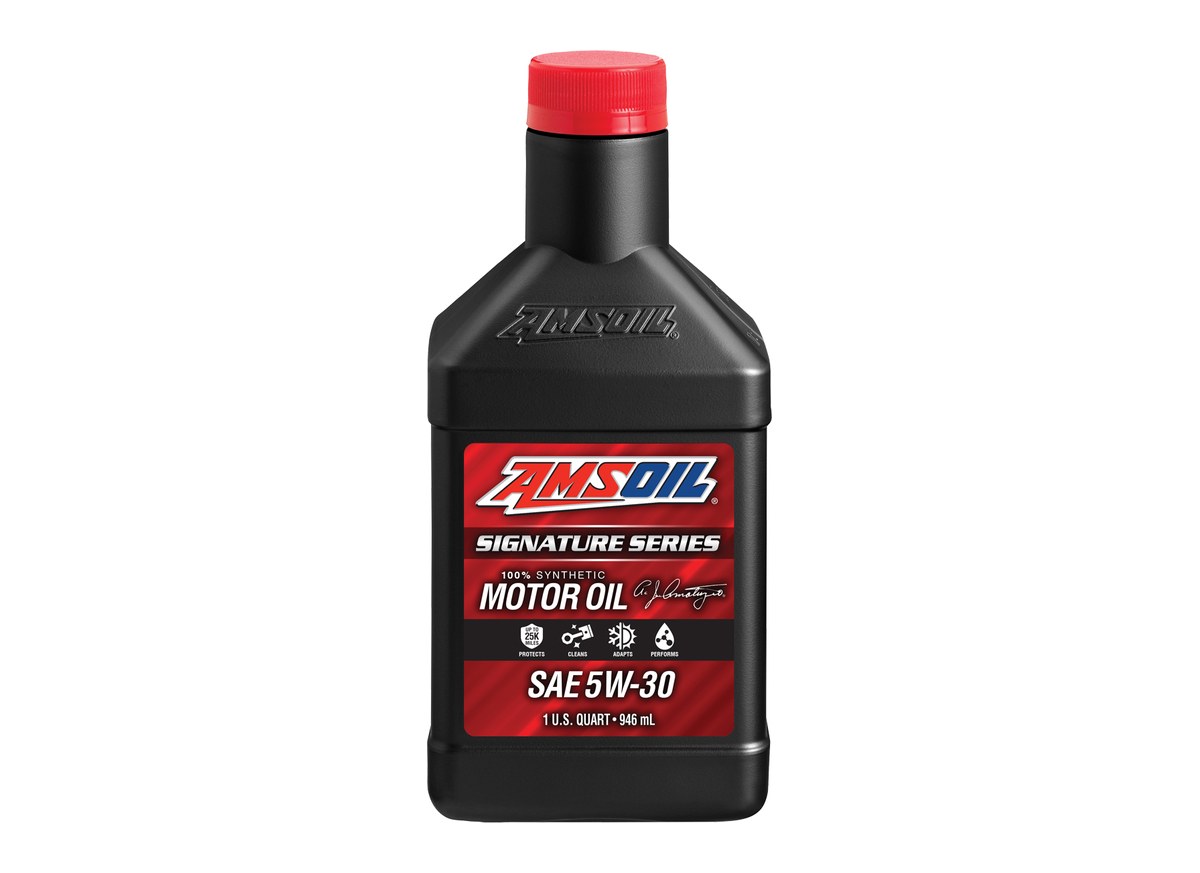
In the table below, you can see that AMSOIL Signature Series 5W-30, the same oil shown in the video above, has a pour point of -54°F (-48°C).
| Grade | Cold-crank viscosity (ASTM D5293) | Pour point (ASTM D97) | NOACK volatility (ASTM D5800) |
|---|---|---|---|
| 0W-16 | 3,897 cP @ -35°C | -53°C (-63°F) | 8.4% |
| 0W-20 | 4,118 cP @ -35°C | -54°C (-65°F) | 7.2% |
| 5W-20 | 3,874 cP @ -30°C | -51°C (-59°F) | 5.6% |
| 0W-30 | 4,450 cP @ -35°C | -50°C (-58°F) | 8.7% |
| 5W-30 | 3,791 cP @ -30°C | -48°C (-54°F) | 5.3% |
| 10W-30 | 3,917 cP @ -25°C | -48°C (-54°F) | 3.9% |
| 0W-40 | 4,878 cP @ -35°C | -50°C (-58°F) | 7.6% |
| 5W-50 | 4,354 cP @ -30°C | -48°C (-54°F) | 6.3% |
Typical properties from the Signature Series data sheet (G2880). Typical values are not manufacturing specifications.
What is cold?
Not to get existential here, but it’s a relevant question.
Folks in the south whose idea of winter is putting socks on for a couple weeks in January may think they’re off the hook.
Do they need to waste mental energy on motor oil cold-flow properties?
Good cold-flow is important to Southerners, too
Engineers agree that most engine wear occurs during cold starts. There are several reasons, but two concern us for this discussion:
- Gravity causes much of the oil to fall back into the oil sump, leaving components unprotected
- Cold oil doesn’t flow immediately at startup, temporarily starving the engine of oil
While true that oil thickens more in sub-zero winter weather and causes increased starting difficulty, an engine is considered “cold” after it’s sat long enough to cool to ambient temperature, typically overnight.
As the oil inside your engine cools, its viscosity increases (it thickens).
When it’s time to start your vehicle in the morning, the thicker oil doesn’t flow through the engine as readily as it does when it’s at operating temperature.
It’s during this time that vital engine parts can operate without lubrication, increasing wear. So, even in warm climates, cold-start wear is a problem.
Southerners are well-advised to use a good synthetic oil with excellent cold-flow properties, too.
Thick or thin winter motor oil?
Motorists sometimes ask if they should use thicker or thinner oil in the winter. Fortunately for them, we wrote a whole post on that topic. Check it out here.
To summarize, use the lowest viscosity oil your vehicle manufacturer recommends in the winter.
Most automakers recommend a lone viscosity year-round. But some allow you to switch to a lower viscosity in winter, which helps improve cold-flow.
If your owner’s manual says you can switch to a lower viscosity oil in winter, go for it.






These are great tips for car oil. Considering the weather is great way of consider vehicle repairs and checks. Whether it’s your car’s engine, tires, or oil, you need to know when to have them check and replaced. Thanks for sharing this information up here.
I have a friend who has a Toyota Rav 4 and it calls for 0-16 the year is a 2019 does Amsoil put out his type of oil.
Hi Robert,
Yes, we offer OE 0W-16 Synthetic Motor Oil.
Thanks,
John
Yes, AMSOIL does produce a 0W-16 Motor oil. PART# OES-qt-ea for one Qt bottle or PART # OES-qt-CA for a case of 12 Qts.