


Nothing starts a social-media firestorm like sharing your opinions on politics, religion or the best motorcycle oil.
Video transcript: How to Protect Your Metric Motorcycle
Featuring John Gardner, host of Motorhead Garage, and Leonard “Len” Groom, AMSOIL Director of Product Marketing (author profile).
John Gardner: Way of life, power and dreams, and let the good times roll. Welcome to this AMSOIL Tech Tip. Now those are all slogans when it comes to metric bikes. What is a metric bike?
Well, we’re talking about Yamaha*, Suzuki*, Honda*, and, of course, Kawasaki*. And those bikes, well, they need service too. You can see it right here. Performance, the checklist, the oil, the oil filter, everything needs to be done.
But what you notice here, there’s just oil and replace the oil. There’s no primary. There’s no secondary. There’s no gearbox.
Everything’s done in one unit. Now what’s the difference between the two? Here’s an actual American made bike here. You can see like a Harley*, it’s actually air cooled versus the liquid cooled.
So you got liquid cooled. It’s not gonna run as hot. But really neat, if you look at the exploded view of the motor there, well, you got the crank case, you got the wet clutches, you got the everything in there. The connecting rods all need to be lubricated.
And, Len, they need to be lubricated with one oil. That’s a tough job to do. AMSOIL has us covered there as well.
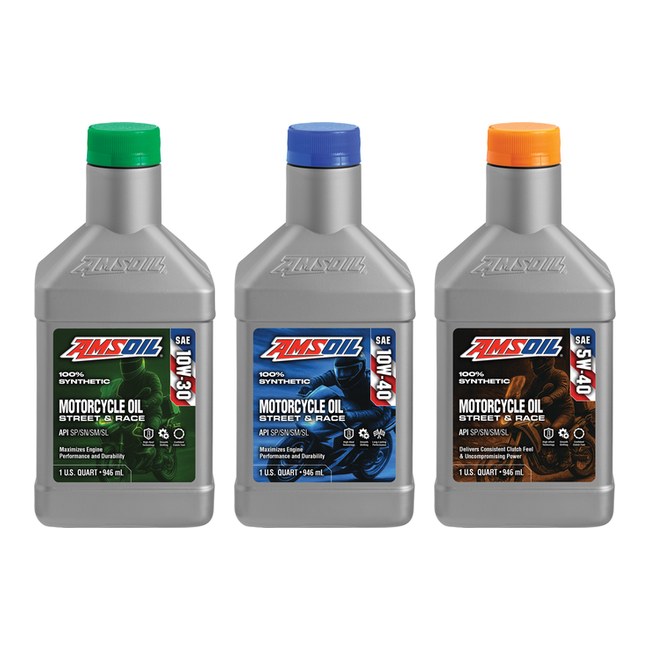
Len Groom: It’s our metric series motor oil. [Editor’s note: now AMSOIL Synthetic Motorcycle Oil.]
That’s got a big job to do. We’re talking about the transmission. We’re talking about wet clutch. We have mechanical shear. We’ve got heat. It’s got all of the bad things that you could do to an oil that we’ve designed that product to deal with. So again, high end base oils, the proper additive package, it’s wet clutch compatible, it’s set to go.
John Gardner: Now that’s gotta be able to withstand all that stuff. We’re talking about clutches as well.
I know we did a dirt bike series way before, but clutch feels gonna be a factor when it comes to this oil.
Len Groom: It is. This is the would be the heaviest in the grip side of things, so it’d be an MA two. So, you get a real nice positive clutch feel with this particular product.
John Gardner: And I have gears as well, and I have a clutch. I have all kinds of things going on inside of there. So, it’s a pretty robust oil. It has to be.
Len Groom: And you get into the mechanical shear with the transmission where it’s chopping up that oil and it tends to thin out. And we know that thin oil doesn’t do a good job of protecting, so it has to maintain its viscosity.
John Gardner: Well, you guys got a ton of metric bikes out there. So go ahead to the AMSOIL website at AMSOIL.com. Check out all their cool products and the science behind it.
It seems like most riders are loyal to an oil brand, and insinuating your brand is better is tantamount to calling someone out for a street fight. Call me a glutton for punishment because in this post I’m going to attempt to convince you that AMSOIL makes the best motorcycle oil.
First, an important word: If you’re happy with your current motorcycle oil, wonderful – keep using it.
This post is for the rider who hasn’t settled on an oil brand. It’s for the rider who feels a little anxious about engine protection when he or she pushes the limits a little too far. For example, when the temperature gauge creeps up on a blistering summer day as you’re crawling down Main Street at Sturgis with no airflow across the engine. Or when you’re ascending a steep hill as the sun beats down and radiates heat off the asphalt.
I hope to convince you that AMSOIL Synthetic Motorcycle Oil is the best choice for delivering the added protection that’ll put your mind at ease.
First, we need to identify precisely what a motorcycle oil must do before deciding if it’s the best at doing it.

Protect against extreme heat
Motorcycles can get hot, especially powerful air-cooled V-twins, which you’ll find on most Harley-Davidson motorcycles. They use airflow across the engine to dissipate heat. Air is inherently less efficient at removing heat than water/engine coolant. Even in a water-cooled bike, like a modern Indian*, oil temperature can still get plenty hot even if water temperature holds steady.
If the engine gets too hot, the oil’s viscosity can decrease (become thinner). This reduces wear protection, putting the engine at risk of piston scuffing or bearing wear.
In extreme cases, the bike’s computer will trigger a warning light and shut down the engine until it’s cooled off.
Extreme heat also speeds the chemical reaction process, called oxidation, that causes oil to break down and lose its protective properties. Oil that has oxidized becomes thicker, which reduces wear protection and energy efficiency, requiring frequent oil changes.

Protect against high-rpm stress
The average motorcycle runs at much higher rpm than your car or truck. A sport bike can easily eclipse 10,000 rpm, and some even push 20,000. In addition, they have much higher power density than a typical automobile engine. Their compression ratio can also be higher.
While that adds up to exhilarating speed and massive grins inside your helmet, it places enormous stress on the bearings, pistons, cam lobes and other components. The intense heat combined with extreme friction can lead to metal-to-metal contact and catastrophic wear if the oil can’t handle it.

Prevent oil shear
Most motorcycle oils must be multi-functional, meaning they have to protect the transmission and primary in addition to the engine.
Protecting the transmission is especially problematic given the intense shearing forces the meshing gear teeth create. The extreme pressure the oil bears as it’s squeezed between the gears can shear the oil molecules, leading to viscosity loss. As noted earlier, oil that loses viscosity can fail to provide the required level of protection.
(Find out how to change transmission fluid and primary fluid on a Harley-Davidson*.)
The best motorcycle oil must also prevent corrosion
If that’s not enough, your motorcycle oil also has to prevent rust and corrosion from forming on engine parts during storage.
Many riders live in climates that require them to store their bikes for part of the year. While it’s sitting in the garage (or living room, if you’re like a neighbor I once had), changes in ambient temperature and humidity can create condensation that causes rust to form.
When you start the bike in the spring, the rust can flake off and contaminate the oil. Prior to lodging in the filter, it can circulate and scour the bearings and other metal components like sandpaper, creating damaging wear.
Now that we’ve adequately defined the challenge, let’s look at the solution.
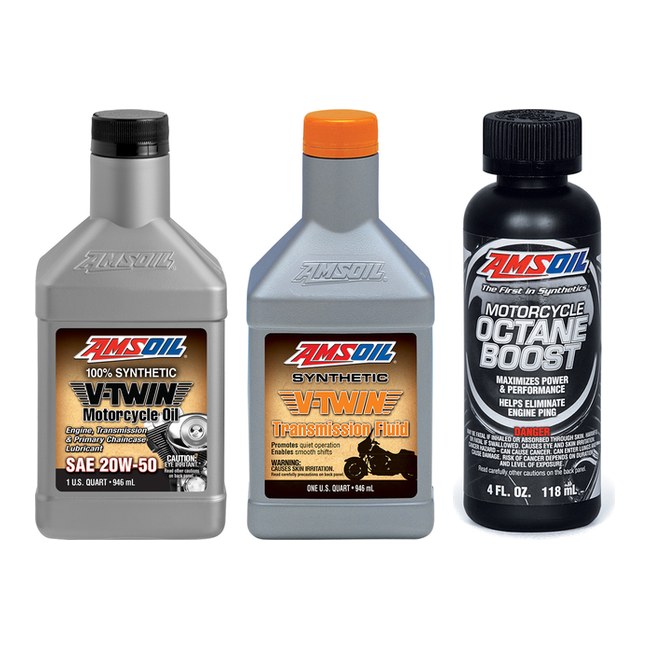
AMSOIL Synthetic Motorcycle Oil is formulated with durable, heat-resistant synthetic base oils. It naturally resists viscosity loss due to elevated heat and shearing forces better than other oils. In fact, AMSOIL 20W-50 Synthetic V-Twin Motorcycle Oil resists viscosity breakdown 6X better that Harley-Davidson SYN3*¹ for improved protection against compensator and transmission gear wear.

It’s also formulated with potent detergent additives that fight deposits and help keep engine parts clean. This translates into maximum compression, power and engine life.
To demonstrate its protection, we installed AMSOIL 20W-50 Synthetic V-Twin Motorcycle Oil in a Harley-Davidson Street Bob with a Milwaukee-Eight* 107 engine for a 1,000-mile extreme-heat dyno test. The test was designed to replicate slow-moving operation in extreme heat with little-to-no cooling air passing over the engine.
The test created severe conditions that included…
- 300°F (149°C) oil temperature
- 420°F (216°) rear-cylinder temperature
That’s much hotter than your bike should ever get. How did AMSOIL perform? Check out the video for the results.
What’s the best motorcycle oil?
Based on proven performance in extreme-heat dyno testing, AMSOIL Synthetic Motorcycle Oil protects powerful, hot-running motorcycle engines in the toughest conditions, giving you peace of mind your bike is protected no matter how hard you ride.
¹Based on testing of AMSOIL 20W-50 Synthetic V-Twin Motorcycle Oil purchased on 3/19/19 and Harley-Davidson Screamin’ Eagle SYN3 purchased on 3/19/19 in the CEC L45-KRL, ASTM D445 test.
This article is part of our Motorcycle Oil and Maintenance guide. See every article in the guide.
Recommended AMSOIL products
Start with AMSOIL synthetic motorcycle oil and check out the AMSOIL Product Guide to find additional AMSOIL products specifically designed for your bike.

Comments
David Hilgendorf is an AMSOIL Technical Writer who develops content for automotive, powersports and industrial audiences. His work includes technical data sheets, magazine articles, blog posts, white papers, product literature and application guidance. Hilgendorf works with engineers, laboratory personnel and technical specialists to communicate lubricant testing, product performance, maintenance practices, metalworking fluids, grease, motorcycles, marine equipment and industrial reliability.
Share: